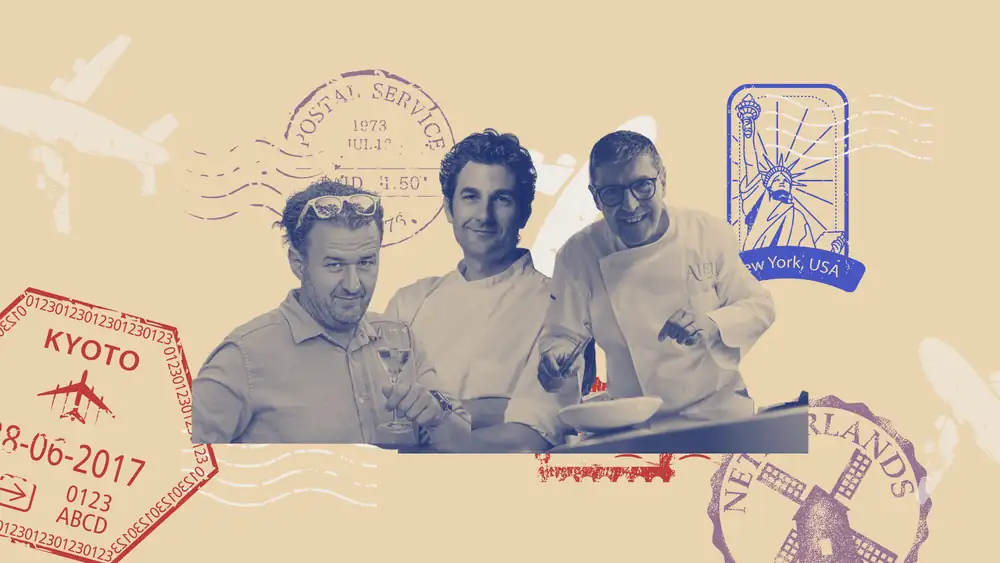
Portuguese sandwich tour, the cradle of tiramisu and the treasures of the Tatra Mountains: three chefs, three tour guides
Szilárd Dudás (My Mom Said) got to know the country's flavors by going from sandwich to sandwich in Portugal, Giorgio Cavicchiolo returned home to the Padua-Vicenza-Treviso triangle in Northern Italy, and István Szántó (Spago) found a familiar yet still undiscovered gastronomic culture in the Polish Tatra Mountains.
Szilárd Dudás – Sandwich tour in Portugal with a few detours
Szilárd Dudás traveled to several places in the first quarter of the year. This was his eighth visit to San Sebastián, but he still found something to discover – which is not surprising, of course, when we know that the Basque capital has an unparalleled concentration of Michelin-starred restaurants, and according to him, visiting the pinxto bars in the old town is a must-do experience. Another trip took him to Piedmont, where he tasted wine at nearly ten wineries, and also to the three-Michelin-starred Piazza Duomo, run by chef Enrico Crippa in Alba. “They set the bar very, very high.” He then enthusiastically told us that the restaurant’s own garden employs four people solely to harvest the freshest, highest-quality vegetables several times a day. Along the way, they also made an exciting stop in Vicenza: the Michelin-starred butcher shop-restaurant Macelleria Damini.
Despite all this, he highlighted Portugal, where he had just visited for the first time, as one of his travel destinations. He deliberately did not travel here looking for starred restaurants, but rather focused on local flavors. His first stop was Matosinhos, the port district of Porto, where freshly caught fish is grilled on the street. "It's a very good value for money place, I would definitely go back here," he says. In Porto, the sandwiches were the main attraction: the classic bifana comes here in a thick bun, with well-seasoned pork cut into large pieces, without any kind of flan. "The owner immediately brought two pints of beer with it, it was 9:48 in the morning, as I can see in the photo - that really caught my attention," he said with a laugh. He also highlighted places that successfully combine land and sea food, but also the piri-piri chicken and the local tripe with knuckles - which, according to the chef, only differs from Hungarian taste in its seasoning.
On the way, in Aveiro – which locals call the “Venice of Portugal” – he tasted fish with a traditional side dish of kale and beans and small potatoes. “If a place has been preparing food this way for a hundred or two hundred years, let’s not start varying it, but taste it the way it is served,” he says.
In Lisbon, he also tried fish dishes at Time Out Market, such as bacalhau in several places, and then started to explore the local, smaller restaurants because of the fado culture. However, the favorite of many, the pastel de nata, disappointed him: “I’m a big fan of vanilla cream, but this cream wasn’t the real thing,” he says, adding that they may have modified the recipe due to mass production. But it also gave him an idea: they returned home with at least thirty pastel de nata baking tins to perfect their own recipe at home. In the capital, he also tasted ginjinha, the local cherry liqueur in a chocolate glass, which reminded him of the kalimotxo he discovered in San Sebastián, a drink mixed with ice, red wine and cola, which reminds him of his youth.
Overall, he had no doubts about Portugal: "I recommend it to everyone, regardless of age or gender. Those who like seafood will find what they are looking for, and those who don't, there are also great meats."
Giorgio Cavicchiolo – Back to the roots with a local friend
Giorgio Cavicchiolo traveled back to his birthplace in northern Italy this year – not out of pure nostalgia, of course, but also in the hope of finding new ingredients. He traveled with a local friend who took him to places he had never been to before. “I think you can travel really well if you have a local connection who knows about those hidden, unique treasures that even as an Italian you wouldn’t necessarily find.” He added: “Italy is a huge country and the best things don’t get advertised, only the locals really know about them.”
The destination was the triangle between Padua, Vicenza and Treviso, which the chef says is still a bit underrated, even though it is a fantastic gastronomic region. "I like places where people are down to earth. They are honest, simple," he said, then highlighted the Bagnoli and San Lorenzo area, where they found some very special producers. One of the main rediscoveries of the trip was a type of rice, vialone nano, into whose world Cavicchiolo has now delved again. Polenta also took on a new meaning for him: they came across an old corn variety, granuarsho, which they started sowing after the war when the pantries were empty, but seeds were still found hidden in attics. "It has a very distinctive flavour, incredibly intense. It requires a lot of water, it has to be cooked for at least 45 minutes, so it takes time - but the taste is incredible."
While in Treviso, he was inspired by several places: he visited the Le Beccherie restaurant, which according to legend is the birthplace of tiramisu, because he was curious about what it would be like to taste the dessert there today. He was also touched by the simplicity of the local, homemade sauces: "The simplicity of a good duck ragout, like what we have on the menu." He also spoke with particular affection about the cicchetti culture in Treviso: in the Piazza dei Signori area, for example, at a place called Muscoli's, the atmosphere of the aperitivo is given by the proximity of the fish market. "You stand there by the fish market, you eat the anchovies, the tramezzini. Actually, you can't go wrong, every version is fantastic."
So if you're looking for authentic Italian flavors while still enjoying the traditional, lighter feel of life, away from the hustle and bustle of the big city or even the overly elegant places, this triangle is the place to be. "Everything around Treviso is very high-quality, but still on a human scale. I think that's one of the most beautiful aspects of Italian life."
István Szántó – The pleasant surprises of Polish cuisine
István Szántó's latest trip was not a typical summer destination: they drove to Poland, specifically to Zakopane and its surroundings, located at the foot of the Tatra Mountains, a region they had never been to before. He set off on the trip without high expectations, so he was all the more pleasantly disappointed by how many positive experiences he returned home with. "I never thought it would have so many surprises in store from a gastronomic point of view."
Basically, the food cultures of Hungary, Slovakia, the Czech Republic, Poland, Austria and Germany are surprisingly close to each other, as the differences are only evident in the methods of preparation. "You can see that in most countries the basic cuisine starts with simple ingredients, and difficult times have taught people to use all ingredients in many ways," he explains. Potatoes, cabbage, root vegetables, dairy products, pork - knuckle, ribs -, smoked cheeses, smoked bacon and dumplings provide the common basis, in other words, "filling, tasty dishes that you really want."
During their travels, they try to visit local markets almost everywhere – even if they are sometimes considered tourist traps – because such a walk gives a great picture and feeling of the atmosphere of a city. This kind of exploration did not fail them in Zakopane: at the local markets, they came across a type of cheese that they had not encountered in any of the aforementioned cuisines. It was oscypek, a smoked cheese popular in the Tatra region, which is sold at markets and street stalls in winter and summer, even without refrigeration in the warm months. “It is prepared and smoked in such a way that it can withstand the heat very well. It is usually grilled over charcoal and is usually served with cranberry or blueberry jam,” says the chef, who was particularly excited by the combination of salty-smoky and sweet flavors, and even immediately saw an idea for a restaurant in the local street food. "It could be a good idea to bring it to the restaurant level: you make a homemade cheese, smoke it, and offer some exciting berry jam on the side."
Rye soup was also a new discovery for him, which he chose because he was definitely looking for something special on the menu – something that no one else dared or wanted to order. “It was brutally delicious. A slightly sour, cabbage-based soup, enriched with smoked sausage, ham, sour cream – there may have been a thickener made from rye, and some kind of ham stock may have been added. It had a terribly good, pleasant taste, we even passed it around the table for everyone to taste,” he recalled.
According to the chef, the rhythm of life in the Tatra region also determines the food: during the day, while hiking or skiing, light, quick snacks are preferred, while in the evening, they replace the calories burned with hearty, heavier dishes – knuckles, a good fiber soup, pies. “This type of cuisine is perfect for this: good smoked bacon, stretched pasta, knuckles, sour flavors – then with a good beer, and then you can fall asleep.”