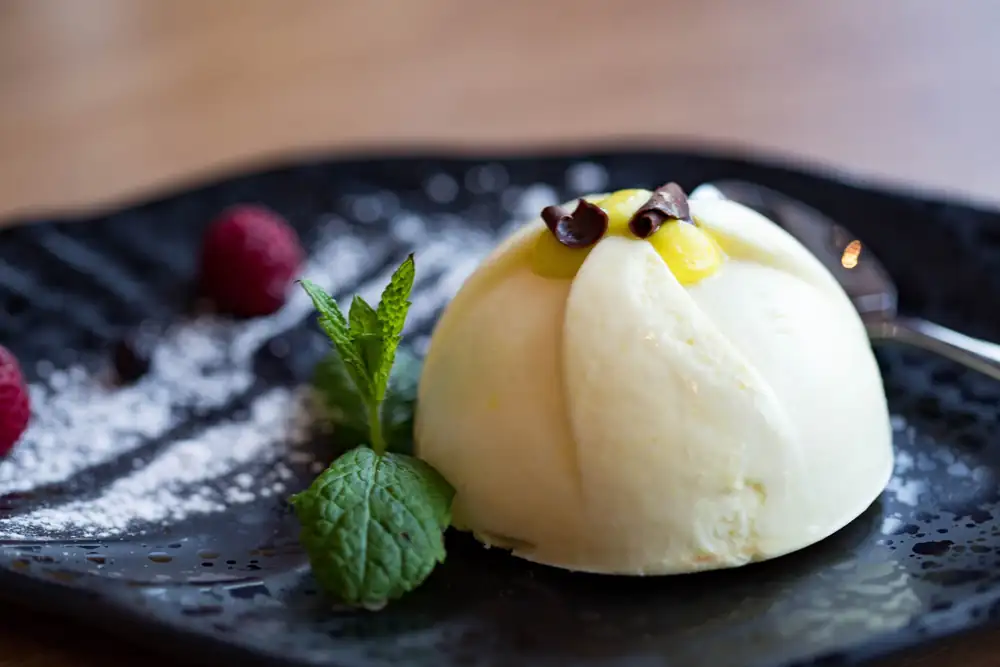
It's neither ice cream nor mousse, but it sure is amazingly delicious: this is Italian semifreddo
Semifreddo literally means "half-frozen" in Italian, but the name describes the texture rather than the actual temperature, as the dessert solidifies in the freezer just like any ice cream.
The result is a consistency halfway between mousse and ice cream, melting into a creamy consistency almost instantly in your mouth, while retaining its slicable shape even when removed from the freezer. And because the meringue and cream incorporate a lot of air into the mixture, semifreddo requires neither an ice cream machine nor any special expertise – one of the reasons it has remained so popular in Italian households.
A surprisingly young story
Strangely enough, semifreddo is far from being one of the oldest Italian sweets. According to gastrohistorians, it appeared somewhere in the late 19th century, most likely as an Italian reinterpretation of the French parfait – the latter’s recipe was first published in 1869. At the beginning of the 20th century, with the spread of gelato-making machines, ice cream became more and more widely available, but semifreddo remained a home dessert for a long time precisely because it never needed similar technology: all it needed was a bowl, a whisk and a freezer. It is no coincidence that it is still one of the easiest Italian frozen treats to make, while the end result is no less elegant than gelato mixed in a workshop.
Exciting flavors
This special dessert can be found almost anywhere in Italy. I first encountered it on the northern Italian coast: around Finale Ligure and Noli, not only coastal ice cream parlors but also most restaurants have it on their menus.
The first encounter was with nougat, and it was so delicious that I tried to taste it everywhere after that. The origin of torrone – or Italian almond-honey nougat – is itself controversial: according to some accounts, a similar sweet was already made in ancient Rome under the name cupedia or cupeto, while according to the best-known legend, its current form was first introduced in Cremona, at the wedding of Bianca Maria Visconti and Francesco Sforza in 1441. However, this story is difficult to treat as fact, since almost every Italian region claims to have invented torrone. What is more certain is that torrone is traditionally a Christmas and New Year's Eve sweet, and Italian households often have leftovers after the holidays – hence the birth of semifreddo al torrone, which is actually the most elegant recycling of leftover nougat. The coarsely crushed torrone is rolled into cream and meringue, then frozen in the freezer into a slicable block, and the result is so timeless that, despite its December origins, it holds up perfectly even on the hottest summer evenings.
Another memorable tasting experience is related to pistachios. Today, they have become one of the most popular nuts worldwide, but in Italy they are more of a tradition than a trend. The best Italian pistachios come from the volcanic soil around Bronte, Sicily, at the foot of Mount Etna, where Pistacia vera bushes have been clinging to the lava rock for centuries. This harsh growing environment slows down the plant's growth, but in return gives the fruit an unusually concentrated aroma - this was also recognized by the European Union in 2009, when the Bronte pistachio was awarded the Protected Designation of Origin (PDO). The crop is also harvested only every two years, in September and October, which further increases its value. Pistachio semifreddo was made in the 20th century. It became one of the prides of Sicilian pastry shops from the first half of the 19th century, and today it is one of the desserts that the island represents far and wide.
It is also at home in fine dining
However, its ease of preparation does not mean that semifreddo has remained confined to Italian family tables and pastry shops. In fine dining kitchens, it is precisely because of its easily shaped texture that it takes on a completely different character again and again. For example, a fig leaf-flavored semifreddo with blackberries and white chocolate appeared on one of the menus at London's Michelin-starred Luca.
Staying even closer to its Italian roots is the Michelin-starred Locanda del Pilone near Alba, where Federico Gallo's current dessert offering includes a dish called Cassis: yogurt foam, blackcurrant-blueberry semifreddo, and blackberry and yuzu sorbet are placed on a plate. The two examples clearly show how freely the genre itself can be manipulated: semifreddo can now be the basis for a fig leaf dessert in a modern Italian restaurant in London, as well as one element of an acidic, fruity plate in a Piedmontese haute cuisine.