Chilly Days Call for These Four New Korean Soup Restaurants
Queens’s Koreatown, run by and for the local residential community since its development in the 1970s, continues to stand as a bastion of Korean tradition despite a shrinking Korean population.
Chilly Days Call for These Four New Korean Soup Restaurants
The new Queens spots offer hearty pork soup and fiery soondooboo.
While certain elements of Korean food have gone mainstream — barbecue, fried chicken, modern-global — the heart of Korean home food is soup, a fixture of almost every meal. There’s even a Korean Netflix show dedicated to it — A Nation of Broth.
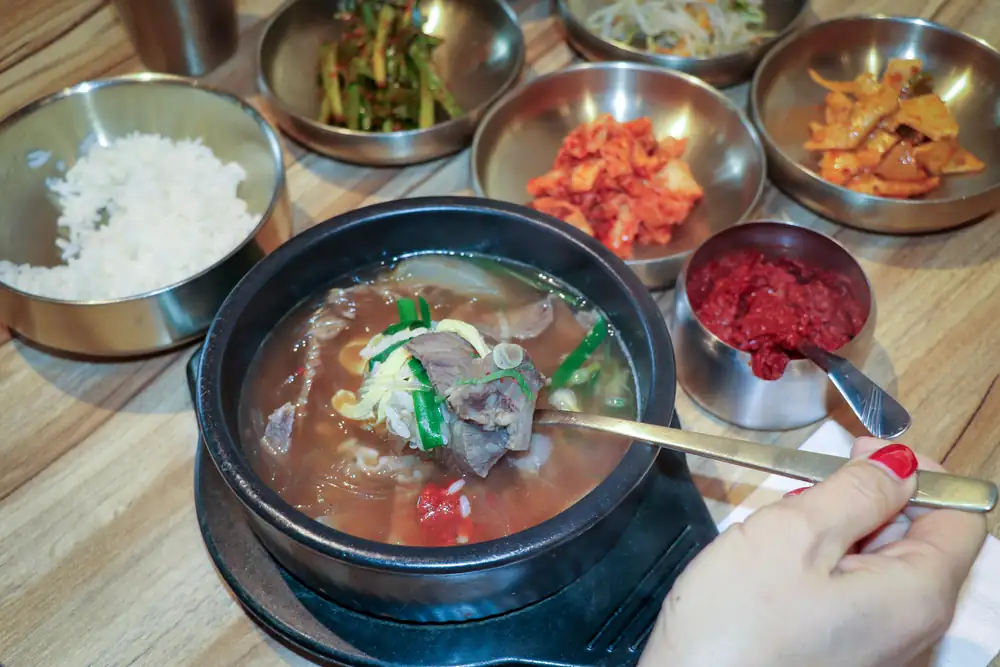
Three of the new Queens restaurants specialize in dweji gomtang (pork soup, which, when combined with rice, is called gukbap or soup rice). They include Jungme Gukbop (35-04 154th Street, at 35th Avenue, Flushing) and Jinsang Gukbap (209-35 Northern Boulevard, at 210th Street, Bayside). There’s also the newly opened Queens location of the New York Times favorite, Okdongsik (43-13 Bell Boulevard, at 43rd Avenue, Bayside), a Hand Hospitality partner. A fourth, Seoul Tofu (146-13 Northern Boulevard, at 146th Street), spotlights soondooboo.
The breadth of Korean soups is so bountiful, it can be broken down into several categories. On menus, you’ll see guk (the native Korean word for “soup”) and tang (“soup” in hanja, the Chinese writing system). They are both highly brothy, but tang usually has a longer simmer and it’s the one for which a diner adds seasoning or condiments — like salt, scallions, chile paste. Other soups include jjigae and jeongol, both dense stews; the latter refers to a large shareable hot pot cooked at the table.
Jungme Gukbop is an old-fashioned endangered style of mom-and-pop restaurant, and the gomtang there is especially beautiful. The broth is clear, the chives are fragrant, and the meat is tender. Chef-owner Yoondong Hwang was a chef for 12 years in Seoul before running a West Indian fruit market in Jamaica. He sold it — “business was very hard,” he said — and opened Jungme last year. Although Hwang says he veered to the restaurant as an easier business to operate, “it’s just not,” he said, laughing.
Hwang’s gomtang takes four days to make. He simmers assorted pork cuts like shoulders and cheeks for hours, removes them from the broth, and ages them in the refrigerator for flavor and texture. As for the broth, he allows the fat and sediment to either float to the top or settle at the bottom during two days of gravity doing its work, after which he scrapes them off. It’s why his broth is so notably clear.
Jungme also features the Chinese translation of the menu, something that’s increasingly common in the neighborhood.
A Chinese translation also appears on the menu at Jinsang Gukbap and Seoul Tofu. Both restaurants, still owned by Sangjin Park, had been a location for Witch Topokki. The closing of one restaurant to open a soup spot speaks to demographic shifts in the neighborhood as the Korean American population shrinks and ages in Queens while the local Chinese American demographic continues to expand.
A representative of both Jinsang Gukbap and Seoul Tofu, Michelle Park, explained that the team saw that tteokbokki appeals to a younger crowd (hence the Manhattan location). In Bayside, they opened a down-home gomtang that mainly caters to the Korean American seniors that opens at 7 a.m. for breakfast for early risers. Over in Flushing, the soondooboo at Seoul Tofu — with its customizable spice levels and bubbling heat at the table like hot pot — also meets the overlapping tastes of the local Chinese and Korean communities.
“We really had to think about who the residents are,” said Park.