Chambacú, a lesson in cooking and history between Africa, America and Spain
With food, something similar sometimes happens: the story behind it can't be more important than the recipe or the flavor itself.
Those who love labels will need plenty of paper, because it's not easy to summarize what this restaurant offers. Afro-Latin-colonial cuisine might work, but the restaurant also features three distinct spaces designed for different occasions or types of diners.
“Memoria”, with a more gastronomic focus and where they work with an à la carte menu and tasting menu; “Candela”, where simpler dishes are served and focused on street food from various regions of America; and “El Patio”, a good place at the entrance to sample the cocktail menu they offer at this establishment.
An ambitious project, both in terms of the size of the restaurant and the family investment required to run it. But also in its broad vision, which aims to tell the story of African and Spanish colonial influences on American cuisine through its dishes. Cooking with memory and serving up a fusion of cultures is the goal, they explain. Nothing less.
So we confess that we sat down at the table with a certain amount of skepticism, facing such a challenge. But it's also true that Sánchez's credentials, having worked at Mugaritz, Nerua, and Arrea, among other restaurants, inspire confidence. But it's not just a matter of his resume; it's above all about listening to him talk about the project and seeing the passion with which he unfolds the story and the reason behind each dish.
Stuffed potato and the three continents
Stuffed potato and the three continents.
And Chambacú - which owes its name to the neighborhood in Cartagena de Indias where the descendants of slaves lived - assumes a certain didactic role for the diner who wants to go beyond a sequence of rich, well-prepared dishes where each element is there for a reason.
Even in a seemingly simple stuffed potato, where the American potato, the Moorish influence on food wrapping—the origin of empanadas—and local nods to the Barceloneta "bomba" coexist. The idea of the three continents thus serves as a common thread in what Sánchez Arango wants to convey here.
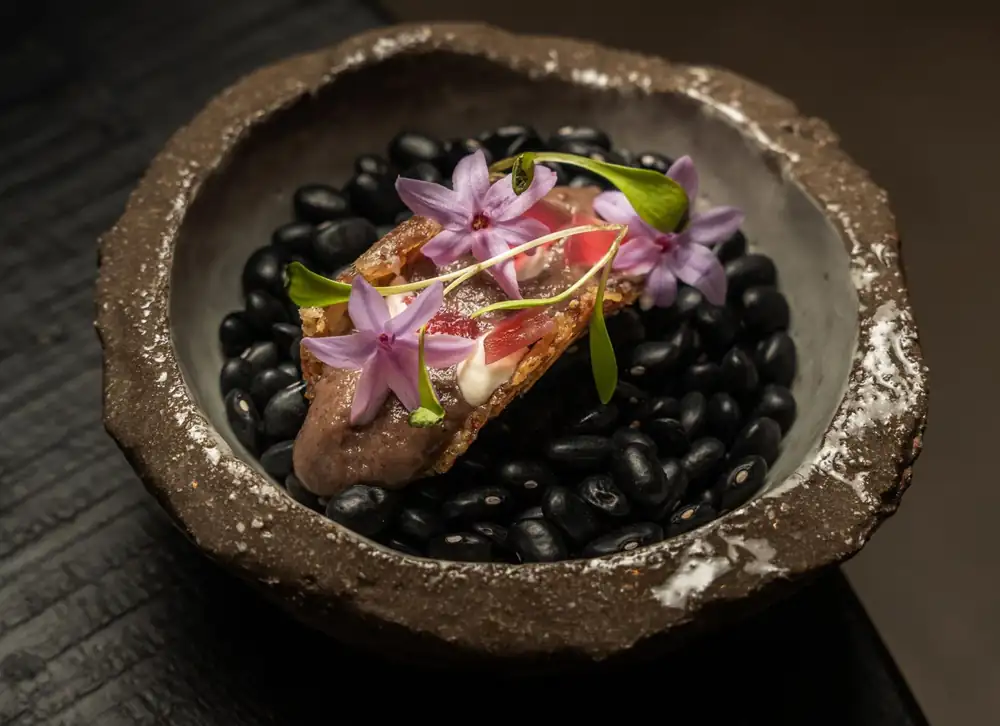
An Afro-American journey with tasty stops at a pork sandwich with sweet potato and huacatay, a taco made from a gelatinous cap i pota well toasted with dots of beans and guacamole inside, or the sancocho in a refined version with a very light and clean broth, a good spicy point and accompanied by a pata made with crispy chicken skin.
The vibrant mole with charred avocado and egg yolk is interesting, and the ceviche prepared in Chambacú's own style is also delicious: served warm and topped with a prawn from La Rapita. The grilled fish and two meat dishes (lamb with sweetbreads and roasted ribs with tamarind) round out the savory portion of the lengthy menu, which culminates in dessert with a delectable lucuma alfajor: the rich Andean fruit used here to create a version of the Argentine cookie, which likely has its origins in Spanish and Muslim pastry.
In addition to the other two spaces of the restaurant designed to enjoy this cuisine in its most informal and agile version, in the gastronomic area of Chambacú they work with a menu and two tasting menus at 55 and 95 euros.
It's also worth checking out their selection of cocktails and homemade drinks - check out the pineapple medley - some of which are served as part of the tasting menu pairing, where Catalan wines also take center stage.
A unique and daring restaurant where you can eat well and learn. That's not something you can say about many places.