When wine creates the dish: this is how PEEGO is born
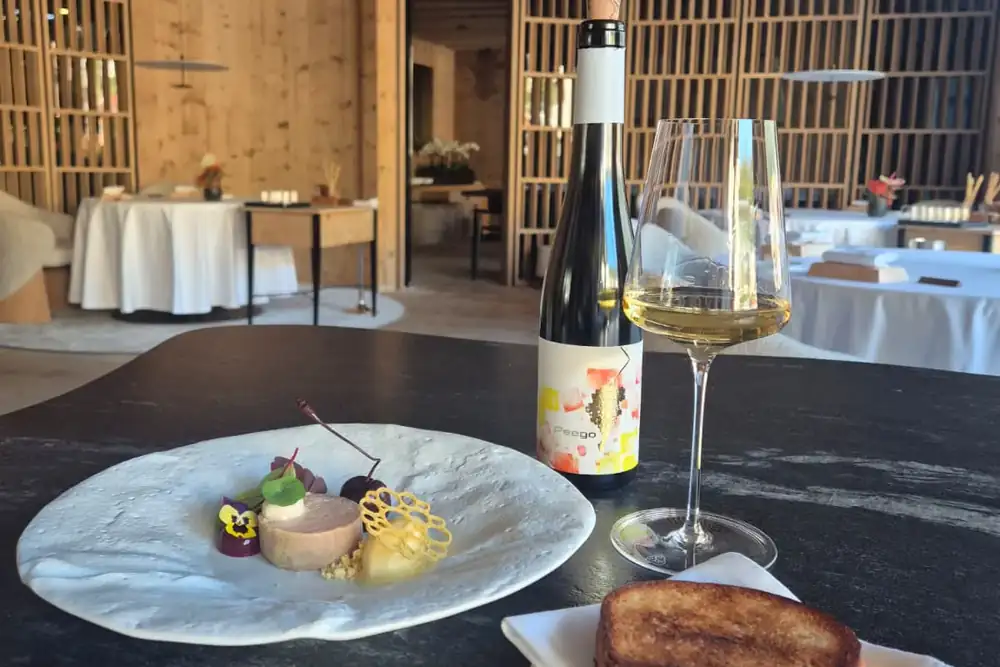
A sweet wine designed not to simply pair with dessert, but to engage with foie gras, starting with balance, acidity, and freshness. This is the idea behind PEEGO, a project conceived about ten years ago by Egon Perathoner together with Cantina Valle Isarco and now developed exclusively for Anna Stuben.
Riesling and Sylvaner, with 42 grams of residual sugar
PEEGO is produced in 600 bottles and is composed of 85% Riesling and 15% Sylvaner. These two varietals play a specific role in the wine's balance. The Riesling contributes acidity, tension, and precision, while the Sylvaner adds an aromatic component characterized by floral nuances and hints of hay, particularly in keeping with the sensitivity of its creator. The wine has 42 g/l of residual sugar.
It's not a question of eliminating sweetness, a key element in pairing with foie gras, but of maintaining it at a level that allows the sip to retain its freshness and complement the fatty part of the dish. The choice follows a precise logic: the sweetness must support the foie gras without adding further heaviness. Acidity thus becomes one of the tools used to create the pairing's balance.
PEEGO in numbers
- Production: 600 bottles
- Destination: exclusively Anna Stuben
- Creator: Egon Perathoner
- Winery: Cantina Valle Isarco
- Pairing: foie gras
- Chief: Reimund Brunner
First the wine, then the dish: pairing changes direction
However, it's in the next phase that the project takes on a less usual character. Typically, the pairing process begins with a pre-defined dish and leads the sommelier to identify the most suitable wine. In the case of PEEGO, the opposite happened. First, the wine was chosen, then chef Reimund Brunner developed a foie gras dish specifically around PEEGO.
This isn't simply a matter of choosing a bottle to pair with a dish already on the menu. The wine and dish were developed as elements of a single gastronomic project, with the goal of finding a balance between the structure of the foie gras and the characteristics of the wine. "PEEGO was born together with Cantina Valle Isarco from an idea of mine: to create a sweet, but not overly sweet, wine designed from the outset to pair with foie gras," explains Perathoner. "The uniqueness of the project is that, once the wine was born, Chef Reimund Brunner developed the foie gras dish specifically around PEEGO."
The sommelier enters the creative process of cooking
The project also reflects a vision of dining room work that transcends the simple selection of wines from the menu. After nearly twenty years of dining room experience and thousands of pairings, Perathoner has chosen to transform his pairing research into a project in which wine and cuisine are developed together. The sommelier, in this perspective, doesn't just intervene at the end of the creative process to find the most suitable wine for a dish.
Wine can instead become the starting point for building a dish, altering the usual pairing approach. This approach is particularly evident at PEEGO, where the wine composition, residual sugar level, and choice of varietals were determined based on the foie gras, while the kitchen then worked on the dish to find a precise match.
Six hundred bottles, one destination
PEEGO remains a deliberately limited project. The 600 bottles produced are intended exclusively for Anna Stuben, making wine an integral part of the restaurant's gastronomic experience. Even the name reflects the project's personal genesis: "PE" derives from Perathoner, while "EGO" recalls Egon, the signature of its creator. More than a new label to add to a wine list, PEEGO was therefore born as an exercise in the relationship between wine and cuisine. A journey that began ten years ago with the question of how to accompany foie gras without relying solely on sweetness, and which led to a solution in which the wine precedes the dish and helps shape its construction.