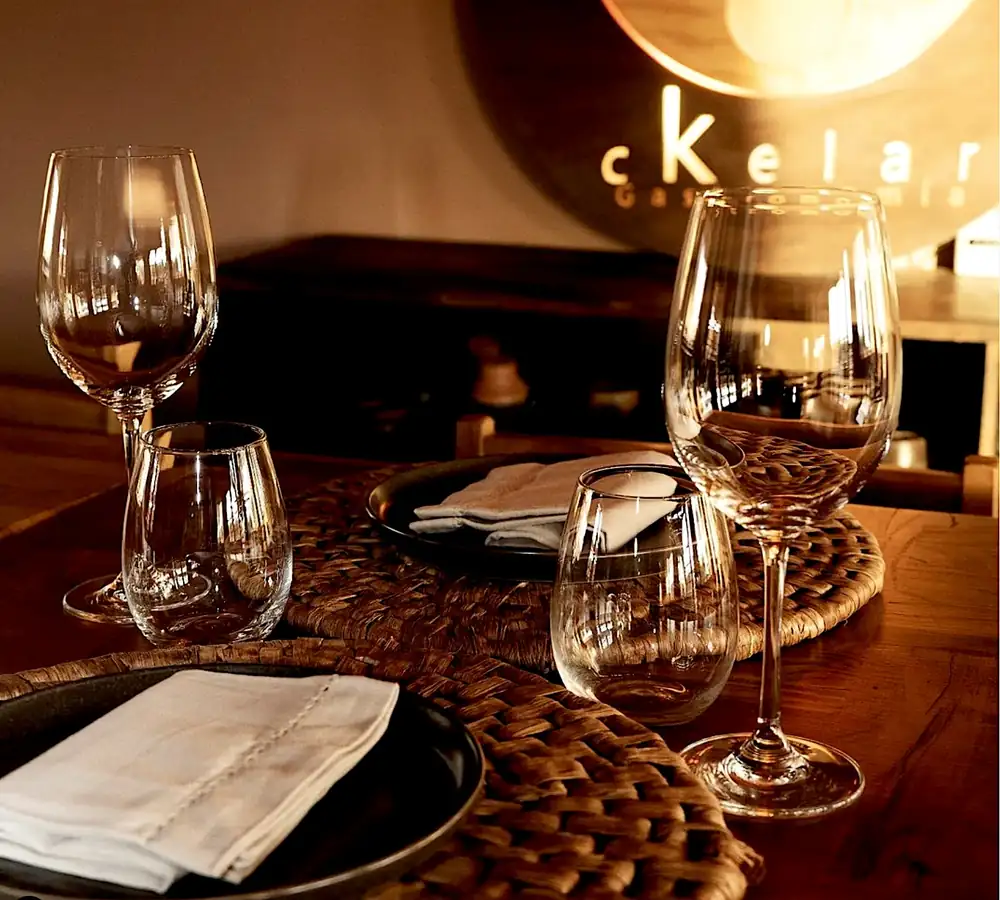
Ckelar, a light in the Atacama Desert
“I understand the territory based on the mobility of its ancient inhabitants and not from its political boundaries, so I work with native products from the desert and also with products from the Andes mountain range, understanding the caravan routes, the connectivity between towns, ecological zones and their bartering,” Leonelo Cuevas tells me as I sit in Ckelar, his gastronomic space in the ayllu
The ayllus correspond to an ancestral form of family distribution of agricultural properties and their irrigation canals, and to this day, many of them are home to indigenous communities.
On the restaurant table, numerous earthenware and clay vessels carved in the shape of human faces announce a journey through the unknown and alluring Andean pantry. I recognize white, red, and toasted quinoa, hominy, carob seeds, chañar fruit, rica rica, and rosa del año, while cachiyuyo, dehydrated Easter pear, muña muña, yareta, chuño potatoes, and tunta potatoes are completely new to me.
The Atacama Desert in northern Chile stretches from the Pacific Ocean to the Andes Mountains, encompassing a vast expanse of spectacular canyons and reddish-orange rocky peaks. It is the driest desert on Earth and perhaps the oldest. It seems frozen in time, otherworldly, and its unique character and the resemblance of some landscapes to the surface of Mars are so striking that NASA tested its planetary vehicles there. Culinary-wise, it is one of Chile's least explored ecosystems and a prime destination that attracts tourists from all over the world.
Leonelo is a licanantay, which in the Kunza language means inhabitants of the territory, although he didn't reconnect with his Andean essence until he was 27. While studying architecture, he grasped the concept of territory and decided to take to the kitchen to share his Atacameño roots with visitors. He created Ckelar at the end of 2017, after working in the kitchens of some well-known hotels in San Pedro. “In our Kunza dialect, Ckelar means fire. It's an element that brings people together, gathers them, and provides warmth and flavor. The hearth is incredibly important in the Andean worldview; it's a symbol of family gatherings.”
Their approach is modern, simple, and decidedly local. They break the mold and are committed to the region (beyond logistical barriers and a shortage of suppliers), exploring it to understand it and then cook with it. They offer three formats: a tasting menu by reservation, à la carte (Thursdays, Fridays, and Saturdays), and private dinners in open-air settings under the stars.
Between mingas and traditional festivals
“I seek to bring the products and flavors of the desert closer to people, and to do so I reinterpret what our grandmothers did at family lunches, at traditional festivals, and at community work days. My grandmother, for example, often bartered fruit with her friends from Toconaon, and in her kitchen she would clean the corn from a young age, later enjoying her incomparable corn pie. That is the spirit of Ckelar.”
I sampled all seven courses of the tasting menu. It begins with three simultaneous snacks: sopaipilla from the north (a fried dough made with wheat flour but without pumpkin, slightly flatter and airier) served with pebre made from cachiyuyo (Atriplex clivicola), a shrub that concentrates salt, with a firm texture and a metallic finish. Alongside it, a goat cheese produced at the foot of the Licancabur volcano, at about 4,600 meters above sea level, which they obtain through bartering on the border with Bolivia; it's a bit wild, one of those that still retains the freshness of the milk. Finally, a cured ham and guanaco pastrami, made in-house. The texture of the ham reminds me of charqui, a bit more refined; the pastrami is tender and slightly caramelized. They make it with the animal's loin. It works.
Next came a tabbouleh of green fava beans, two types of quinoa, yareta, and spirulina, which needs to be reviewed: unbalanced and too acidic. The yareta (Azorella compacta) is noteworthy, one of the most important discoveries of the trip. It's a chamaephytic shrub that grows above 3,000 meters, has a mossy appearance with small yellow flowers, and is a member of the Apiaceae family, related to celery, cilantro, and fennel. It has numerous medicinal properties, especially for the treatment of diabetes.
The smoked pork is best served as a quinoa-coated croquette on a barbecue of chañar, the most famous fruit of the desert. Chañar is a legume with a high sugar content, used to make arrope, a kind of viscous, concentrated syrup obtained by cooking the dehydrated and caramelized fruit. The dish is finished with a handful of popcorn seasoned with merquén.
The best dish features llama as its star. Braised and slow-cooked llama, tender and succulent, served over an elegant broth made by reducing and clarifying the cooking juices. It comes with a sweet and creamy smooth potato, also known as olluco, and fried llama jerky. It's flavorful and complex, making the entire meal worthwhile.
The lamb rib dish is interesting, though it needs further refinement. It's accompanied by pink potatoes, oca potatoes, and black chuño, which in this part of the Andes is frozen underground during the austral winter and then sun-dried. This ancestral dehydration and preservation method, typical of the Andean world, allows it to be kept for years. The plating needs to be rethought, as it's difficult to eat, and the cooking time of the tubers needs to be carefully monitored to improve the texture.
The other star camelid of the highlands is the guanaco. It's served as roasted loin, cooked to perfection, tender and juicy, accompanied by the extraordinary and creamy tunta potato, or white chuño. Unlike the other type, this white chuño is submerged in riverbanks and then sun-dried. It turns white and can be preserved almost indefinitely. Simple and impeccable.
The course concludes with a clever rose sorbet, perhaps with a touch less pepper, which cleanses the palate and leads into a creamy chañar dessert with chocolate, quinoa crisp, and corn crumble. The combination of textures and nuances of sweetness from the fruit, corn, and cacao is pleasing, although a touch of acidity would have been welcome, which would have taken it to another level.
Throughout the menu, I encounter unfamiliar ingredients. While rica rica (Acantholippi a deserticola), a high-altitude herb with notes of mint, bay leaf, and yerba mate, along with roses of the year, carob, and chañar, are recognized products in kitchens like Boragó's or some of Camila Fiol's sweets, they have little to no presence in Chilean cuisine. Neither my palate nor that of many Chileans naturally recognizes these flavors.
The experience in Ckelar is like an ethnographic menu with a youthful culinary approach. I see consistency in the narrative and honesty in the processes. Leonelo acknowledges the agricultural losses on the Chilean Andean side, a consequence of tourism and mining, and addresses this by traveling to the border with Bolivia and Peru to stock up on a shared larder, based on the concept of biomes and ecological zones that has always defined the territory and its inhabitants, and which has never been tied to any nationality.