When the moon is traditionally eaten
Traditional holidays are often characterized by similar and recurring patterns. There's a date that recurs on the calendar, a story heard dozens of times, a ritual whose origins we've sometimes forgotten, and at least one food that identifies it, a must-have on the table when it's time to celebrate.
The holiday is one of the most important in the Chinese calendar after New Year and falls on the fifteenth day of the eighth lunar month, which this year corresponds to September 25th. Born from ancient harvest rites, over time it has become primarily a family celebration, an occasion when people gather, observe the full moon, and share cakes that reproduce its shape.
Like any self-respecting tradition, this one too has its own legend. At its center are a girl named Chang'e and Houyi, the archer who saved the Earth by shooting down nine of the ten suns that were burning it. For this valiant gesture, Houyi was gifted the elixir of immortality, which, according to different versions of the myth, was drunk by Chang'e, destined to fly to the moon and separate from her beloved.
Mooncakes, yuebing in Chinese, are small round cakes, often decorated on the surface with auspicious motifs or characters. The shell encloses fillings that vary according to regional traditions: lotus seed paste, red beans, dried fruit, sweet and savory ingredients. One of the most popular versions features a salted duck egg yolk in the center, which when cut resembles the full moon and is a symbol of fertility and abundance.
They are rich desserts, quite far from the Western idea of dessert, and are traditionally cut and shared, often accompanied by tea.
As often happens with foods when they begin to travel, mooncakes have also undergone a transformation. Alongside traditional preparations, new interpretations have appeared, featuring matcha, chocolate, fruit, or the more recent snowskin mooncake, served cold. The encounter with European tastes has favored less sweet and dense recipes and more familiar fillings, sometimes eliminating the salty yolk that is probably the most unsettling element for a Western palate.
It's an adaptation that also tells us something about how traditions work, which, in order to continue circulating, can change forms and languages, while preserving some elements that still allow us to recognize them.
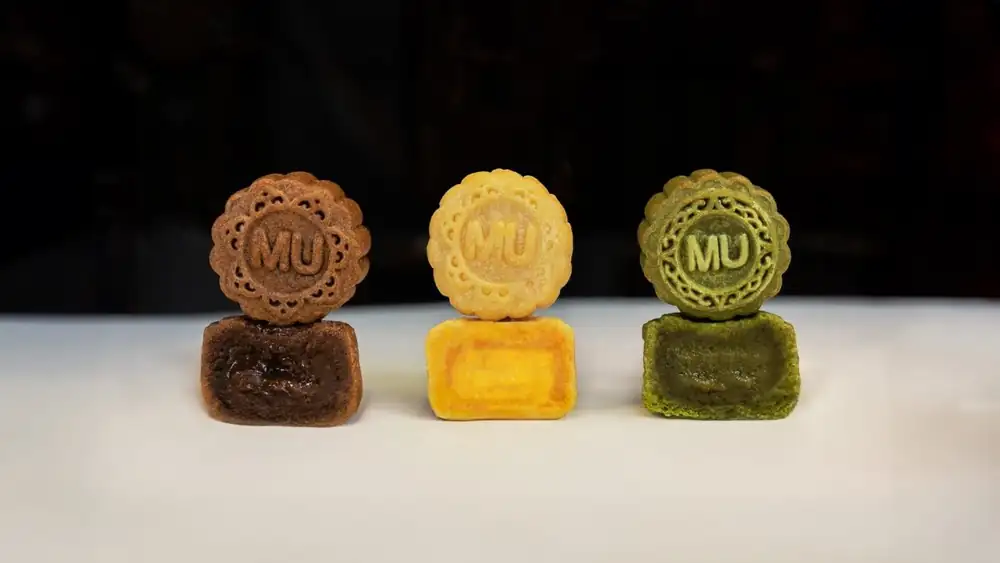
In Milan, for the Mid-Autumn Festival, the Chinese restaurant MU Dimsum offers its artisanal mooncakes in three variations: matcha, chocolate, and salted duck egg yolk cream. Three flavors that combine evolution and tradition, two immediately recognizable even to Western audiences, and one that retains the signature blend of sweet and savory. A small example of how a recipe can shift geography and flavor while continuing to evoke the same celebration each year.