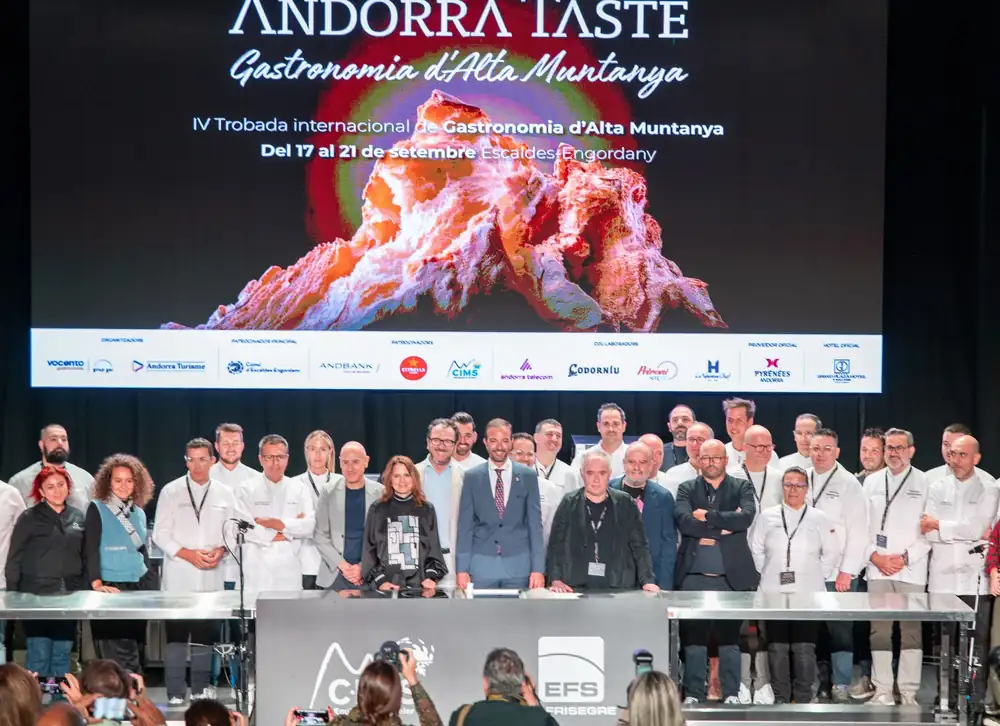
Ferran Adrià proposes his recipe for being part of the culinary elite at Andorra Taste: “Planning, investment, identity and work”
These last two concepts take on special relevance in this fourth edition, in which the Andorra Taste Award was presented to Ferran Adrià, a champion of the gastronomic revolution that changed the world culinary landscape twenty years ago.
The Minister of Tourism and Trade of the Government of Andorra, Jordi Torres, emphasized this spirit of unity within the sector during the official opening of the event, stating that at Andorra Taste, “we believe in dialogue among mountain people.” This dialogue, he added, must allow Andorran chefs to continue growing “while maintaining their essence and adapting to the demands of the times,” as Benjamín Lana, the congress director, pointed out.
The professional conference, held in Escaldes-Engordany (Andorra), once again focuses this year on the neighboring Alps, a mountain range with much to offer as it is a melting pot of culinary traditions. The first day of Andorra Taste 2025 centered on some of these traditions and the value of mountain produce. A highlight was the presentation by Oriol Castro, chef of Disfrutar*** (Barcelona), who shared the stage with master distiller Carles Bonin to unveil their first non-alcoholic spirits. Disfrutar, which participated in the first edition of Andorra Taste, returns to the Principality with a new product that "aims to inspire Andorran chefs to look to the land." In this case, the Disfrutar team wanted to translate "the landscape created by the melting snow in the Andorran valleys into a beverage, a non-alcoholic spirit," perfectly in line with the current trend of non-alcoholic pairings. With moss, mushrooms, fennel, licorice, juniper, and pine blossom, the Andorran mountains are recreated in 'Terroir del Desglaç' ('Terroir of the Thaw'). This spirit also has a smoked version made with smoked pinecones, since "the smoke from chimneys and the comfort of the fire are also part of that mountainous imagery," Bonin explained.
The mountain, pantry and endless inspiration
One of the advantages enjoyed by chefs in high mountain regions is the availability of a wide variety of locally sourced products, just a short distance from their restaurants. The mountains are a larder with endless possibilities, and some of the products they offer were the focus of several presentations on the first day of this fourth edition of Andorra Taste. Game was the star of the first presentation, given by Luis Alberto Lera (Lera**, Castroverde de Campos, Zamora), one of the Spanish chefs who has worked most extensively with and best understands this type of cuisine.
Lera has brought to Andorra the traditional culinary techniques of the Spanish plateau to prepare game found in the Pyrenees. During his presentation, the chef from Zamora emphasized the need to cultivate "identity and a sense of belonging to move away from homogenized cuisine." "We must look inward," he said. He demonstrated this on the stage of the Auditori del Prat del Roure, reviving preservation techniques from the traditional recipes of Tierra de Campos—"which, after all, are survival techniques"—with which he prepared dishes such as pickled wild boar tongue and cured chamois. Finally, Luis Lera asserted that game "should be included on restaurant menus, even if it requires a touch of elegance, because this will prevent the loss of a culinary richness that defines each region."
From hunting to gathering with mushrooms. A star product of the mountains, an extreme example of seasonality and a metaphor for autumn, the mushroom was the absolute protagonist of a mycological jam session orchestrated by Pau Santamaria, son of renowned chef Santi Santamaria and distributor of garden produce and mushrooms through Santamaria Gastronòmic, and in which several Andorran chefs participated. Four chefs from the Principality, using different mushrooms, demonstrated that mushrooms are not only a magnificent accompaniment but can also become the basis of a recipe. Among them were the porcini mushroom, the cauliflower mushroom, and the Boletus edulis; the latter being a mushroom about which Santamaria had a request for the chefs: “I ask you to value the Boletus mushrooms from here, because we are getting used to those that come from Romania or other countries and no longer appreciate the native ones.” Victoria Kemerer (Kökosnøt, Andorra La Vella), Jordi Grau (Ibaya*, Soldeu), Marcel Besolí (El Celler d'en Toni, Andorra la Vella, Andorra), and José Antonio Guillermo (Odetti Bistro, Escaldes-Engordany, Andorra) agreed with the distributor and added that “even within the same country, mushrooms taste different depending on the area.” “Each mushroom tells you about a terroir,” Kemerer summarized.
And from specific products to the global perspective. Francis Paniego, chef at El Portal de Echaurren** (Ezcaray, La Rioja), spoke at Andorra Taste about how to bring the forest to the plate. The Riojan chef advocates for “moving away from a faithful representation of the landscape; we don't want to create a portrait but rather reflect the sensations that the landscape evokes in us on the plate.” In this sense, the recipes he presented, which are part of the current menu at Echaurren, were very illustrative. With cheese, walnut oil, and parsley powder, Paniego evoked fresh grass; with a tapioca crisp, bone marrow butter, and frozen broccoli—which adds moisture—he transported the audience to a damp forest; and with pebbles made from trout paste and coated in gelatin, one could journey along a river. Examples of a cuisine that works in a very personal way “with nature, seasonality, a commitment to the land, and inherited memory.” Paniego acknowledged that this memory is vital for a chef, "since our mothers' cooking is deeply rooted and forms part of our DNA as cooks." Reinterpreting and preserving it is, therefore, "vital for our regions."
This vision was shared by Austrian chef Maximilian Stock, who offers Alpine cuisine at Die Geniesserstube Im Alpenhof (Tux), a small restaurant in Tyrol that recently received a Michelin star. Stock, who doesn't use seafood on his menu and bases his cuisine almost entirely on local products, advocates for "rediscovering local ingredients to foster value creation from the producer and the product, through the chef and the region of origin."