Gurí, a neighborhood gastronomic revolution
Nicolás Zas is a Uruguayan chef with a curious history with cooking, which he fell in love with in the Canary Islands, going from delivering pizzas to kneading the dough. Perhaps this journey is the reason for his honest, straightforward, and unpretentious approach.
This approachable and down-to-earth character is reflected in its three tasting menus: Gurí (10 courses, €85), Charrúa (7 courses, €58), and Gurí Daily (4 courses, €32), as well as its à la carte menu (with appetizers between €4 and €9, main courses between €12 and €32, and desserts between €4 and €9). The experiences—and prices—are clearly and consistently tailored to the restaurant's unpretentious and unconstrained culinary ethos, reflecting the vibrant neighborhood in which it's located. At Gurí, signature dishes, Uruguayan influences, modern techniques, and street food come together to the infectious rhythm of funk music. This funk embodies fun, intimacy, relaxation, naturalness, and comfort—a desire to dance that mirrors the desire to savor the food.
And alongside naturalness, the second magic: enjoyment. That's precisely Nicolás's limit; people must enjoy what comes out of the kitchen, and this perfectly complements his values and his food. On Gurí's menu, ferments have gone from being anecdotal—lactic fermentations here and there for contrast—to a guiding principle—but not intrusive—of products made from scratch for different purposes: to make the most of the ingredient, to refresh, to contrast the fat, to deepen the flavor…
The best example of this is one of the first foods that arrives at the table: Osvaldo Brito's sourdough bread, from the baker at Pa de Kilo, served with shio koji butter made from scraps of the same bread; a technical success that reinforces its flavor —the acidity, the natural sweetness, the toasting— while taking advantage of the waste of something that was never thrown away in the past and that at Gurí is reused from a ferment.
As for the story, Nicolás shares his biography through flavors and preparations—corn, tapioca, chili peppers, empanadas, yerba mate, alfajores—which are found both on the menu and in the set menus. In this case, after bread and butter, comes the Fainá in bite-sized form; a crispy chickpea flour flatbread, a Uruguayan dish created in homage to his grandmother, served with a Reixagó cheese foam—from an artisanal dairy using its own milk in Olost, 100 kilometers from Barcelona—Iberian bacon, and fig leaf mayonnaise. In the same spirit, a classic empanada arrives filled with another fascinating local product, the blue crab from the Ebro Delta, served with a sea lettuce emulsion.
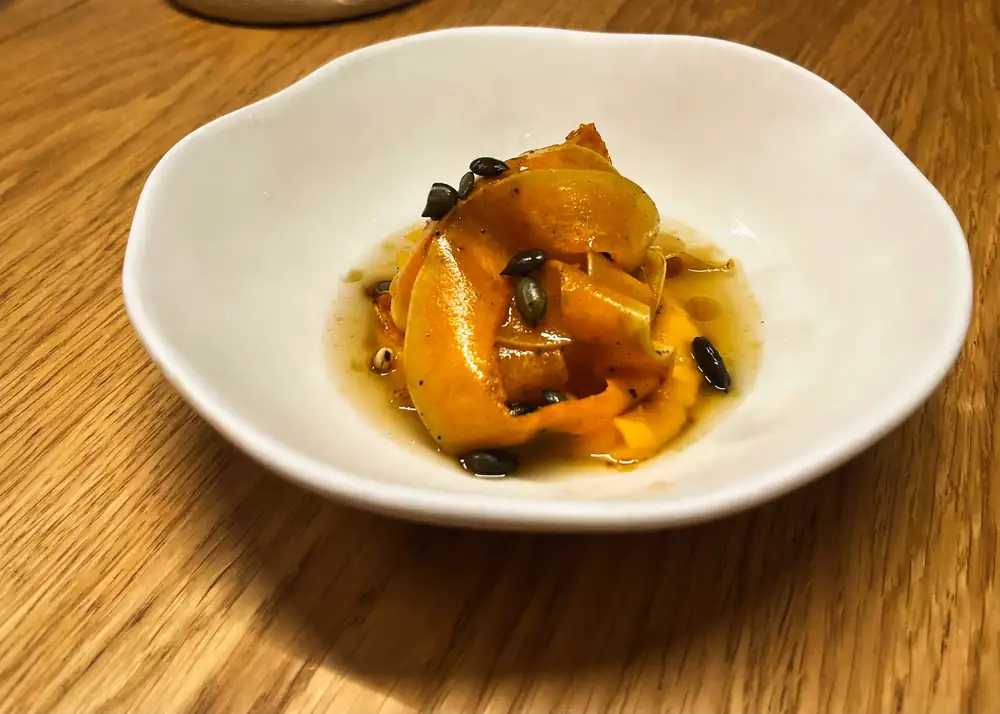
In other dishes, the chef's present is history, and in them he expresses his concerns and curiosity. Examples include the pumpkin in textures (header photo), where crispy pumpkin noodles are served with a vegetable garum, a lacto-fermented pumpkin water, and pumpkin seeds; or the grilled chanterelle mushrooms with hazelnuts, fermented corn, mushroom shoyu, and kaffir lime. A lover of fermentation, Nicolás uses it across the board to contribute to all his dishes in a practical, not intellectual, way—that is to say: logical, understandable, and effortlessly natural. All these ferments, which he has been developing in a fermentation room for the past year, have been integrated into his cooking as another technique, like a broth or a base for sofrito.
Nicolás's proposal, in addition to his history and his present, is based on quality local products —squid caught by jigging, chanterelle mushrooms, delta eel, red mullet…— which are the basis of the dishes that follow on the menu: the squid caught by jigging, cooked to perfection, seasoned with its garum and its ink and served with a creamy cod brandade, pickled fennel and saffron; the artisanal tortelloni of young lamb, which are accompanied by a silky sauce based on butter, 10-year kefir (to contrast the fat) and black garlic.
The savory part of the Gurí menu ends with two top-quality grilled products: the perfectly cooked red mullet, served with a sauce made with chickpea miso, bay leaf oil and fermented citrus fruits, and the Gascon pork shoulder matured in shiokoji, with a soft texture, a good amount of infiltrated fat and intense flavor, finished with its garum, eggplant and mustard seeds.
The menu and wine list are rounded out by a selection of four desserts, including Mate (a dessert-cocktail), the light option, which cleanses the palate with gin, mate and lemon; the ice cream alfajor with dulce de leche and yogurt ice cream; the nectarine, inspired by a typical Uruguayan tart, but with accompanying flavors such as Earl grey or tonka bean; or the chocolate cream with miso caramel, candied nuts and carasau bread.
The friendly yet gastronomic philosophy is maintained with a wine list offering a good selection of wines by the glass—ranging from Corpinnat to whites, rosés, sparkling wines, and reds from Catalonia and Uruguay, and concluding with three sweet Catalan wines of distinct profiles—and a comprehensive and varied wine list (with prices between €23 and €68 per bottle) featuring renowned Catalan wines (Castell d'Encús, Gramona, etc.), some from other Protected Designations of Origin (Rioja, Ribera del Duero, etc.), and a selection of noteworthy Uruguayan wines. Beer and vermouth—a nod to the neighborhood—and specialty coffees from La Cherry in Barcelona are also available.