The greatness of island wines
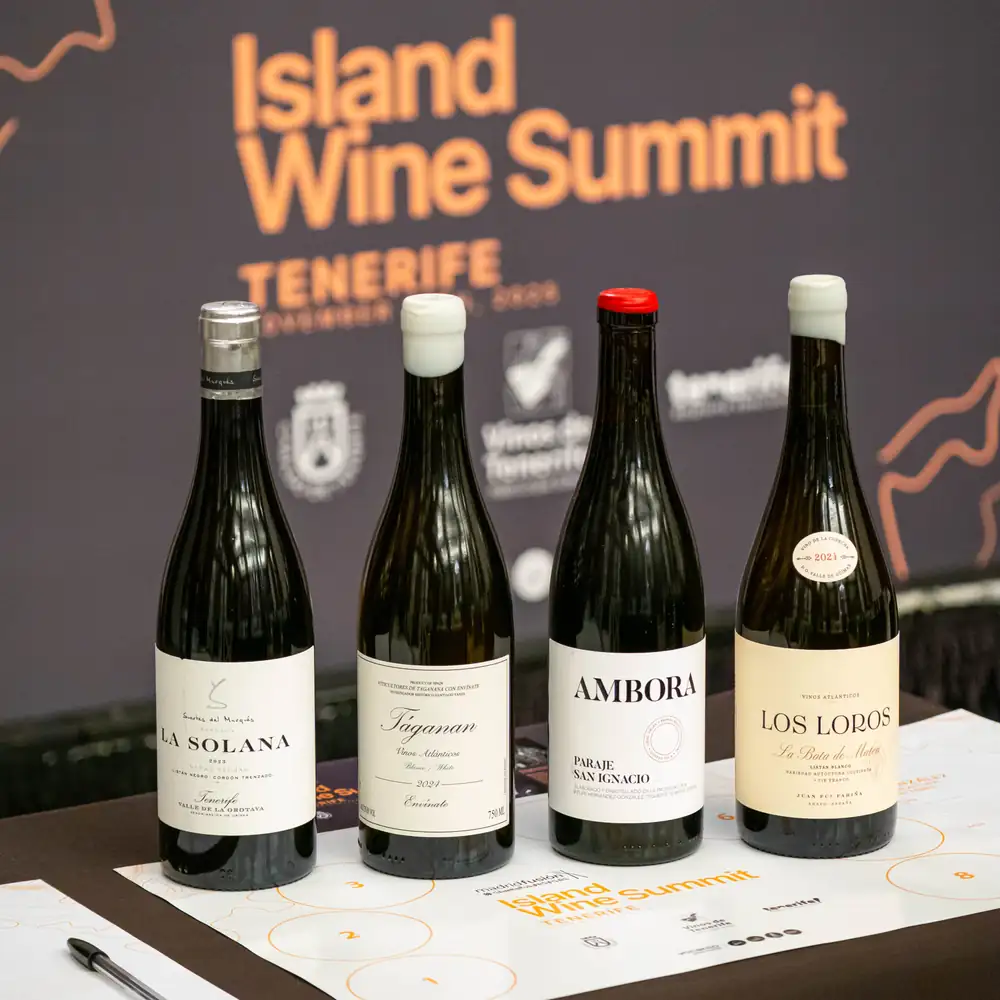
While Storm Claudia reigned over the south of Tenerife last Thursday the 13th, with rainfall rarely seen in those parts, in the north, specifically in the capital, Santa Cruz, something similar to the miracle of the Wedding at Cana occurred and the water that, in theory, was going to be unleashed by some dark clouds ended up being turned into wine thanks to the Island World Summit, a meeting for p
Winemakers, oenologists, sommeliers, distributors and journalists gathered for an intense and very fruitful day at the Hotel Mencey to attend a program designed by the Master of Wine from Zaragoza, Fernando Mora, who acted as master of ceremonies and revealed the key characteristics of the Tenerife vineyard, the volcanism, the sea and the trade winds, which translate into "tension, salinity, minerality, energy and acidity"
Next, and accompanied by several of the most prestigious winemakers from Tenerife, such as Roberto Santana or Borja Pérez, the Canarian sommelier Rodrigo González proposed an illustrative tour of the six designations of origin of the island, starting in the north, in Taganana, practically at sea level, and finishing in the South, in Granadilla de Vilaflor, at 1,700 meters altitude.
A journey that touched on the island's six designations of origin (the five local ones: Tacoronte-Acentejo, Valle de la Orotava, Ycodén-Daute-Isora, Valle de Güimar, and Abona, plus the generic Islas Canarias, shared with the rest of the archipelago) to demonstrate the tremendous diversity of its wines, both white and red, ranging from some deeply iodized and austere to others spicy and robust, brimming with umami. All of them, however, are characterized by the omnipresence of the volcanic nature of the terroir and the resulting minerality.
Defining that intangible yet ever-present quality of Tenerife wines—minerality—was one of the day's major challenges. François Chartier, a Canadian sommelier and scientist based in Spain, a leading figure in the world of food and wine thanks to his molecular harmonies, questioned whether it was myth or reality, ultimately answering that it is "a multisensory construct born from contrasts. It is, first and foremost, a perception, a sensation."
For his part, Luis Gutiérrez, a taster for The Wine Advocate in Spain, Portugal, and Jura, explained that “minerality is something that is most noticeable in the texture of wines. It is obvious that stones have no flavor, but with a little training, one can recognize, through texture, whether a wine comes from a calcareous, granite, or clay soil.”
Gutiérrez was in charge of leading the “Great International Tasting of Island Wines” which, starting from Pico Island in the Azores, visited ports in La Palma, El Hierro, Porto Santo (Madeira archipelago), Sicily and Mallorca to highlight the complexity of producing island wines, mainly due to climatological and orographic issues, and to emphasize the many similarities and profound differences from one island to another.
To end on a high note, Gutiérrez had a trump card up his sleeve: attendees had the opportunity to taste a Torre Bela Terrantez from the island of Madeira, produced in 1860. This wine, at 165 years old, appeared full of life, vigor, and energy, perfectly drinkable and enjoyable, with, obviously and inevitably, high volatile acidity, oxidative notes, and great concentration, but also with freshness and pleasant sweet and saline touches. Intense and with an almost endless aftertaste, it is a supposedly unique experience that will be hard to forget.
Finally, the Catalan sommelier (Monvínc and Alkimia) and wine distributor (Ithaca Wines and Soulwines) Bernat Voraviu addressed “An Inland Sea: The Mediterranean as a Bridge,” which, as its title suggests, focused on the Mare Nostrum of the Romans. The white wines from the Greek islands of Crete and Santorini, made with the indigenous Vidiano and Assyrtiko grape varieties, were a delightful revelation. It was interesting to see how one of the trendiest grapes in Spain (and indeed the rest of the world), Garnacha, behaves so differently in Sicily (where it is called Grenazzu) than in Sardinia (Cannonau). And lastly, an extraordinary solera-aged sweet wine from Samos helped to explain why, historically, some of the most expensive wines in the world were produced on this Greek island.
And so, brilliantly, the Island Wine Summit in Tenerife unfolded, which, let's not forget, was just a taste of what's to come to the Canary Island in the spring of 2026. And, judging by what we've seen, it looks more than promising.