Chef Richard Sandoval Is on a Mission to Save the Bees
With 60 restaurants spread across 12 countries and 10 U.S. states, chef Richard Sandavol has built a reputation for his Latin cuisine, but now, he wants to put the attention on bees.
“Every region has different types of bees, and it’s almost like wine. Based on the terroir in the area, the honey they make is different from region to region.”
Chef Richard Sandoval Is on a Mission to Save the Bees
Texans can eat pollinator-dependent dishes at the Viva Abejas dinner, hosted in his restaurants in Austin, Houston, and Fort Worth.
This spring, Sandavol brings back his Viva Abejas dinner for the fourth year. The name, which translates into “long live the bees” in Spanish, hints at Sandavol’s initiative to bring awareness to the importance of bees to our food system. The dinner is available across Texas, in Ciclo at the Four Seasons Austin, Toro Toro in the Worthington Renaissance in Fort Worth, and Houston’s Four Seasons, running now until Earth Day, April 22, 2025.
This year, the dinner focuses its story on oranges, a fruit dependent on pollinators to survive. Sandoval says it was inspired by his trip to the orchards that supply oranges for Alma Finca liquor, which plays a role in many of the dishes and cocktails. Additionally, the Four Seasons in Austin installed a bee colony at Sandoval’s urging. The on-site apiary houses 150,000 bees on the hotel’s back lawn, which are being cared for by Two Hives Honey.
A portion of the proceeds from the Viva Abejas dinner is donated to the World Bee Project. Eater caught up with Sandoval to talk about bees and how they affect our food, sustainability, and eating bee pollen.
Eater: How did the concept for this menu come together?
Richard Sandoval: The campaign came about three or four years ago, when I read about bee habitats being affected and disappearing. I said that as a leader in the industry with all these restaurants, using all these ingredients, and always being passionate about sustainability and locally sourced foods, there has to be something I can do. I felt that, through this campaign, we could offer education and raise funds. This year, with Alma Finca, we can put cocktails at the heart of the campaign.
How did installing those beehives at the Four Seasons in Austin come about?
I brought it up. It took about a year, through different partnerships. Now, the hotel can walk guests through the process and tell them about the beehives. We feel people from the younger generation are the ones who can be most impactful. I think most children, if you ask them about bees, they know they sting us [laughs]. Teaching them that one in every three bites we eat relies on bee pollination and how important they are creates a lot of awareness. I also wrote a kids’ book about it. All the profits from my book go to the World Bee Project.
The loss of bees would ultimately have a catastrophic impact on food, right?
One hundred percent. If we don’t do something now, then in 10, 15, 20 years, this will be a very different world. Most people think they can’t be impactful, but you can’t think of yourself as one [person]. All of us together make the big picture, and we all do a little bit to help; it makes a difference. If we don’t do it now, in the future it will impact our ingredients and the food we love to eat.
This dinner is a great opportunity for education. How did you add bees and pollinators to the menu?
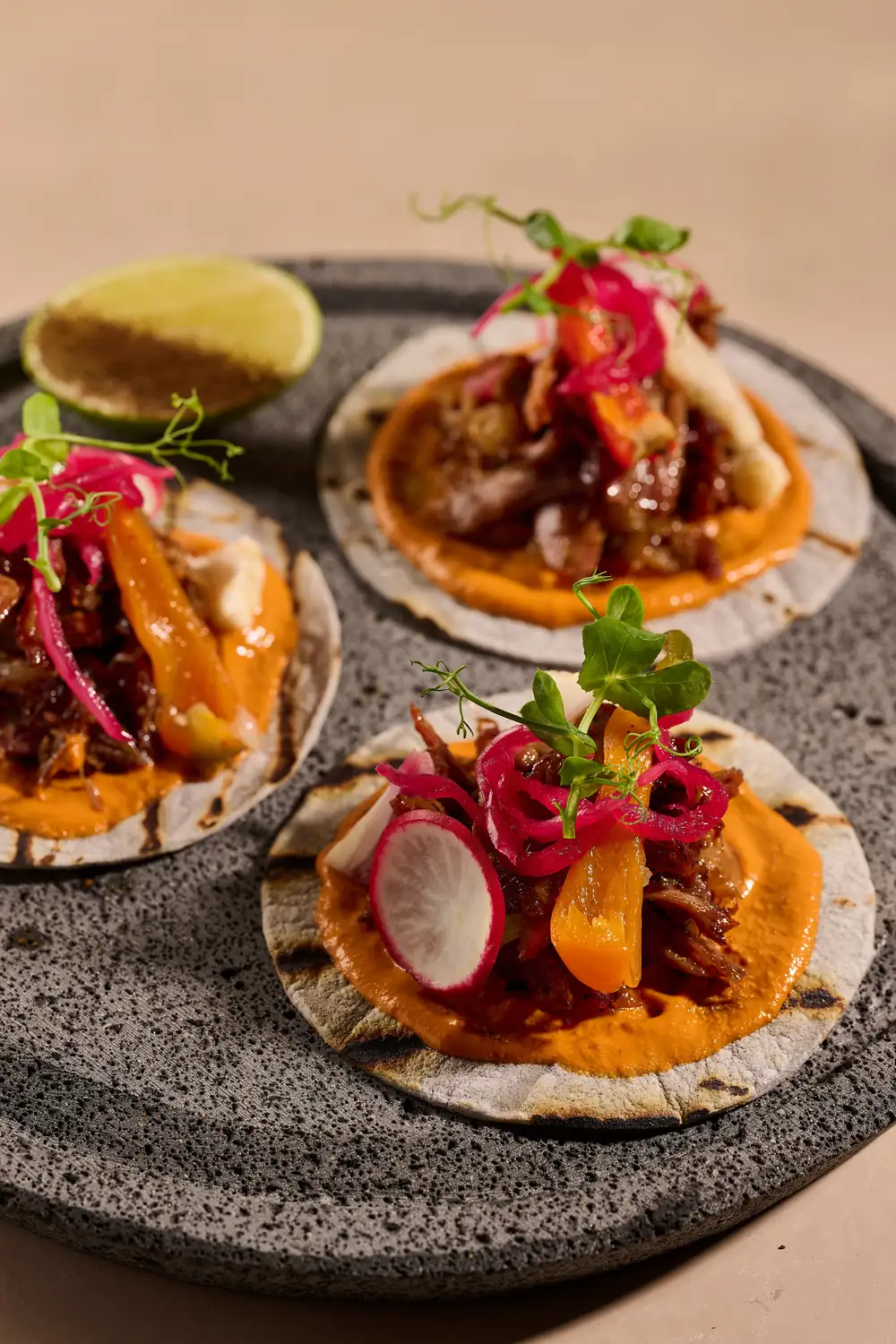
This year, we came up with an avocado salad where we grill the avocados and use them like sashimi. The avocado is heavily dependent on bees, so that showcases an ingredient that is influenced by pollinators. We add quinoa, some beet puree, and bee pollen to give it texture. We also have a braised short rib that uses agave honey — it is also reliant on pollinators. It is served with heirloom carrots and chimichurri. So, not only do we have ingredients that are dependent on bees, but also honey that is made by them. There’s = a coconut ceviche that uses coconut water and orange blossom honey. And we have duck confit tacos served with peanut pipian sauce, pickled vegetables, and blue corn tortillas. These dishes were put together throughout the year as I’m traveling. I get together with my team four months before we launch the dinner to finalize them and make sure the ingredients connect to the story of the bees. The honey cheesecake is topped with honeycomb and an orange sauce that we flambe using Alma Finca liquor.
What did you learn while visiting Alma Finca’s orchards in Mexico?
Every region has different types of bees, and it’s almost like wine. Based on the terroir in the area, the honey they make is different from region to region in how it looks and tastes. It was also interesting to me to learn they have maps inside them, when they leave the beehive to get food and pollinate they stay in a certain perimeter, do their thing, and come back to the hive.
Based on the terroir in the area, the honey they make is different from region to region.”
Seeing the honeycomb on a cheesecake is quite a beautiful look at the world of the bees.
It’s spectacular. When you open a beehive, for perspective, there are 50,000 to 80,000 bees living in it. They have a queen to protect them, and it’s mind-boggling to see how they play their different roles. Having the beehives at the Four Seasons stokes a curiosity for people.
What is bee pollen like as an ingredient?
It has an orange color and a texture to it. My style of food in my restaurants has a boldness; bee pollen is a colorful food, with vibrant colors that’s texture-oriented. It also brings bold flavor.
Did you use different honeys in each of your dishes?
We use local honey based on where we are, so for each restaurant, we use something from local beehives, meaning you will get different characteristics on the plate depending on which restaurant you go to.
This interview has been edited and condensed for clarity.