Cómo uno de los chefs más talentosos de Los Ángeles revitalizó la escena gastronómica de alta cocina de Dallas
El chef Charles Olalia tiene una personalidad jovial y afable en la cocina, donde se siente más cómodo. Incluso en el salón del restaurante Rosewood Mansion on Turtle Creek, donde asumió recientemente el cargo de chef, su confianza se refleja en su amplia sonrisa mientras habla de los platos, algunos del menú de la mansión y otros que aún está desarrollando. Pero lejos de la cocina, mientras nos sentamos para una entrevista en un comedor privado, alrededor de una gran mesa redonda cubierta con un mantel color marfil, emana una energía nerviosa. No está claro por qué, ya que Olalia ha sido objeto de una intensa atención mediática durante años.
Chef Charles Olalia has a playful, amiable personality in the kitchen, where he is most at ease. Even on the floor of the restaurant at Rosewood Mansion on Turtle Creek, where he took over as chef in October 2023, his confidence beams through his broad smile as he discusses dishes, some on the Mansion menu and some he’s still developing. But farther away from the reaches of the kitchen, as we sit for an interview in a private dining room at a large circular table draped in an ivory tablecloth, he emits waves of nervous energy. It’s unclear why, Olalia has been closely covered by the press for years.
How One of LA’s Most Talented Chefs Injected Life Into Dallas’s Fine Dining Scene
Chef Charles Olalia looked to the Mansion’s history, and Filipino five-spice mix, to reimagine the mainstay’s menu.
Olalia moved to Dallas in 2021 to take a job as corporate director of culinary for Makeready Hotels, where he oversaw the various restaurants in the historic Adolphus Hotel. The only more legendary hotel kitchen in town is the Mansion Restaurant, which has featured many of Dallas’s culinary greats as executive chefs before Olalia: Dean Fearing, a father of Southwest cuisine that was popularized here; Bruno Davillion, whose work earned the restaurant a five-star review in the Dallas Morning News; and the divisive John Tesar who legendarily blew out at the Mansion and has been on an up-and-down redemption arc since. Olalia follows in their lead by centering Texas dishes on the menu (Fearing’s famed tortilla soup is still there). At the same time, though, he carves his own path. Olalia is the first person of color to hold the position since the Mansion opened in 1980, where he incorporates Filipino influences from his culture into dishes: his famous lumpia turned from thin twists into fat cigars stuffed with lobster and caviar, or his salt and pepper fried quail.
“Of course it’s an honor to be the first Filipino, first Asian to hold this position” Olalia says. “I take it with great respect and reverence for what it is, but at the same time, I’ve worked hard to get here, you know?”
Back in Los Angeles, where Olalia and his family lived before coming to Dallas, Olalia helped make the Filipino food scene one of the best in the country, according to Eater LA and the Los Angeles Times. He opened Ma’am Sir in Silver Lake (the Lakewood of LA) with a menu that combined Southern Californian and Filipino cuisines, and it instantly earned raves. His counter service restaurant Rice Bar, opened in the unlikely neighborhood of Downtown LA, was a media darling. Before that, he worked as executive chef at Patina, a now-defunct fine dining restaurant started by famed LA chef Joachim Splichal. His career includes stints at Ritz-Carlton in Half Moon Bay; two-Michelin-starred Restaurant Guy Savoy in Las Vegas (at the same time Davillion was in that city), chef Thomas Keller’s French Laundry, and Mar’sel at Southern California’s ritzy Terranea resort.
“Of course it’s an honor to be the first Filipino, first Asian to hold this position. I take it with great respect and reverence for what it is, but at the same time, I’ve worked hard to get here.”
Olalia has the training to execute resort-style cooking at the Mansion and more conceptual fine-dining fare. He knows that breakfast is an important meal in a hotel, the one guests are most likely to stay on the grounds to eat, so his revamp of the Mansion’s menu saw a lot of Tex-Mex items stripped away in favor of classic egg white frittatas, vegetable-packed omelets, and cast-iron baked waffles. (The huevos rancheros, however, remain.) He has also expanded the menu’s tea offerings, which read like a wine list. “It’s just education. Having a somewhat robust tea program was important to us” he says. “We have loose leaf [teas] that are properly sourced and not just an opening-a-bag situation.”
The Mansion’s diners, who tend to be wealthy locals and travelers and big groups for weddings and conventions, also informed how Olalia shaped the menu, it had to be broadly appealing while still upscale, serving classic fine dining dishes to wealthy Dallasites and meeting the standards of celebrities who come from afar. When pressed, Olalia says his most famous diners to date are rapper Travis Scott, actor Matthew McConaughey, and chef Thomas Keller, and he didn’t go over to say hi to any of them. “I’m terrible at coming out at meeting them; I tend not to” he says with an easy smile. “Even when it’s for [the staff], I will not. I stayed in the back.” He attributes it to coming up at Patina, where celebrities stopped all the time. He also has a hard-and-fast rule about not going to tables at breakfast and lunch, when he feels people just want to eat and be left alone. Keller was in for breakfast, so it was a no-go.
The Mansion itself is no longer the hot spot it once was, far from the flavor of the month in Dallas. There hasn’t been a superstar chef on the premises to drive change and put a face on the kitchen since Davillion left in 2015. It is legendary, but trapped in its own legend. Olalia says he took time to learn about the Mansion’s history, which gave him a framework for reimagining the menu. “It reminds me of stepping into the role at Patina” he recalls. “All the great chefs in LA have come through that kitchen. To have it at the youngest age ever from that group was daunting, but at the same time, being young and naive helped me.”
Olalia’s decade working in LA helped him realize who he is as a chef and become more confident. “This place is almost like Disneyland in terms of its tools” he says, referencing his long overhaul of Mansion’s pasta program, which includes both extruded and sheet pasta. “It’s just a matter of when and where to use them.” He spent a good chunk of time teaching the Mansion’s chefs how to make it both ways to ensure everyone was on the same level in terms of skill. “I wanted to build a foundation” he told me when we spoke in October 2024, just months after he debuted a new tasting menu. “Before coming here, I saw this trend toward convenience more than setting foundations. This job was so alluring to me because it gives me the history, foundation, and willingness to create that.”
His August 2024 tasting menu reflected that foundation-building, with dishes like a foie gras in a pastry shell with house-made berry jam, a crudo served in a half-shell with thinly sliced cucumbers, cheese-stuffed tortellini surrounded by a creamy foam, and sliced wagyu served with stylized dollops of mashed potatoes and a pour of au jus from a silver sauce pitcher.
The dinner also featured an early version of what has become his signature dish: rice flour-fried quail. Olalia’s rendition is unlike the popular forms of quail that exist in East Texas cafes. This one connects the fowl’s throughline to French cooking, where quail is a favored Old World dish, and in Filipino cuisine, where quail and quail eggs feature. Olalia’s quail is brined for 24 hours in milk, salt, and a dash of Tabasco, then dry-battered in rice flour, corn starch, and a homemade five-spice mix. It has the crunch of Korean-style fried chicken from the tempura-like batter it is double-dredged in; the quail is then double-fried for a savory, juicy bite. Eat it like a taco, the chef suggests, noting that the quail, served atop a spicy beurre blanc and tomato blend, evolved from a feature on the Mansion Bar menu, to a tasting menu dish, to a highlight on the dinner menu this year. “I never thought we’d sell quail as much, but it’s very popular” he says.
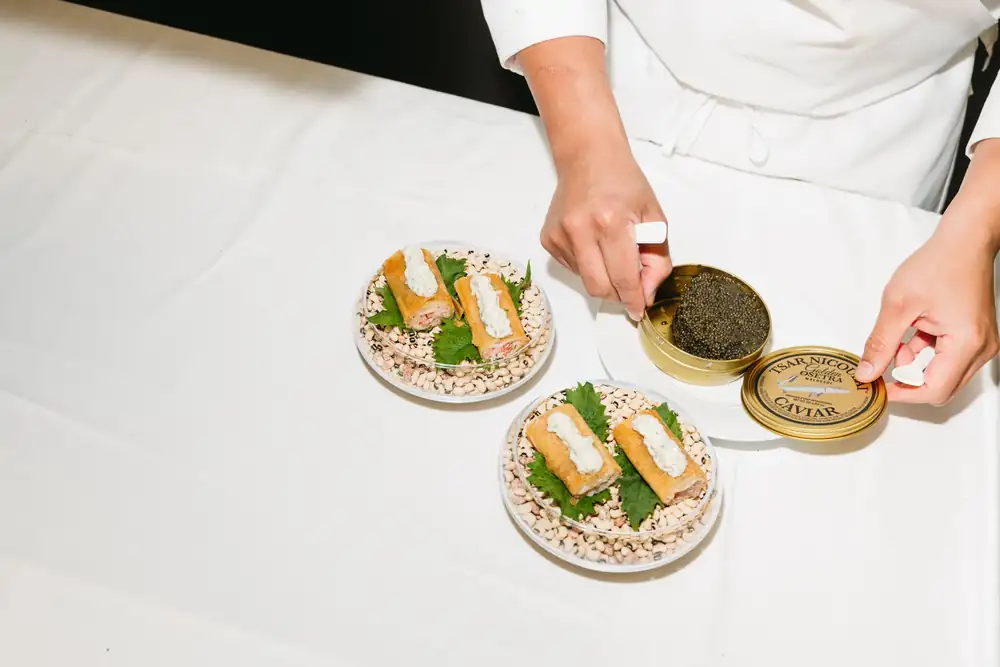
Olalia’s flair also makes it into his lumpia. Stuffed with shrimp and lobster, the crispy, cigar-shaped Filipino spring roll gets wrapped with feuille de brick and a shiso leaf and is served with sauce ravigote. For Lunar New Year, Olalia served his lumpia on a bed of uncooked black-eyed peas to marry Western and Eastern New Year traditions around prosperity with a wink. “I was trying to get to a certain point where we had a handle on the classics” he says. “Now that the foundations are in place, we can do more.” For Valentine’s Day, he created the Cured in Love, hibiscus-cured hamachi served with pickled purple radishes, thin slices of blood orange, and fresh cucumbers cut into small flowers. Hibiscus is a common flower in the Philippines; cucumber season lasts year-round there.
His five-spice mix is multipurpose, which is why he uses it in an evolved version of the Mansion’s short rib dish. The dark maroon-hued rib is served atop a bed of lush potato puree made with beef tallow, while a bone filled with rich marrow rests on the side. A sauce incorporating red wine and a homemade barbecue sauce ties all the flavors, old and new, together.
The show-stopper is arguably Olalia’s take on lobster Thermidor, in which lobster drowns in a béarnaise sauce made with Gruyere, Swiss, and Parmesan cheeses, and crispy crumbles made of anchovies and sourdough. He serves it on a bed of uni pasta, a result of that in-house pasta program he was so keen to start, with a sauce Américaine blended with uni and fortified with butter. It is one of the richest and most decadent dishes in Dallas right now, and bucks the ongoing trend of shaving truffles on top to hike up the price. It also demonstrates Olalia’s willingness to cater more to his diners than to his own nostalgia.
“I feel like it needs a little bit more, even though it doesn’t, so we added the pasta” he says and laughs. “Personally, I would eat it with rice.”