Los jóvenes talentos de la vanguardia iluminan Madrid Fusión
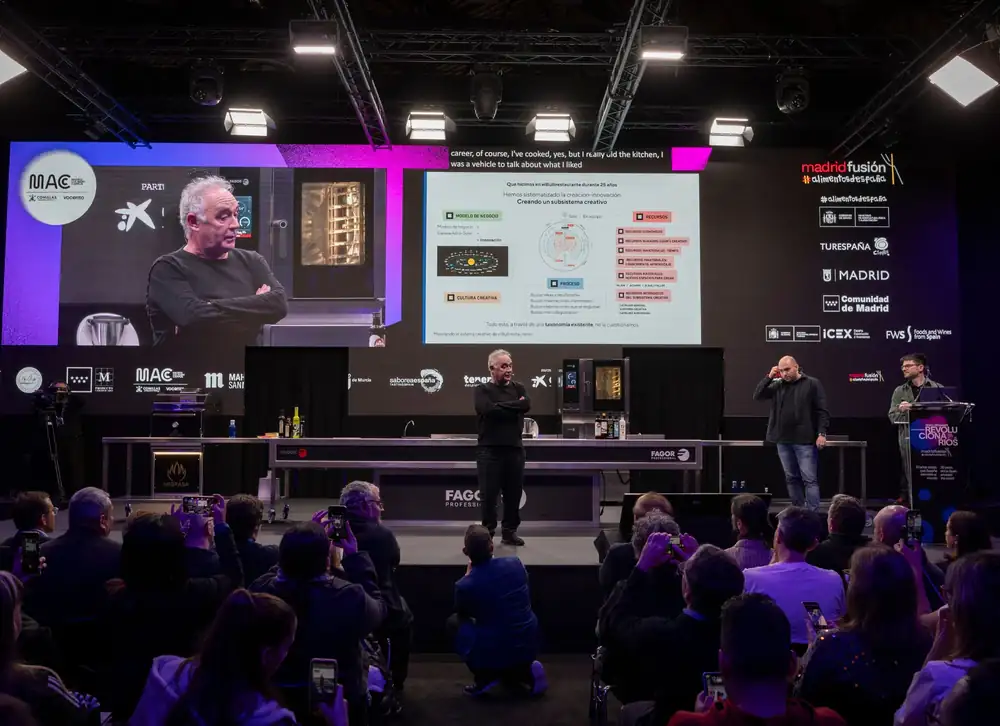
Ferran Adrià y su hermano Albert conversando sobre cocina de vanguardia en Madrid Fusión Alimentos de España. Puede parecer un déjà vu, pero es la tónica en la cumbre culinaria más importante del mundo.
Ferran Adrià and his brother Albert discussing avant-garde cuisine at Madrid Fusión Alimentos de España. It might seem like déjà vu, but it's the story of this Monday at the world's most important culinary summit. The Adrià brothers' presence wasn't so much about dusting off past glories, but rather about taking a broader view of a phenomenon that's now three decades old and has permeated every level of the industry. The program featured the Mount Rushmore of Spanish gastronomy, Disfrutar, Joan Roca, Quique Dacosta, Ángel León, Dabiz Muñoz, who still have much to say. Alongside them were young professionals like David Chamorro and Eneko Axpe, who were just kids when Spain astonished the world in the mid-90s, but who keep that revolutionary spirit alive.
“Making a revolution is one thing, understanding it is another” declared a Ferran in top form. After spending the first part of his career turning the profession on its head, he now aims to systematize the creative process. The task is monumental, and the details of the culinary taxonomy he presented alongside Rubén Zubiri, head of R&D at Enigma, may seem dry to the uninitiated, but his presentation generated a flurry of headlines. “The concept of good or bad means nothing to me” the chef declared, aware that these are fickle terms. He recalled that “the word avant-garde comes from war; it defines those who risk being killed to be the first to arrive” and warned that “very few of the 10 million restaurants in the world are currently striving to break new ground.” In one of its pendulum swings, the current scene seems to be rejecting the legacy of elBulli. Adrià bares his claws: “This talk of product-driven cuisine is nonsense; all cuisines start with a product, the difference lies in the level of preparation.”
It was in these preparation processes that the Cala Montjoi restaurant proved truly disruptive, inviting chefs to change the techniques that had governed the profession for centuries. Today, a new generation is taking up the mantle, with professionals like David Chamorro, a kind of Thomas Edison of the kitchen capable of laser hair removal on a chicken. The director of Food Idea Lab spoke about the use of light beams in the kitchen, "the most precise knife and blowtorch in the world", about the properties of sunlight to preserve and enhance flavors or multiply vitamins in vegetables, which could revolutionize preservation methods, and about using pulsed light, so popular in cosmetic dermatology, to streamline processes.
A story with a bright future
NASA physicist Eneko Axpe, along with three-Michelin-starred chef Eneko Atxa, also broke new ground. While in the previous edition they applied artificial intelligence to the design of haute cuisine dishes, this time they brought the tool to the table for creating set menus. The platform they developed allows for the generation of starter, main course, and dessert options, taking into account cost, selling price, available chefs, preparation time, and the number of covers to be served. A ray of hope for the set menu, currently struggling due to food inflation, the Americanization of customs, and remote work.
In one of those contrasting culinary experiences that Madrid Fusión often showcases, four leading figures in contemporary cuisine paid homage to the recipes of Ruperto de Nola, whose 500th anniversary is being celebrated. Joan Roca, Nacho Manzano, Pepe Solla, and Iván Cerdeño found connections between Nola's recipes and their own approaches, whether through distilled spirits, waterless cooked octopus, lamprey pie, or pickled dishes. Another chef who draws inspiration from history to enrich his culinary offerings is Ángel León, with dishes that evoke survival diets at sea, such as moldy bread or alcohol-soaked biscuits. Incidentally, he announced that he will finally be able to welcome customers to the marshland surrounding Aponiente, thanks to a collaboration with Ecologists in Action. "I feel like the dreams we've been cherishing for 15 years are finally coming true."
Quique Dacosta and his artistic cuisine, Albert Raurich and water as a philosophical concept in Japanese gastronomy, or Diego Guerrero's battery of ideas for using waste products paraded through an auditorium that burst at the seams during the joint presentation by Dabiz Muñoz and Gastón Acurio, a game of mirrors around ceviches that gives meaning to the fusion surname of the Madrid summit.