Bakea, the new Basque memory
It's called Bakea, peace in Basque, but it roars. A facade as dark as wet asphalt is barely visible on the ground floor of the building it occupies in the small Biscayan town of Mungia. It's not yet two in the afternoon.
We have to ring the bell to enter, which reminds us that however public we may consider them, restaurants are private spaces. We must be welcomed into them. We must say thank you. Once inside, the interplay of light and shadow takes hold. Black walls, wood, metal. A long table, like those in gastronomic societies, which we will share with strangers. An intimate lighting scheme divides the table into the groups seated at it. The blinds on the windows are drawn. Outside it could be night and we wouldn't notice. Outside the world could end and we would still be eating, as if we believe there is still time to change things.
None of that is happening. It's just that we're here at Bakea, where a very young team—some barely thirty, others not even worried about it yet—has been cooking with passion and sensitivity for a year. They can do so because they're part of a generation that knows how to navigate the unpredictable without flinching: where there's wood, there's iron. Where there's shadow, there's light. Where there's memory—oroimena, the backbone of the beast—there's a future. They have it etched in their minds, the only source of heat they use.
Sense and Sensibility
Iron melts at a temperature of 1,538ºC. Before today's welcome, before the idea for Bakea, for Mugaritz, even before his days at the Artxanda Hospitality School, Alatz Bilbao knew this. For five years he worked as a lathe operator in a local workshop. Metallurgy is as much a part of the Basque Country as cooking, and he has honed his skills in both.
However, gastronomy was not an escape. Every now and then he puts on his blue overalls, the same ones they wear in this dining room, and goes back to the workshop to produce the cutlery and some of the tableware on which they present the simple and highly sensitive recipes we are about to eat, preparations that are beyond perfection: "They are not perfect, they are ours," Alatz, with light eyes and fair skin (his grandfather was called 'the German'), will say as he serves them himself at the communal table.
There's a thrill in a butterfly anchovy from Bermeo, coated in honey and pollen, served like a jewel on a pebble from the Biscayan coast. Again, opposites: a firm surface that yields tender flesh, a sweet start to a bite that finishes with a salty note—the very antithesis of happy endings. It arrives after a txakoli granita that washes away any lingering thoughts from our mouths.
A ceramic egg by Ainara Garay, also from Mungia, whose composition contains ashes generated in Bakea, opens to reveal a Bizkaigane yogurt covered with trout roe, a subtle but strangely evocative, almost maternal, flavor.
Then, the iron
The chef's obsession with tools is integral to the kokotxa course. He uses a flambadou, a kind of metal funnel for cooking with burnt fat. It's heated red-hot, and a piece of fat—in this case, from a txuleta (rib steak)—is inserted. Upon contact with the metal, it ignites and melts over the kokotxas, confiting them. The only trace of the fire remains, just elegant toasted nuances. Thus, after this lipid consecration, two kokotxas appear on two spoons that are actually one, joined by an iron rod over half a meter long. To taste them without them flapping on the table, we must be perfectly synchronized from end to end. A balancing act that testifies to Alatz's time at Mugaritz.
Playing with tradition
This is followed by a juicy piece of grilled grouper, which, thanks to oak smoke, is presented on a potent sauce made with txakoli vinegar, beef garum and rapeseed oil ('ajilimójili' for the family), which is also great to dip with the farmhouse bread that Txomin Urkiza makes by hand in Otumetxu (Meñakabarrena).
The background music, which until now has been exclusively Basque songs, blares. The roar of a foundry at full capacity fills the air. On the table, they place a bowl with a dirty rag, smelling of turpentine. The culinary highlight is a delicious dish of lentils (“a dish loaded with iron”) with beef heart and pig's blood that resemble red beans. The workers' lunch.
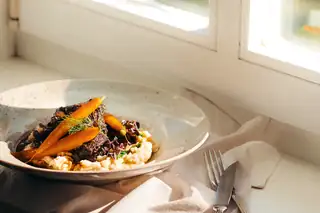
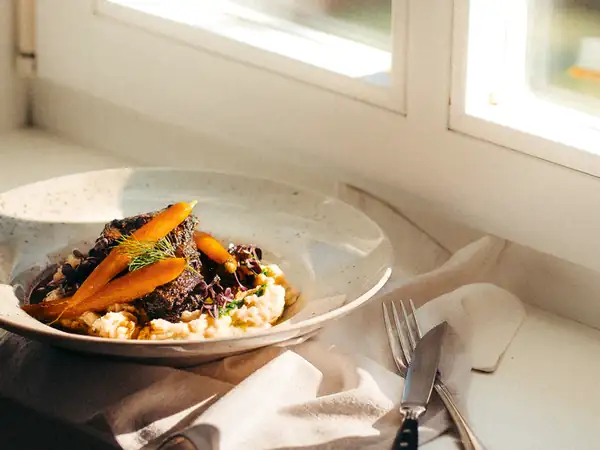
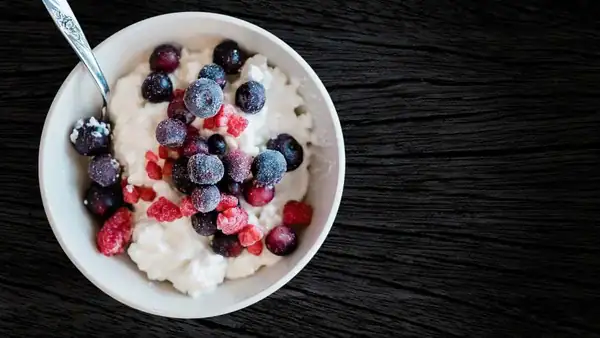
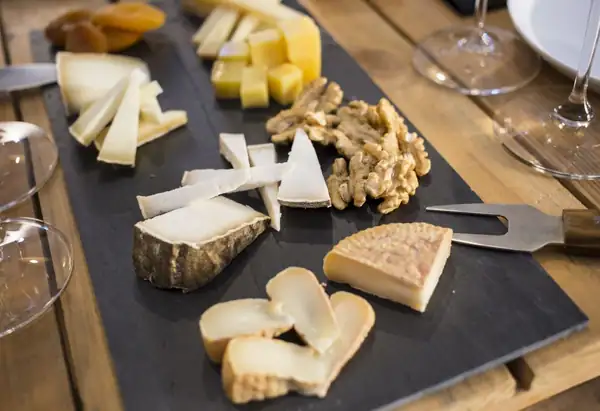
At Bakea, they elevate the everyday gestures of Basque culture to a high-end restaurant. The same is true of morokil, which is to the Basque Country what porridge is to Great Britain: a breakfast made with local cornmeal (txakinarto) boiled in milk and sugar. They bring it to the savory world with Ossau-Iraty cheese and Espelette pepper oil, which ignites the dish. There's a lot of tradition at Bakea, but it's not a traditional restaurant, as you can see with the wild boar ribeye steak, aged for three days in koji and seared on both sides—the central theme of this cuisine.
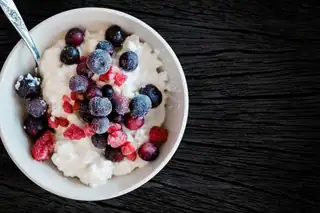
They show inventiveness in their desserts, although some work better than others. The tomato in syrup, a substitute for the classic peach, isn't convincing. Their version of sweet talo (a type of Basque flatbread) is curious, in which a dry white pepper meringue is used to spread a chorizo chantilly cream, although the contrast doesn't work in its favor. More delicious is their chocolate (they use Kaitxo's, which never disappoints) textured with beef tendon, accompanied by Bakio oyster mushrooms cooked on a griddle and topped at the table with a superb toffee made from the same mushroom. And of course, there's the curd with honey, and the traditional coffee brewed in a pot with chicory. Just like the ones from back in the day.
Axel Leis, a wine expert also trained at Mugaritz, flits around the table with selections that, like everything else at Bakea, are produced in the Mungia area and in the Basque Country and Navarre, with the occasional foray beyond the Rioja Alavesa region. There are the highly personal reds of Manin y Sus Muchachos, the barrel-fermented txakolis of Doniene Gorrondona, the unique whites of Imanol Garay, rosés like the Navarrese La Peli, and a non-alcoholic option from Ama Brewery to demonstrate their commitment.
The Machine
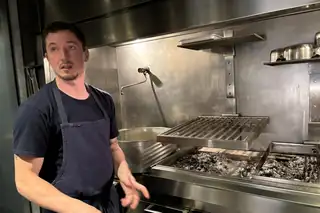
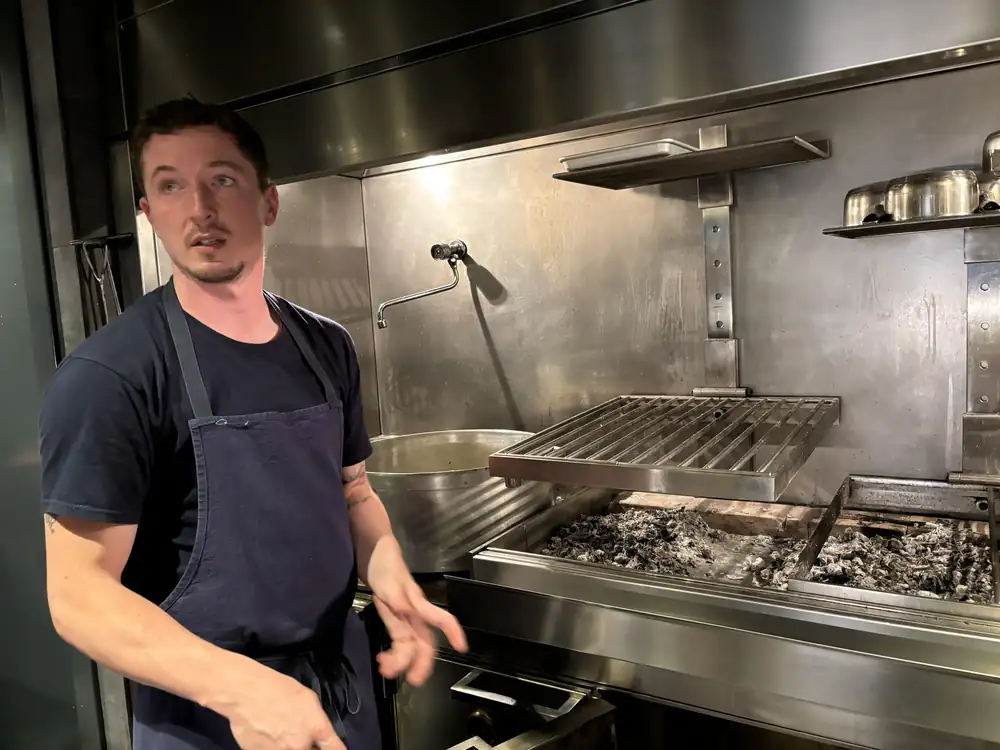
It's hard to sit at the table and not glance at what's happening in the kitchen every time that door opens. It's full of rudimentary tools, including the stove, the most rudimentary of all. He says that when the essentialist Bittor Arginzoniz, one of his influences along with Andoni Luis Aduriz and the poets Josean Alija (Nerua) and Pedro Sánchez (Bagá), visited him, he admired how the grills raised and lowered automatically. No need to strain his muscles turning cranks like ship's wheels. A simple button and the pieces rise and fall from heaven to hell. Alatz is clearly inwardly proud of having personally designed a machine full of conduits that transfer heat from one oven to another like incandescent aortas. He calls it the Machine. It's a metallic heart that produces emotions.
He does this using ingredients that don't break the bank, but do spark the imagination, allowing him to create dishes that are not only delicious, but also meaningful and full of character. If these dishes reflect a commitment to and respect for the land and its people, all the better. It's not just about honoring the memory of a place, its culture, and its people, but about forging a new one through it.
At the end of the experience, the blinds, which had remained closed throughout the service, are raised. The day surprises us as if we were as young as they were, and dawn had caught us before we'd even gone to bed. When we leave for Mungia, a warm breeze foretells rain. The dogs and children make the most of the time before they're dragged home. The world hasn't ended. Behind the now-closed door, just as dark, breathes that machine that was only cold when it still existed in the cook's mind. The German's grandson and his family prepare for the next service. A calm roar is heard. Nobody said peacetime was quiet.