What Is French Miche Bread?
We've all heard of French bread. Known as the global Capital of Bread — according to Le Cordon Bleu Malaysia – France has a longstanding tradition of taking bread very seriously.
What about sourdoughs, though? As explained by The Sourdough School, sourdough bread predates the 1800s' mass production and commercial yeasts. Sourdough instead uses a starter, salt, and flour to create something that's chewy, pungent, and tangy. Nowadays, this rustic type of bread is making a comeback, and France is not one to be left out of any breaded conversation.
Miche is sour yet hearty
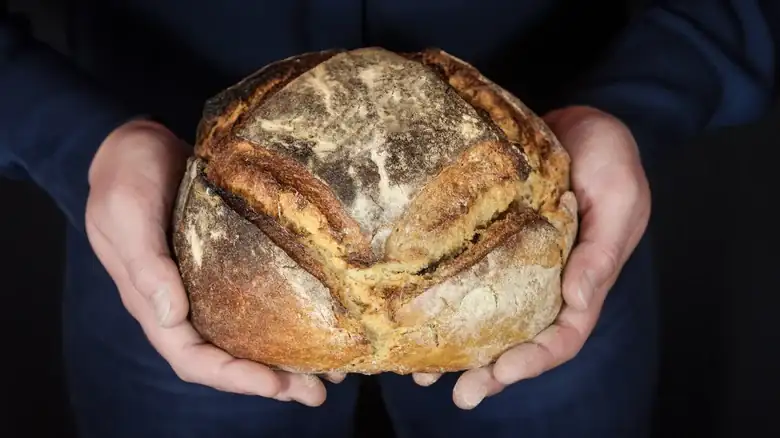
For a classic French sourdough, look no further than miche bread. Literally translating to "round loaf," per MasterClass, miche combines sourdough starter with whole grain, stone-ground wheat flour. This combination results in dark brown, hearty bread with a tight crumb. Miche is not alone as a French sourdough — pain au levain also qualifies — and miche's taste is admittedly milder and less tangy than famous San Francisco sourdough. However, its acidic and nutty flavors, as well as its aromas and long-lasting qualities do set it apart from your standard white bread. Also known as country bread or millstone bread, according to Hudson Valley Magazine, the crunchy-crusted miche is often used in sandwiches and tartines. It's also great for dipping into soups, holding jams, and even joining granolas or sauces as crumbs.
The specifics of miche production can change with each particular recipe, and extra ingredients such as walnuts are occasionally added in. Modern recipes sometimes also include rye or white flour, as well as larger amounts of water, thus resulting in an airier, moister, and softer bread. Still, the basics remain the same, and the end result is consistently mouthwatering.
It's culturally significant
French bread in general has a long and proud history, and miche bread is a big part of that tradition. Over the course of hundreds of years, per MasterClass, bread was made by the French people in communal ovens. Since bakers needed to share these devices, families would produce bread that could last them a while, and that made miche a perfect choice. However, in the early 20th century, commercial yeast made its debut, and the baguette started to replace sourdough in France. Some still stuck with miche to set themselves apart and keep the tradition alive, but it wasn't until fairly recently, according to Hudson Valley Magazine, that country bread made its resurgence.
One of the most important names in modern miche is Poilâne. Circa 1932, Pierre Poilâne opened a bakery bearing his name in Paris, France. Back then, white bread was all the rage. So, in order to beat baguettes, Poilâne made affordable, long-lasting, country-style wheat breads, selling them to the working class. Two generations later, and this family bakery still hand-makes miche in its wood-fired ovens.
Another contributor to miche's comeback is Bread Alone Bakery, an organic baker located in New York. It also utilizes wood-fired brick ovens and has championed natural, artisanal breads such as miche since 1983, helping bring Poilâne-style loaves to the United States. Indeed, from its humble beginnings (and despite its once-waning popularity), miche has since become an internationally acclaimed bread worth keeping around.