14 Regional Gravy Styles You'll Find Across The U.S.
What makes shrimp gravy so distinct is its preparation and ingredients. This dish begins with a base of bacon drippings and flour to create a dark roux. Chopped onions, bell peppers, and celery get incorporated before beef stock, Worcestershire sauce, and herbs join the mix.
“However, its earliest origins go back even farther to the enslaved populations brought from Africa to the plantation kitchens of the Lowcountry. Food historians like Mike Twitty, author of the James Beard award-winning”
Many early recipes, including one from a cookbook dating back to 1861 called "Handbook for Active Service," offer recipes for how to make gravy from this salt pork. Most recipes require boiling slices of the salt pork in water briefly to remove any excess salinity. Once the water evaporates, these pork slices get placed on a platter before flour gets added to the pan and whisked together with milk to create a savory, if not particularly salty, topping for the cured pork. This dish often gets served atop mashed potatoes or biscuits for a calorie-dense, affordable meal. While it isn't something you might see in today's more health-conscious culture, it is a dish worth noting for its historical importance.
The recipe seems simple enough. Start with either bacon grease or butter, then stir in whisked eggs and milk. Some recipes indicate using flour as a thickener, while others suggest simply letting the heat to do its magic on the eggs, allowing them to thicken on their own. Regardless of the recipe, the result is a clumpy egg sauce to serve over mashed potatoes, biscuits, cornbread, ham, and fried eggs for a country-style breakfast. The only thing that could make this particular recipe palatable is to save the bacon bits from the rendered bacon and return them to the sauce for some added texture and flavor. Otherwise, we recommend sticking with a Hollandaise sauce , even if it is a more complex recipe to recreate.
Sawmill gravy
When Southerners think of the term "biscuits and gravy," this type of gravy comes to mind. Historically, sawmill gravy evolved during the 1800s, when resourceful Appalachian loggers would hop from one off-the-beaten-path site to another, establishing logging camps. These hard-working loggers needed hearty food to help fuel them through harsh weather and long, arduous workdays. Dense biscuits, which, back then, were nothing like the fluffy ones we now make using leaveners and commercially produced flour, would get covered with a rich gravy made from rendered bacon fat, cornmeal, and milk. Because of the gritty texture the cornmeal gave this gravy, loggers often accused the chefs of making it with sawdust, hence its moniker. Today, sawmill gravy typically gets made with flour instead of cornmeal, sausage often replacing the bacon drippings, and herbs and spices
Chili gravy
If you have ever eaten a plate of piping hot enchiladas in a Mexican restaurant in the U.S., you've likely had chili gravy. Chili gravy is a classic Tex-Mex invention, the perfect example of two cultures merging their culinary histories. The earliest mention of this type of sauce dates back to the 1890s, and canned versions could be found by the early 1900s. The sauce begins with lard or oil, which gets thickened with either flour or masa to create a roux. The key to chili gravy lies in the spices used, primarily chili powder, cumin, garlic, smoked paprika, and oregano. Once these spices have toasted, the sauce gets finished with chicken or beef broth. The result is something of a cross between a classic Mexican red enchilada sauce, which gets made with tomatoes, and a brown gravy. This sauce is also commonly used to garnish burritos, rice, and beans. It is also a
Brown gravy
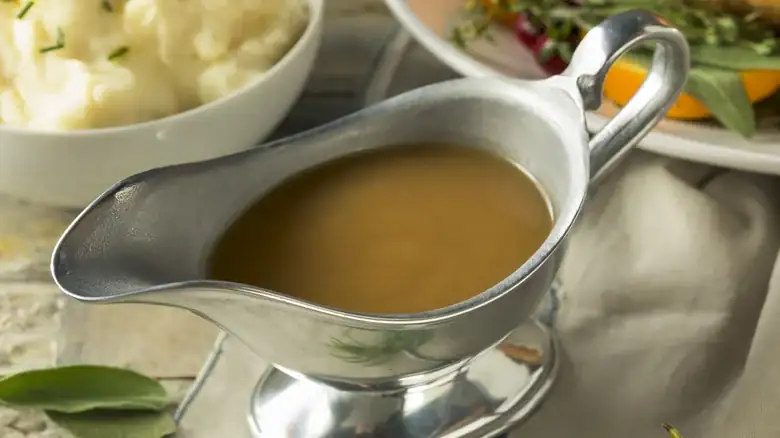
Brown or pan gravy is most quintessentially recognized as gravy in Britain. This gravy takes advantage of meat pan drippings whisked together with flour into a dark roux and thinned with beef stock. Its origins likely date back to the Middle English period, which spanned between roughly 1150 and 1450 in Britain, during which the term "gravé" emerged. This term presumably came from the French, as similar recipes were commonplace in that country during medieval times. While this variation of brown gravy very likely made its way from Britain to America aboard the Mayflower, it became a staple in the post-Civil War U.S. Today, mass-produced variations of brown gravy are available in dried packets, cans, and jars labeled "Brown Gravy." It most often gets served with roast beef and mashed potatoes. For a more sophisticated iteration of a brown sauce, consider making
Red-eye gravy
Facebook Perhaps no gravy is as quintessentially Southern as red-eye gravy, also known as poor man's gravy, bird-eye gravy, bottom sop, muddy gravy, cedar gravy, and red ham gravy. It's a key component of what is known as a "meat 'n' three" dinner, which includes a choice of meat (often country-fried steak, ham, or pot roast) served with a choice of three side dishes, including potatoes, corn, lima beans, macaroni, cornbread, and biscuits. This feast gets topped off with this delectable gravy made simply from the drippings of a pan-seared, salt-cured, hardwood-smoked country ham and mixed with leftover black coffee. That's it. No flour, no other liquid. It is exceedingly simplistic, yet its origins are steeped in legend. While some believe red-eye gravy gets its name from how the ham on a plate coated in this sauce looks like a red eye, others insist it is because after you eat this grav
Chocolate gravy
The pride of those from Appalachia and the Deep South, chocolate gravy is a dish that evokes nostalgia. It is a simple recipe often made by combining bacon drippings or butter with sugar, flour, cocoa, and milk, creating a sweet treat that can get served over sweet or savory dishes. Chocolate gravy is especially popular with breakfast biscuits, and it is an unspoken rule to crumble your biscuit rather than slice it in half to maximize the quantity of gravy that gets soaked up. The origins of this gravy are very ambiguous. One theory is that it evolved from the trading network between Spanish Louisiana and the Tennessee Valley, introducing Mexican-style breakfast chocolate to Appalachia. Another theory suggests that it is a remnant of the 16th and 17th centuries, when a mixed-race group known as the Melungeons occupied the Spanish colonies of the East Coast.
SOS, aka hamburger gravy
Facebook While several sources attribute hamburger gravy to the Midwest, research shows that this simple dinner has its origins in a dish called SOS that was a staple for the Armed Services. "SOS" is short for "S*** On A Shingle," referring to a gravy made of chipped beef served over toast. The earliest reference to this dish is in the 1910 Manual for Army Cooks, although it became popularized during World War II as a quick, easy, shelf-stable meal for a large group of starving soldiers. In its earliest iterations, salt-cured chipped beef would soak in water overnight to remove some of its excess salinity. This beef would then get added to a simple gravy. The gravy used equal parts butter and flour for a roux, beef stock, and canned evaporated milk. By 1942, a variation of this dish called creamed beef had become common. This recipe involved cooking ground beef in onions and creating a g
Chicken gravy
If you have ever had a classic Southern fried chicken recipe, chances are it came with a heaping helping of whitish gravy with black speckles of pepper. This gravy, sometimes known as Southern country gravy, country-style gravy, peppered white gravy, and Cracker Barrel sawmill gravy, has as many iterations as there are Southern grandmothers. A few staples must be observed for this gravy to be authentic. The first key is smoked bacon — not lean, maple, turkey, or vegan. This bacon gets rendered down, and its fat becomes the base for the roux made with flour, salt, and the next important staple — black pepper. If your gravy does not have black speckles, it does not qualify as real Southern chicken gravy. Next comes the milk, or cream if you are feeling particularly cheeky. Once this gravy is smooth and creamy, it is perfect over chicken and waffles, biscuits, or
Tomato gravy
Facebook Another quintessentially Southern gravy is a basic tomato gravy. Tomato gravy is the ultimate "desperation gravy" — a dish made when resources are thin, but creativity abounds. Tomato gravy generally gets served for breakfast atop biscuits, cornbread, rice, grits, and scrambled eggs. It is a comfort food born out of necessity; the adage "when life gives you lemons, make lemonade" applies here. Toward the end of summer, unpicked, overripe tomatoes are practically falling off their vines. These tomatoes are often quite large and watery, making them challenging to use for anything other than a sauce of some ilk. Enter gravy. This gravy has a myriad of permutations, beginning with the fat used. Pan drippings from bacon or sausage are preferred, but butter will do. Next comes the thickener, which may be flour, cornmeal, or no thickener. This roux should get cooked to a dark amber col
Cornmeal gravy
Facebook While early renditions of sawmill gravy used cornmeal as a thickener, it was hardly the first variation of a sauce to use cornmeal. This tradition can be traced back to the Indigenous populations of North America. Native Americans of the Mississippi Delta region would make a dish known as selu'si asusdi, which would be served atop fry bread or other vegetable dishes to help extend the meal when meat was unavailable. This type of gravy has a texture akin to grits, making it particularly hearty. The basic recipe is similar to other early gravy recipes of the South. It begins with pan drippings, ideally from bacon, but other fats can get utilized. Some recipes suggest pre-toasting the cornmeal until golden brown for an extra nutty flavor and golden color, while others add the cornmeal to the bacon fat. The gravy gets finished with either milk or buttermilk for a more tangy aftertas
Mushroom gravy
It would be impossible to pinpoint mushroom gravy to a single location in the U.S. — it was likely brought to America by early colonists who were already making a similar type of mushroom sauce to garnish various cuts of meat. Indeed, one can look at the legacy of recipes for mushroom gravies like a French chasseur, German jägerschnitzel, and Italian Marsala for evidence that versions of mushroom gravy evolved in many regions. Because mushrooms are so ubiquitous, it makes sense that each culture would adapt a gravy recipe to accommodate locally sourced mushrooms. That said, the techniques for all variations of mushroom gravy are essentially the same. Mushrooms are added to pan drippings or butter and sautéed until they cook down, yielding all their natural moisture. Then the flour is added as a thickener and liquid as a finish to the gravy. While stock can get
Giblet gravy
Giblet gravy is another gravy associated with Southern cooking, although it has been a staple of Eastern European Jewish families for generations. It is a recipe seeking to take advantage of every part of a turkey or chicken without wasting an ounce, another example of ingenuity when frugality lent itself to creating something delicious. The giblets include organ meats like the heart, liver, gizzard, and neck of a turkey or chicken. These often get tucked into small packets inserted into the cavity of the neck of the bird. Anyone who has ever roasted a turkey without checking that cavity may have found this little surprise lurking there when they went to carve their Thanksgiving turkey. What may set the Southern version of this gravy apart from its Eastern European Jewish cousin is the addition of a hard-boiled egg to the recipe, which gives it additi
Shrimp gravy
Shrimp gravy, the base of the quintessential breakfast food shrimp and grits, is most often attributed to Charleston, South Carolina. The first "Breakfast Shrimp" recipe appeared in a cookbook published in 1950 entitled "Charleston Receipts." However, its earliest origins go back even farther to the enslaved populations brought from Africa to the plantation kitchens of the Lowcountry. Food historians like Mike Twitty, author of the James Beard award-winning "The Cooking Gene," note that similar shellfish-based dishes were well-known in Africa before the beginning of slavery in the U.S. What makes shrimp gravy so distinct is its preparation and ingredients. This dish begins with a base of bacon drippings and flour to create a dark roux. Chopped onions, bell peppers, and celery get incorporated before beef stock, Worcestershire sauce, and herbs join the mix. The
Salt pork and milk gravy
Salt pork was a typical staple ration of the early settlers of New England. The most fat-laden cuts of pork would be cured with salt, making them more shelf-stable and more easily transportable, an attribute that made salt pork particularly helpful for soldiers during the Civil War. Many early recipes, including one from a cookbook dating back to 1861 called "Handbook for Active Service," offer recipes for how to make gravy from this salt pork. Most recipes require boiling slices of the salt pork in water briefly to remove any excess salinity. Once the water evaporates, these pork slices get placed on a platter before flour gets added to the pan and whisked together with milk to create a savory, if not particularly salty, topping for the cured pork. This dish often gets served atop mashed potatoes or biscuits for a calorie-dense, affordable meal. While it isn't some
Egg gravy
Since none of the gravies heretofore mentioned included eggs, at least not in their raw form, this particular recipe intrigued us. It makes us think of a classic French Hollandaise sauce that has been poorly executed. The exact origins of this sauce evade us — while it was reportedly also known as rich man's gravy, YouTuber Courtney Morris describes it as a "vile act of desperation." The recipe seems simple enough. Start with either bacon grease or butter, then stir in whisked eggs and milk. Some recipes indicate using flour as a thickener, while others suggest simply letting the heat to do its magic on the eggs, allowing them to thicken on their own. Regardless of the recipe, the result is a clumpy egg sauce to serve over mashed potatoes, biscuits, cornbread, ham, and fried eggs for a country-style breakfast. The only thing that could make this particular recip