15 Traditional British Foods That You Need To Try
The stew is centered around cuts of red meat, with beef and lamb leg or shoulder commonly used, although mutton, ham, or even bacon may make it into the dish as well. The meat goes into a large stewing pot, alongside root vegetables like potatoes, swedes, carrots, and leeks.
In our humble opinion, it's probably wise not to make a habit of making this dish too often (because of health and stuff). But if you really wanna try it, you can make the deep-fried Mars bar in your very own home. Whip up a batter from milk, flour, baking powder, and a pinch of salt, and then dip a Mars bar, or some fun-size Mars bars, inside to coat them fully. Lower them gently into some hot oil, and cook them until they're browned. Pull them out, allow the excess oil to drain off, and then give them a bite.
We'd argue that Eton mess is all the more delicious for being combined in such a way. It's super easy to make at home, too. You merely need to crumble store-bought meringues into a bowl and add some strawberries that have been lightly pulsed in a food processor with some sugar. Add them to the meringues, pour over some double cream, and mix the whole thing together. If that's what they teach you how to do at Eton, we're paying our tuition right now.
Full English breakfast
If you like your breakfast on the light side, it's time to look away now. While it's not something that's eaten every day, a full English breakfast is a one-of-a-kind way to start the morning. Dating back to roughly the 1400s, the full English breakfast originated in the countryside, as a way to fill up before going hunting. Over time, this morning feast morphed into a bonanza breakfast plate, that today is still commonly served in "greasy spoons" across the country. The full English breakfast contains a combination of food that varies and is usually customizable to people's specific tastes. But the standard items you might find include bacon, sausages, eggs, baked beans, fried tomatoes and mushrooms, toast or fried bread, hash browns, and black pudding. Many of these items are non-negotiable, with bacon being far and away the most popular element of the full E
Haggis
There are some truly unique foods in Britain, but arguably none are as unique, or as infamous, as haggis. This meat dish, often hailed as the national dish of Scotland, is a singular creation. Haggis is a minced meat food that combines lamb meat with oats, suet, onion, and seasonings. What sets haggis apart, however, is the type of meat that is used. Haggis is typically made with organ meat, specifically with sheep lungs, liver, and heart. While that may put some people off, it is a truly resourceful way of using offcuts of meat that would otherwise be discarded. Once the raw meat mixture is combined, haggis is traditionally cooked by boiling it in the sheep's stomach. In the modern era, though, an artificial bag is commonly used instead. The dish, like many others, developed as a way to make the most of a hunted animal's meat, and to somewhat preserve it too
Beef Wellington
While British food is usually not thought of with the same sense of elegance as, say, French cuisine, it still has its moments of grace and splendor. One of these comes in the form of the Beef Wellington. A truly classy dish, Beef Wellington gets its name from the Duke of Wellington himself, who famously led Britain to victory over Napoleon Bonaparte. Such a win deserved a winning dish, and so chefs designed the Beef Wellington, a sirloin fillet covered in a luscious coating of duxelle (a mushroom, onion, and herb paste), and then wrapped in a parcel of pastry. The whole thing is then baked in the oven until the pastry is golden and crispy and is then sliced and served. It can be plated up alongside vegetables or potatoes but is so rich that it can be enjoyed on its own. Beef Wellington is somewhat infamous as one of the harder British dishes to make, partly because
Welsh rarebit
Welsh rarebit, also known as Welsh rabbit, might just win the award for "most confusingly-named dish." But whatever you're expecting from a Welsh rarebit, it's probably not what you think. This Welsh dish is actually a very fancy cheese on toast, with a luscious sauce made from melted cheddar, milk, flour, and additional seasonings poured onto crunchy bread. Mustard may also be added on top of the cheese, to give it some additional heat, and ale may also be stirred into the sauce. Welsh rarebit is hearty enough to be eaten on its own, so you don't have to worry about any side dishes, although a green salad can add contrast to the heavy cheese-based meal. But where does that unique name come from? It may have all started as an inside joke. It was common in 17th and 18th century Britain to take normal, easily-made meals, and give them grand names, to humorous effect. T
Steak and kidney pie
Steak and kidney pie is part of Britain's world-famous pie legacy, with the baked dish served up in the United Kingdom since the 12th century. Pies filled with steak and kidney are a relative newcomer to the scene, beginning to appear in the late 17th century. But once people caught on, they gained a timeless place in Britain's national menu. Steak and kidney pie is pretty much exactly what it sounds like. But if the thought of eating kidneys puts you off, give it a try — it might surprise you. Chefs will typically simmer a combination of chopped steak, kidneys (which may be beef, pork, or lamb kidneys ), and onions, in a meaty, thick sauce. The mixture is then spooned into a waiting pie casing, where it's topped with pastry and popped in the oven until it's browned on the outside, and bubbling in the middle. This pie has had no shortage of fans over the years and was
Sunday roast
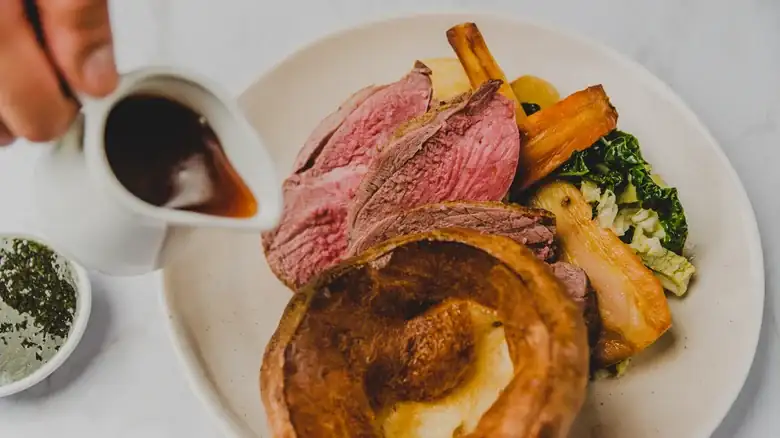
The Sunday roast is, arguably, the quintessential and most beloved of all British dishes. That's not just us talking. According to a survey published by YouGov, Sunday roasts are the joint-second most popular food in the U.K., tied with fish and chips and just slightly less universally praised than Yorkshire puddings (but as Yorkshire puddings are commonly served with Sunday roasts, we think it's fair to combine the two). With one mouthful of a classic roast, you'll see exactly why they're so popular. Sunday roasts are an irresistible combination of meat, roast potatoes, Yorkshire puddings, and vegetables, with stuffing also frequently featuring on the plate. The whole thing is then drowned in thick gravy. Beef, chicken, pork, and lamb are the most common meats used in a Sunday roast, with beef potentially the most traditional choice. The tradition of piling a p
Ulster fry
The full English breakfast isn't singular. In Northern Ireland, they have a cooked breakfast of their very own — and it could just rival the full English in terms of deliciousness. The Ulster fry is potentially the best-known Northern Irish meal and is a super-hearty breakfast comprised of cooked meats, eggs, and soda bread. With everything fried on its way to the table, this isn't a breakfast you should take lightly — but boy, is it tasty. The Ulster fry contains several elements that are familiar to those across the Irish Sea, with sausages, bacon, and eggs usually appearing on the plate. Where it differs most significantly, though, is in the bread that's used. Whereas the full English uses a standard white loaf for its bread, the Ulster fry uses soda bread (also known as soda farl). Made by combining flour with baking soda, this bread is cooked in a hot pan, w
Bangers and mash
One of the key strengths of British cuisine is that it knows how to do a lot with a few ingredients. Bangers and mash is a prime example of this. This dinnertime staple manages to extract an unbelievable amount of flavor and comfort out of just several components. To make bangers and mash, all you need are some mashed potatoes and a few quality sausages. Spoon the mashed potato onto a plate, top it with your sausages, and pour gravy on top. The reason the sausages are called "bangers" in this dish is not that they're especially loud, but thanks to a unique slang term for sausages coined in the early 20th century. When sausages were cooked, the skin that was commonly used to encase them would often explode, making a loud "bang!" — and thus, the nickname was born. The flavor in bangers and mash comes from all the little details. Traditionally, a Cumberland sausag
Welsh cawl
If there's one thing that British people know how to make, it's stew. Stews have been made in Britain for thousands of years in various forms, and over time, regions across the country have developed their own specific recipes. Welsh cawl is one such regional specialty, potentially dating back to the 11th century, and it's as robust and filling as they come. The stew is centered around cuts of red meat, with beef and lamb leg or shoulder commonly used, although mutton, ham, or even bacon may make it into the dish as well. The meat goes into a large stewing pot, alongside root vegetables like potatoes, swedes, carrots, and leeks. Some choice seasonings are added, usually in the form of readily-available herbs like rosemary and thyme. Beef, lamb, or vegetable stock is then added, and the whole thing simmers away for hours until the meat is tender and the vegeta
Battered Mars bar
A Mars bar covered in batter and deep-fried is hardly the pinnacle of human achievement, and nor is it healthy. But there is absolutely no denying that this food is pretty delicious, and is a must-have at least once in your life. The battered Mars bar came into existence thanks to a dare between two boys in Scotland, back in 1995, who asked the chef at their local fish and chip shop to cover the chocolate bar in the batter and put it in the fish fryer. The chef did as he was asked, and the result was a total hit. Word spread like wildfire — and the battered Mars bar was born. In our humble opinion, it's probably wise not to make a habit of making this dish too often (because of health and stuff). But if you really wanna try it, you can make the deep-fried Mars bar in your very own home. Whip up a batter from milk, flour, baking powder, and a pinch of salt, and th
Lancashire hotpot
Certain foods, like fish and chips and the full English breakfast, are pretty well-known outside of Britain. Others are less so, but that doesn't make them any more delicious. Lancashire hotpot is a regional staple of the Northwestern county of Lancashire, and it's as tasty as they come. This dish has been around for generations, and was particularly popular during the Industrial Revolution, thanks to the ability to leave it cooking during working hours and come home to a finished meal. Eventually, though, its recipe made its way into print, and the Industrial Revolution became the hotpot revolution. A Lancashire hotpot is a simple, satisfying dish, in which lamb or mutton is layered into a large pot. Between each meat layer is a layer of sliced potatoes and vegetables. The whole thing is finished with a final layer of potatoes, which crisp up in the oven, giv
Spotted dick
This curiously-named dessert is as British as they come, and while these days it's not exactly served every night, it has a pretty extensive history. Spotted dick has seemingly been around since the 19th century, and gained prominence in Victorian Britain. Its name, interestingly, is derived from the original English word for "pudding," which was "puddick," and the "spotted" part comes from the dried fruit inside, which gives it a polka-dot consistency. But while a lot of people may have heard of spotted dick, they may not have tried it, or even know what's inside. So what is it? Spotted dick is a fairly dense, somewhat pillowy pudding made from flour, milk, and suet, a type of animal fat. The whole thing is mixed with currants and sugar, and lemon zest is added to flavor it. Then, the pudding mixture is piled into a greased dish and steamed for roughly two hours, u
Sticky toffee pudding
Now, aren't those three words that you just love seeing together? Sticky toffee pudding is a British classic, and as desserts go, they don't get much better, or much more traditional, than this. While it's a popular dish across the U.K., there remains a fair bit of argument about where it actually comes from, with various claims of its origins from places in Cumbria, Aberdeenshire, Yorkshire, and even Canada. No matter who invented this dessert, though, there's no denying that it tastes good. The main bulk of sticky toffee pudding comes in the form of a dense sponge, made from a batter of flour, eggs, baking powder, sugar, and various flavorings. Some of these flavorings include vanilla, dates, and muscovado, which gives the whole thing a deep, fragrant, toffee fragrance and taste. The pudding is then baked until just tender throughout and is then taken out of th
Eton mess
Eton mess may be named after one of the most well-to-do schools in England, but there's nothing uptight about this dessert. A jumble of berries, cream, and meringue, Eton mess was apparently created completely by accident. At a cricket match between Eton College and fellow prestigious school Harrow, someone allegedly took a tumble while holding a dessert made of meringue, strawberries, and cream. The once-attractive sweet treat broke into pieces and was considered wasted — until someone enterprising spooned it all into a bowl, and served it. We'd argue that Eton mess is all the more delicious for being combined in such a way. It's super easy to make at home, too. You merely need to crumble store-bought meringues into a bowl and add some strawberries that have been lightly pulsed in a food processor with some sugar. Add them to the meringues, pour over some doub
Knickerbocker Glory
Come on, now. Have you ever heard such a fabulous name for a dish? The British have a knack for creating meals that not only taste good but are an utter treat to say, with the Knickerbocker Glory surely taking the top spot. Luckily, this dessert is just as fun to eat, too. The Knickerbocker Glory is in effect a mega ice cream sundae. Although the exact recipe can vary from dessert to dessert, the key components are ice cream, meringue, a drizzle of syrup, and a squirt of whipped cream on top, served in a tall glass. Nuts, crushed-up biscuits, chopped fruit, and a maraschino cherry on top are all also frequently included. But obviously, you're wondering where that wonderful name came from. The truth is that there's no established history for it. One potential source is some association with New York's Knickerbocker Ice Company, while another argument goes tha