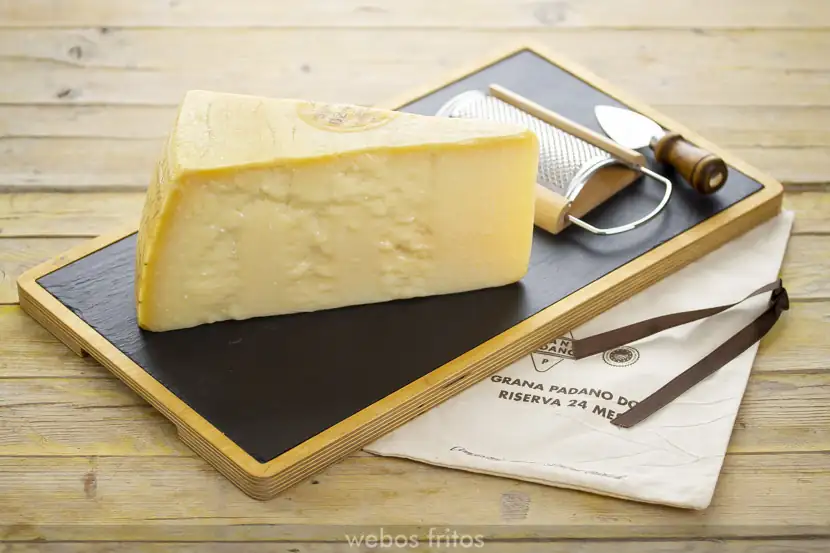
Grana Padano cheese with DOP
A couple of months ago, I had the pleasure of receiving a magnificent portion of this iconic cheese from the Consorzio Tutela Grana Padano.
Grana Padano Cheese
What does this designation of origin refer to?
It refers to cheese produced year-round with raw cow's milk, partially skimmed through natural blooming, cooked, hard and slowly matured, for use as table cheese or grated, and which meets established quality requirements.
What is its area of origin?
The production area is the so-called Po Valley, coinciding with the Po River valley in northern Italy. It is bordered to the north and west by the Alps and to the south by the Apennines, and opens onto the Adriatic Sea to the east.
What shape does it have?
It has a cylindrical shape, a hard, golden, and oily rind. It weighs between 24 and 40 kilos. The selection process for Grana Padano involves adjusting the molds with a special hammer and needle to check the consistency and aroma.
What is its method of obtaining it?
Grana Padano PDO cheese is made with raw cow's milk from cows milked twice a day. These cows must be fed green or preserved fodder.
The process is as follows:
The milk is skimmed by natural blooming and introduced into kettles, shaped like upside-down bells, made of copper or copper-lined.
Coagulation is achieved with calf rennet. The curd is broken into fine granules which are cooked until they become elastic.
Then they are left submerged in the same kettle for 70 minutes from the end of cooking.
They are placed in their molds where they remain for 48 hours.
They are then kept in brine for 14 to 30 days.
Its natural maturation is carried out by preserving the product in an environment with a temperature between 15º and 22ºC for a period of 9 months, brushing and turning them every fifteen days.
What are its characteristic features?
Three:
the casein plaque placed on the flat part, which bears the inscription GRANA PADANO and the identification codes for each piece,
the four-leaf clover, which indicates the province and the cheese factory.
And the diamond-shaped mark that guarantees the cheese's typological characteristics, along with a script that is repeated across the entire rind. This is perhaps the most recognizable feature in the classic photographs of those enormous wheels placed on the wheels while they mature, which I find an impressive sight.
Are there different aging processes for Grana Padano?
Yes, let me tell you:
Grana Padano DOP, aged from 9 to 16 months. It has a milder and more delicate flavor.
Grana Padano DOP aged for over 16 months. It's suitable for grating and also for use in other types of recipes. It has a crunchy texture when you bite into it.
Grana Padano DOP aged for over 20 months. This cheese has a special excellence, with a fragrant and delicate flavor.
Let's go to the kitchen
Any ideas for its application?
Grana Padano DOP, aged for 9 to 16 months, is ideal as an aperitif, in salads lightly flaked with nuts and honey, in meat carpaccio, in artichoke salads… It doesn't overpower any flavor, but rather complements and harmonizes them. It pairs wonderfully with young, fresh white wines.
Grana Padano DOP aged for over 16 months. It's ideal for adding to meat, vegetable, and omelet fillings, or for canapés, savory tarts, and pizzas. The perfect wine pairing is a moderately intense red.
Grana Padano DOP aged for over 20 months. It's extraordinary for seasoning pasta and soups. Magnificent in dishes that call for traditional balsamic vinegar. Ideal in charcuterie boards, soufflés and fondues, or for thickening risottos. It pairs very well with reserve wines.
How to preserve it?
Grana Padano cheese should be stored in the refrigerator at a temperature between 4° and 8°C, away from other cheeses and wrapped in cling film. Before eating it, take it out of the refrigerator and unwrap it to allow it to breathe and reach the proper temperature.