11 consejos que necesitas para hacer la mejor masa para pasta fresca
Preparar pasta casera solía ser una necesidad y una tarea habitual en la cocina. Ahora, la pasta seca se encuentra fácilmente en el supermercado y tiene una vida útil de varios años.
Making pasta from scratch used to be a necessity and a regular task in the kitchen. Now, dry pasta is readily available in the supermarket and has a shelf life of years. Fresh pasta can also be found in the refrigerated section of the store, and while it carries a higher price tag and a shorter shelf life, it's ready to boil for a convenient meal.
Now, making homemade pasta is a labor of love. An Italian nonna may make a fresh batch of dough every Sunday morning, but many of us only roll up our sleeves to make pasta for special occasions. Others may want to try making dough for the first time but are wary of the process, which can look long and intimidating. It's true that homemade pasta takes time and effort and a little clean up, but it's a rewarding process. There's nothing quite like enjoying the freshest kind of pasta you can taste.
If you'd like to learn more about how to easily make pasta dough , keep reading and follow the basic tips outlined below. You can get started with a few basic ingredients and no special equipment. I've drawn on my own experience as a recipe developer to write this article. My specialty is Italian food, which I learned about through almost a decade and a half of living in Italy. But before that, I learned how to make ravioli as a small child with my grandmother every year before Christmas.
Use the right tools
A few tools are necessary for making pasta dough, but you can keep it simple or get fancy according to your preferences and budget. On the most basic level, all you need is a work surface like a kitchen table or counter top and a fork to beat the eggs. A table is lower, so you'll be able to exert more downward force on the dough while kneading. That's all you really need if you arrange the flour directly on the work surface and use your hands for mixing. Some people are more comfortable mixing the flour and eggs in a mixing bowl, so that's a useful tool to keep the flour mixture contained. If you make pasta regularly, you may appreciate having a wooden pasta board like this one sold on Amazon. A lip on both sides helps the board stay positioned against the table so it doesn't slip around. Not only is a board a convenient large, flat surface for working with dough, it
Understand the types of fresh pasta dough
Pasta dough can be made with or without eggs. Egg scarcity in poorer Southern Italy in the past led people to create eggless dough, which is delicious and can be made into many shapes. Dough with eggs, called pasta all'uovo in Italian, is richer dough with a more yellowish color. Pasta dough with eggs is made with 00 flour, which is made from grano tenero (Triticum aestivum ), or soft wheat. It's white and will say farina di grano tenero if you have an Italian package (farina means flour). It's this soft wheat that is subjected to different grinds to produce type 00, 0, 1, and 2 flours, which gradually increase in coarseness. Eggless pasta dough, on the other hand, is made from grano duro (Triticum durum), which is hard wheat. Italians call the flour resulting from the finest grind of hard wheat semola rather than farina, and it translates to durum wheat semolina. I
Reach for 00 flour for egg pasta dough
00 flour is a very fine and soft Italian flour. It's pronounced double zero flour, but it's sometimes labeled with its Italian name: doppio zero. 00 is the finest grind of Italian white flours made from grano tenero, or soft wheat. It's also the most refined and therefore least nutritious, since the fiber and nutrient-rich bran and germ are removed. The numbering system from 00 to 2 is different from American flour labeling, which categorizes flour based on it's protein content. For example, all-purpose flour is made from a mixture of hard and soft wheats and is characterized by a protein content of about 12%, which is why it's a versatile option for a range of recipes. If you look at 00 flour next to all-purpose flour, you'll notice it's ground much finer and looks more powdery. 00 flour isn't just used for pasta. Italians prefer it for pizza for the same reason
Measure accurately
American recipes that include flour and eggs are generally written with the flour measured in cups and the eggs listed by number and size. Italian recipes generally use grams. The classic Italian recipe for homemade egg pasta dough calls for 55-57 grams of egg for every 100 grams of flour (that's enough for one generous serving). Unless you've been making pasta for a long time and have developed a feel for the proper proportions, it's best to weigh the ingredients on a food scale that can be set to grams for the best results (or convert grams into ounces of weight). Weighing is more accurate because a cup of flour can contain a different weight of flour depending on who is measuring it. Flours and measuring devices differ, and how it's spooned, sifted, or poured out of the package can cause it to be packed more or less tightly. If you use a scale, 100 grams of f
Follow the correct mixing procedure for pasta dough
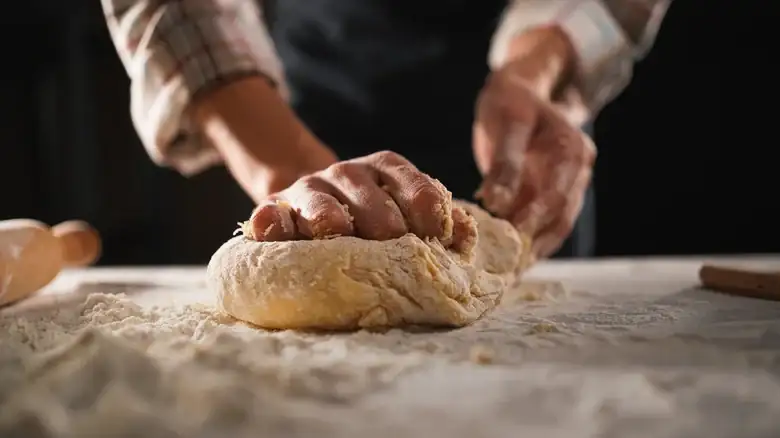
The traditional way to mix pasta dough by hand, which is sometimes called the volcano method for making pasta dough, involves arranging the flour in a well on the work surface and lightly beating the eggs with a fork in the center depression. Sprinkle the salt onto the flour before you add the eggs. Then use the fork to gradually incorporate and mix some of the flour from the well's inner walls into the eggs. The dough will start coming together until it's hard to use the fork. Switch to using your hands then, pressing the dough together and starting to knead it until it forms a rough ball. You can choose to mix the eggs into the flour in a mixing bowl if desired, but it won't save on cleanup. It adds a bowl to wash and you'll need to dirty the work surface anyway to knead the dough. Another benefit of the well method is that all of the flour and eggs won't
Understand why kneading is important
Proper kneading is very important when making pasta dough. It allows the flour and eggs (or flour and water) to mix together evenly. More specifically, kneading allows the proteins in the flour to form bonds, developing the gluten network and making the dough stronger and stretchier. Don't worry about overkneading, which is pretty hard to do by hand. Underkneading, which is more likely, is problematic because if dough that's not strong enough will be difficult to roll out and shape, and the pasta could even fall apart when you boil it. Recipes often recommend anywhere from 8 to 20 minutes of kneading for pasta dough, but 10 to 15 minutes is a good rule of thumb. Knead until the dough is smooth without any splotchy areas of color. It should spring back to its original shape when lightly pressed with a fingertip. Unlike softer pastry dough, kneading pasta d
Correct dough that's too wet or dry
When you start kneading, it's important to assess whether the dough is too wet or too dry and remedy the moisture level in the initial minutes of working the dough. Although weighing ingredients can help the dough turn out better, sometimes making pasta dough is more of an art than a science. Experience is useful in this regard, but there are signs to look out for either way. Dough that's too dry will crumble and not hold together, leaving a lot of small pieces on the work surface. If the dough is dry when you begin kneading it, there may be too much flour for the amount of eggs or water used. If this happens, add a small amount of water, about half a tablespoon, and keep kneading to see if it worked before adding any more. It's easy to overdo it with the water and end up with a slimy mess, so wet your hands with water rather than pouring water onto the dough or use a spray bottle to spr
Don't skip the resting step
Even if you're excited to start rolling out the dough or making pasta shapes right away, or if you're pressed for time, don't skip the resting step when making homemade pasta dough. Resting isn't passive waiting time. While the dough sits, those strong gluten bonds you worked so hard to form when you kneaded the dough will now relax. This is important because if they don't relax, the dough will shrink back up when you try to roll it out, and it will be hard to work. Resting also allows the ingredients to combine even more, resulting in a moister dough. So don't let all your hard work go to waste. Give the dough – and yourself – a well-deserved rest after all that kneading. Keep the dough out at room temperature while it rests. Cold dough will be harder to work with. Make sure to wrap it, or it will quickly dry out. You can wrap it in a damp towel placed under an ove
Store pasta dough properly
Some people get in the habit of making their own dough every week, but most of us aren't making a batch of homemade pasta that frequently. The whole process can be time consuming, so if it's more convenient to make the dough on one day and the pasta on another, that is an option. Just store the dough in the refrigerator for one or two days until you're ready to work it. Keep the dough tightly wrapped when chilling it, just like you would when letting it rest on the counter, or it will lose its much-needed moisture. Don't wait more than two days before using the dough. Fresh pasta dough has a short shelf life and will go bad sooner than cooked leftovers will. It's hard to work cold pasta dough, so bring it up to room temperature before you use it. You can easily warm it up to the right temperature by letting it sit out on the counter for about 60 minutes. Y
Know your options for rolling out pasta dough
Some pasta shapes require special tools, like garganelli, which are made with a grooved wooden board, and maccheroni al ferro, which are rolled on a metal stick. Otherwise, a pasta machine, a simple rolling pin, or just your hands will get the job done. Using a manual pasta machine is a good way to make a variety of basic shapes. You'll start by rolling small pieces through the rollers, starting at the widest setting, which is usually zero, and going as thin as needed. The resulting sheets can be used to make pasta like ravioli and lasagne noodles, or they can be further cut with the machine into long noodles like tagliatelle. More complex machines have attachments that can make hollow shapes like penne and rigatoni at home. Without a pasta machine, just roll the dough into sheets with a rolling pin. Then, instead of cutting noodles by machine, fold each shee
Don't wash your pasta machine
A manual pasta machine is a useful tool for rolling and cutting dough, and a good quality machine will last a long time if you maintain it properly. Making pasta with dirty machines can result in uneven or discolored pasta sheets and it can jam or damage the machine over time. The most important thing to understand is to never wash the machine with soap and water, or even worse, put it in the dishwasher. Make it a habit to clean it after each use, as it will likely get covered with flour and bits of moist dough both inside and out. First wipe down the exterior with a dry or slightly damp cloth, and then immediately dry it. Consult the manufacturer's instructions for how to detach any removable parts, and then wipe them clean. Plastic pieces can be cleaned with soap and water, but dry them completely before replacing them. Brush off as much debris as you can from th