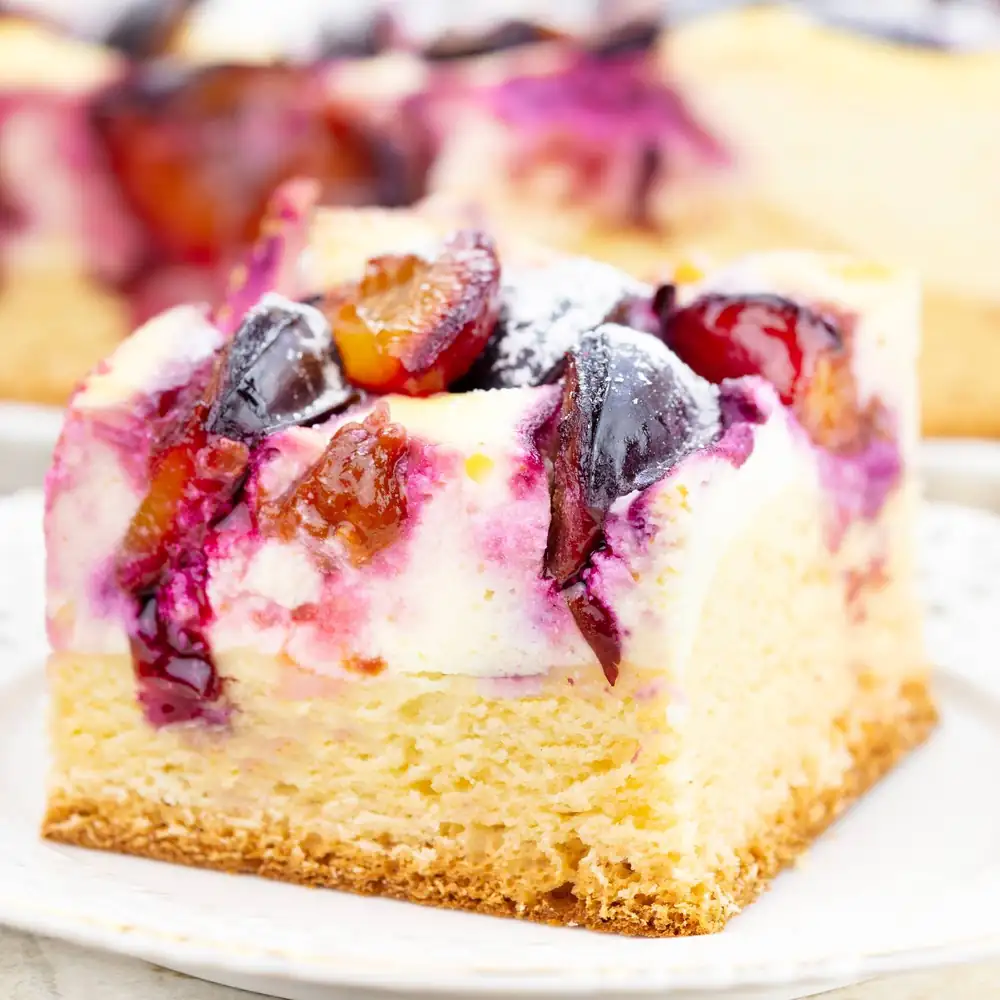
Yeast cake with plums and cheese
This yeast cake with plums and cheese, served in a large baking sheet, is a wonderful, homemade fruit cake. This recipe is perfect for many autumn occasions. It's delicious and stays fresh for a long time.
Preparation time: 45 minutes
Rising time: 1 hour
Baking time: 45 minutes
Number of servings: 25/38 cm form - approx. 3200 g.
In 100 g of cake: Energy value 201 kcal Carbohydrates 29 g - Of which sugars 13 g Protein 9 g Fats 5 g Diet:
low-fat, vegetarian
- all-purpose wheat flour 620 g
- regular or fine sugar 160 g
- milk - not from the fridge 250 ml
- butter - very soft 100 g
- 4 egg yolks
- fresh yeast 40 g
- a large pinch of salt
- semi-fat cottage cheese - you can use a 1 kg bucket
- 2 eggs
- sugar-free cream pudding 1 sachet - approx. 40 g
- fine sugar 100 g
- fresh plums 1 kg
Yeast cake with plums and cottage cheese
My baking tin was 25/38 cm.
Baking: 175 degrees, middle shelf with top/bottom baking option.
Baking time: approximately 45-50 minutes.
Read the entire recipe first, and only then start preparing the dough to know what to prepare when and what other ingredients you can use. You can prepare the cheesecake filling and fruit, for example, while the dough is rising.
In a large bowl, pour 620 grams of all-purpose or cake flour. Add a pinch of salt and 160 grams of caster sugar. Then add 4 egg yolks, 40 grams of fresh yeast crumbled in your hands, and 100 grams of melted and cooled butter (as you can see in the photo, the butter wasn't completely melted, but the pieces were completely soft). Finally, pour in another glass, or 250 ml, of slightly warm milk.
Tip 1: You can substitute 10 grams of dried yeast for fresh yeast. It's best to first add the dried yeast to a glass of milk, then stir it in before pouring it into the bowl with the remaining ingredients.
Tip 2: You can replace cow's milk with a neutral-tasting plant-based milk. Instead of butter, you can use a plant-based cube like Kasia, in the same quantity.
Tip 3: You can replace some of the regular sugar with vanilla sugar, for example, add 120 g of fine sugar and one large sachet of vanilla sugar weighing about 40-43 grams.
Transfer the bowl with the dough to a stand mixer fitted with a dough hook. Knead the dough for at least 5 minutes. You can also knead the dough by hand.
After kneading, the dough should be slightly sticky and looser. It will still stick to the sides of the bowl. Don't worry about this, though. Leave the dough in the bowl. Cover it with a cotton cloth or clear plastic wrap. Set aside to rise for at least one hour. Choose a warm, draft-free place. After an hour, the dough should have risen nicely. If your dough hasn't risen as well, extend the rise time. In hot weather, an hour is sufficient, but on cooler days, this time can extend to up to two hours.
The photo below shows the dough before and after rising.
Start preheating the oven. Set it to 175 degrees Celsius with the top/bottom baking option. Preheat the oven with a rack or a large, thinner baking tray. Place the rack or tray on a shelf slightly lower than the middle shelf. Place the baking pan on this preheated rack/drawer.
Prepare a large baking pan, approximately 25x38 cm. Line the pan with baking paper. You can also line the sides with taller strips of parchment paper or simply grease them with soft butter. Fill the entire bottom of the pan with the risen yeast dough. Try to even out the surface as much as possible. Set the pan aside while you prepare the cheese mixture and plums.
In a large bowl, place 1 kg of semi-fat cottage cheese, preferably cream or classic, in cubes. A whole bucket of high-quality cheesecake cottage cheese will also work well. Beat in 2 eggs. Add a sachet of vanilla or cream-flavored custard powder and 100 grams of caster sugar. Thoroughly mash all ingredients with a fork or blender. The cottage cheese doesn't have to be perfectly smooth.
Tip: You can always replace some of the caster sugar with vanilla sugar, and the custard powder with 40 grams of potato starch.
Spoon by spoonful of the cheese mixture onto the yeast dough, then carefully level the surface.
- Wash 1 kg of fresh, firm, healthy plums, dry them, divide them into two halves, remove the pits, and press the plum halves into the cheese mixture in various places.
Tip: You can also use frozen fruit, but first defrost it, dry it well and warm it to room temperature. If it is too wet, gently mix it with a bit of potato starch or a dry jelly from a sachet, e.g. any "sweet moment".
Place the cake pan in an oven preheated to 175 degrees Celsius (top/bottom heat). Select the middle rack. Bake the cake for about 45-50 minutes (shorter or longer). After about 40 minutes of baking, check if the cake is done (somewhere on the side of the cake) with a wooden skewer. If the skewer comes out clean, you can safely turn off the oven. Don't worry about the cake not being baked through, and try not to overbake. Baking the cake too long can dry out and lose its moistness. After baking, slightly open the oven door. After 10 minutes, open the door and remove the cake from the oven. Remove the sides and transfer the cake to a wire rack to cool.
Tip 1: Place the baking pan on a preheated, thin baking tray or rack. The tray or rack should be positioned so that the baking pan is roughly centered in the oven (not too close to the upper and lower heating elements).
Tip 2: Because the cake contains a lot of fruit and cheese, check for doneness with a skewer not in the center, but closer to the edges of the cake, pointing the skewer diagonally toward the center. If it doesn't work, just look at it. The cake should rise/rise noticeably.
This yeast-raised plum cake stays fresh for a very long time. After cooling, I recommend dusting it with powdered sugar, loosely wrapping it in parchment paper, and then placing it in a clear grocery bag or a ziplock bag. Store the cake in the refrigerator until the next day. If you plan to eat it later, store it in the same wrapping in the refrigerator for up to 5 days.
Enjoy your meal!