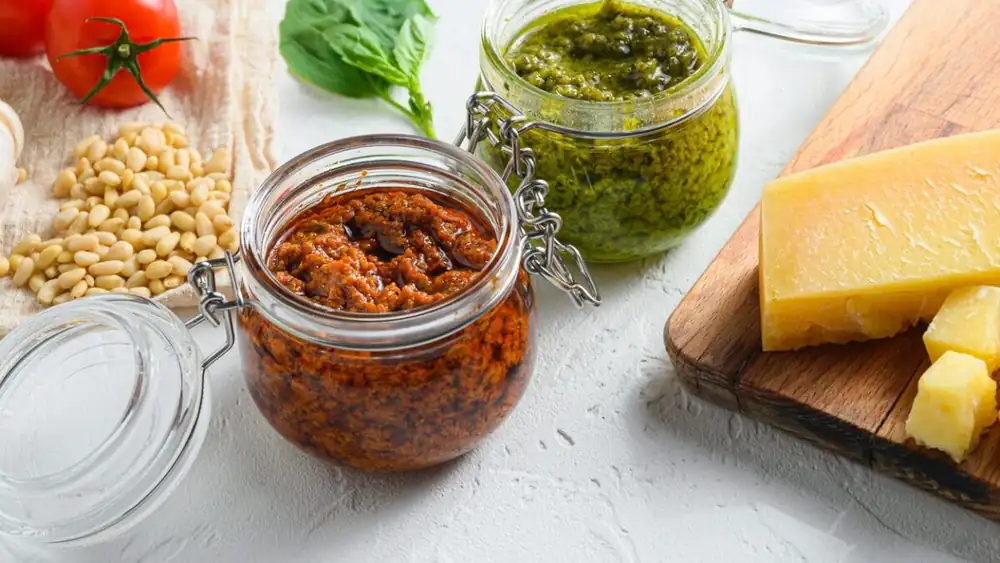
How to recover a sauce that is too liquid or too thick
A staple of Italian cuisine, pesto sauces are one of the oldest condiments in history.
Muddled sauces generally consist of just a few ingredients and are fairly simple to prepare, but be careful not to confuse "simple" with "easy": it doesn't take much for the consistency to be off the mark, becoming either too runny or too thick. Does this mean you have to throw it away and start over? No, waste is best avoided in the kitchen whenever possible. The solution to reusing mulled sauce is often right there, right among the recipe's ingredients: you just need to understand how to intervene and, above all, when to stop, because the secret to this sauce, and its reuse, is finding (or rediscovering) the right balance. Here are the most common mistakes in making mulled sauce and how to reuse it, should you make a mistake, without compromising its flavor, aroma, and characteristics.
Why can a pounded sauce be too runny or too thick?
The most common mistakes you can make when making a muddled sauce are getting the ingredients in the wrong balance, resulting in a sauce that's either too thin or too thick. It's not just the amount of liquid added that determines its thickness: it also depends on how much water the fresh ingredients contain, how much oil is incorporated, the amount of solids, and, most importantly, how they're muddled or blended.
When a sauce is too thin, the first suspicion naturally falls on excess oil or another liquid. This assumption is often correct, but it's not always sufficient to explain the result. Ingredients like basil, parsley, tomatoes, zucchini, or other vegetables can contribute a significant amount of their own water. Even fresh cheese, very ripe fruit, or an ingredient previously washed and not dried thoroughly can significantly alter the ratio between solids and liquids. A recipe can therefore have the same quantities on paper and still produce a thinner sauce, simply because the original ingredients contain more water.
A second key factor is the ratio of solid to liquid ingredients. Nuts, aged cheeses, bread, dry vegetables, seeds, and other structural ingredients contribute to the sauce's body. Oil, water, or other liquids, on the other hand, increase its flow. But this isn't a purely mathematical ratio: some solids are able to absorb or retain liquid much more than others. Finely ground nuts, for example, can incorporate a considerable amount of oil and help create a creamy consistency; very watery vegetables will behave differently. Grain size also plays a decisive role. The finer the ingredients are reduced to particles, the greater the surface area available to interact with the oil or water. A coarsely ground sauce can appear more rustic and consistent, while a very prolonged process tends to produce a more uniform and creamy texture.
The opposite problem, that is, a sauce that's too thick, generally arises when the amount of solids is too high compared to the liquid phase, or when these ingredients absorb more liquid than expected. This can happen, for example, by increasing the amount of nuts or cheese to achieve a more intense flavor without adjusting the amount of oil accordingly. The same phenomenon occurs when using particularly dry ingredients or when a sauce is left to steep too long: over time, the solid particles can continue to bind some of the available water or oil, and the sauce can become more compact. Then there's an often overlooked aspect: temperature. Oil and other fats change viscosity as a function of temperature, and some ingredients, especially those rich in starch or protein, can change their behavior when heated or cooled. A sauce that seems to have the ideal consistency when freshly prepared may therefore appear different after a few minutes in the refrigerator or, conversely, after being brought to room temperature.
The way the sauce is prepared also plays a role, as it's essential for achieving the right consistency. The order in which the ingredients are added can also have an effect: working the solids first and gradually adding the liquid generally allows for better control over the final consistency than pouring everything in at once. Once the cause has been identified, the most important rule is to avoid drastic adjustments: the adjustment must be gradual, tasting and evaluating the consistency after each addition.
How to thicken a too runny pounded sauce
The easiest situation to manage is a pounded sauce that's too runny: it's easy to thicken it; you just need to rebalance the recipe's solid components. It's essential to do this gradually, however, to avoid overdoing the additions and ending up with the opposite problem: a sauce that's too runny. That said, here are the main remedies for thickening a pounded sauce that's too runny.
1. Let the sauce rest
It seems like the most obvious solution, but in some cases, it's all you need: sometimes a freshly prepared sauce seems thinner than it actually is. Solid ingredients may need a few minutes to absorb some of the oil or water and stabilize their structure. A short rest allows you to assess the actual consistency before adding anything else. This is particularly useful when the sauce is only slightly thinner than expected. After resting, you can stir it again and only then decide whether or not it's necessary to add another ingredient.
2. Add dried fruit
In crushed sauces made with basil, herbs, or vegetables, dried fruit is one of the most natural remedies for restoring an excessively runny consistency. Pine nuts, walnuts, almonds, or other nuts called for in the recipe can be crushed or finely chopped and incorporated little by little. In addition to increasing the solid content, they absorb part of the liquid phase and help make the sauce creamier. Start by adding a teaspoon of the chosen dried fruit, blend the mixture again, and check the consistency before adding more.
3. Increase the amount of cheese
When the recipe calls for grated aged cheese, such as Parmesan or Pecorino, a small addition can be enough to give more structure to a too-thin sauce. Cheese adds solidity and, especially when finely grated, easily distributes throughout the sauce. Here, too, it's crucial to proceed gradually. Cheese not only changes the consistency, but also the flavor and aromatic intensity. Therefore, before adding more, it's a good idea to taste the sauce to avoid simultaneously correcting a density problem and creating an issue of excessive saltiness.
4. Incorporate a solid part of the recipe
It's not always necessary to add an additional ingredient. If the sauce contains vegetables, herbs, or other solid ingredients that have been used in small quantities, you can increase that ingredient (as in the case of the dried fruit we just mentioned). This is the most respectful method of maintaining the original balance, because it strengthens the existing flavor profile rather than introducing foreign flavors. The solids should preferably be added already thoroughly dried and blended until the desired grain size is achieved. This increases the thickness without making the sauce simply fattier or flourier.
5. Use breadcrumbs or bread, when the recipe allows it
In some traditional recipes, such as Piedmontese green sauce (Bagnet verd) or walnut sauce, breadcrumbs are used to thicken the sauce. Their porous structure absorbs some of the liquid and quickly thickens the sauce. If the sauce is too thin, you can add a little breadcrumbs, but you should incorporate them in very small amounts and let them absorb the liquid before deciding whether to add more.
6. Add a small amount of dehydrated ingredient
If the recipe calls for a dehydrated ingredient, such as sun-dried tomatoes, slightly increasing the amount can help to restore a thin sauce. The benefit is twofold: it absorbs some of the excess liquid and maintains the recipe's aromatic flavor. However, it's important to keep in mind that dehydrated ingredients often have a very concentrated flavor, so even small amounts can significantly alter the final result.
How to thin out a thick mashed sauce
The problem of a thickened sauce is more delicate: it takes very little to overdo it, making it too runny, and even altering the flavor. In this case, even more so, the advice is to proceed gradually, tasting after each small addition to assess the consistency and flavor of the sauce. Remember that, after each small addition, it's helpful to let the sauce rest for a few moments before deciding whether to make further adjustments: solid ingredients, especially those containing nuts, cheese, or other absorbent ingredients, can gradually absorb the liquid.
1. Gradually add the oil
Oil is the first ingredient to use to correct an overly thick consistency. Oil increases fluidity while simultaneously preserving the fat and flavor of the sauce. It's important to add it in small doses, stirring or muddling after each addition. Adding too much at once can make the sauce greasy and cause the liquid to separate from the solids, rather than achieving a creamy, smooth consistency. It also risks altering the sauce's flavor. The amount needed also depends on how finely the solid ingredients have been blended and their ability to absorb oil.
2. Use the pasta cooking water (only when seasoning)
If the sauce is intended for a pasta dish, a drop of the pasta cooking water is very useful for making it more fluid and creamy: the starch in the water helps bind the fat to the pasta. However, be careful: the cooking water should only be added when tossing the pasta in the bowl, and never directly into the container or jar where you store the sauce. Adding free water to the sauce beforehand will jeopardize its shelf life in the refrigerator, accelerating bacterial growth and causing the oil to separate from the other ingredients.
3. Work the sauce again
A sauce that's too thick isn't necessarily lacking in liquid: sometimes it's simply been processed to a very compact consistency. Before adding more liquid, try stirring, muddling, or blending again to evenly distribute the liquid ingredients already present: this can help redistribute the liquid among the solid particles and achieve the sauce's characteristic consistency.
Muddled Sauce: Mistakes to Avoid
Whether your sauce is too thick or too thin, there are some mistakes to avoid to save your sauce from being thrown away. We've said it before, but it bears repeating: the most common mistake when trying to salvage a sauce is using too much of a corrective ingredient. Adding a lot of oil to a sauce that's too thick or a lot of dried fruit to a sauce that's too thin may seem like the quickest way to achieve the desired result, but it makes it difficult to control the final result. Instead, the consistency should be adjusted in small increments.
Remember that after each addition, the sauce must be muddled again to fully incorporate the corrective ingredient and decide whether to add more. Above all, let it rest for a bit before tasting. The consistency observed immediately after processing is not always the final one, so when the difference from the desired consistency is minimal, it's best to wait a few minutes before proceeding. After the required number of minutes, don't make any further additions without tasting the mixture: increasing the amount of certain ingredients will also alter the flavor of the recipe. The most reliable rule is always to proceed in small steps: add a small amount of the ingredient, mix, let it rest, taste, and only then, if the result is still not satisfactory, proceed with another small addition.
Another common mistake is adding extraneous ingredients to a recipe to try to salvage it. In the case of crushed sauces, this can be a real disaster: to correct the consistency, it's best to use ingredients already present in the recipe. If a sauce calls for oil, add more; if it contains nuts, slightly increase the amount; if it's for pasta, the liquid provided for stirring may be helpful. Adding an extraneous ingredient simply to achieve a certain consistency can solve the structural problem, but if it's not balanced, it can also alter the flavor, aroma, color, and identity of the sauce, ruining the balance between its defining ingredients.