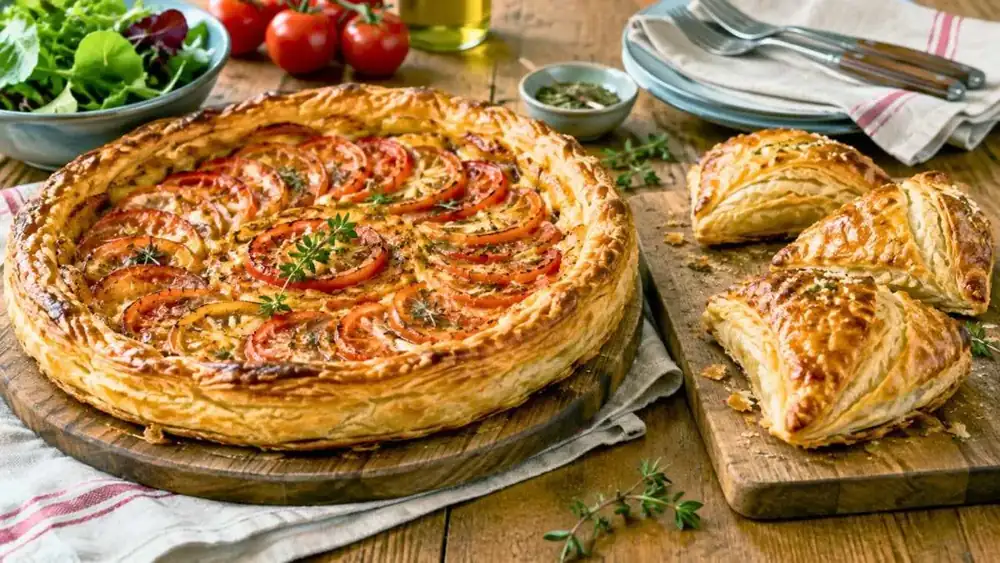
This homemade puff pastry relies on cold temperatures and patience to reveal an irresistible crispness
Making homemade puff pastry often seems more complicated than it really is.
- 250 g of wheat flour
- 125g of very cold water
- 5 g of fine salt
- 200g of cold butter, preferably a butter suitable for puff pastry or rich in fat
- Prepare the puff pastry step by step without unnecessarily complicating the rolling process.
- The principle may seem technical, but the method relies primarily on a series of simple steps. You prepare the dough, enclose the butter, then roll it out and fold it over several times. Between these steps, chilling the dough keeps the butter firm and relaxes it, making the process much easier.
- Mix the flour and salt in a bowl, then gradually pour in fresh water until you obtain a smooth, supple and non-sticky dough.
- Form a slightly flattened ball, wrap it carefully and let it rest for 30 minutes in the refrigerator so that it relaxes before rolling.
- Flatten the cold butter between two sheets of baking paper with a rolling pin to obtain a regular square, flexible enough to bend slightly without breaking.
- Roll out the dough into a square larger than the butter, place the butter in the center and then fold over the four sides to completely enclose it.
- Gently roll out the dough into a rectangle, then fold the bottom third towards the center and the top third over it, like a letter. Rotate the dough a quarter turn.
- Repeat the rolling and folding process, then chill the dough for 30 minutes. Perform two more sets of turns in the same way, chilling the dough as soon as it becomes too soft.
- Let the finished dough rest for at least an hour in the refrigerator before rolling it out and using it for a tart, turnovers, palmiers or other puff pastry preparations.
Why cold transforms a few ordinary ingredients into a spectacular puff pastry
The secret to puff pastry lies almost in a simple scientific experiment. A thin layer of butter is placed between two layers of dough. In the oven, the water it contains produces steam. This steam pushes the dough and helps form those delicate, airy layers.
Everything hinges on what happens before baking. If the butter becomes too soft, it mixes with the dough instead of remaining in separate layers. That's why the refrigerator becomes a real ally: it allows you to work calmly, without constantly worrying about a dough that sticks or shrinks.
Four ingredients are all you need to prepare a generous and buttery puff pastry
This recipe deliberately goes back to basics. Wheat flour, fresh water, salt, and good butter are all you need to make a versatile dough. The butter should remain cold but soft enough to be flattened without breaking: this texture makes folding much easier and results in a more even layering.
A few simple tips to vary the uses without compromising the crispness of the puff pastry.
Once the homemade puff pastry is ready, it can serve as the base for many recipes, both savory and sweet. A few adjustments can also help to better adapt it to the chosen filling. The key is to keep the pastry cold, limit moisture, and avoid making the layers too heavy before baking.
- Add a thin layer of almond powder under very juicy fruits to absorb some of their juice.
- Sprinkle a little sugar on the dough before baking to prepare palmiers, twists or caramelized puff pastries.
- Sprinkle with grated cheese, seeds or some dried herbs to transform leftover dough into appetizer bites.
- Use a well-chilled filling to prevent it from warming the butter before baking.
- Keep the leftover dough in the fridge and layer it gently rather than kneading it, in order to preserve its flaky structure as much as possible.
The little things that really make a difference when the dough finally reaches the oven
Before baking, a final chill in the refrigerator helps the layers retain their structure. A very cold dough in a preheated oven promotes a more defined rise. It's also important to avoid flattening the edges after cutting, as this will cause the future crispy layers to stick together.
The beautiful golden color is an excellent indicator. A pale pastry risks being undercooked and remaining moist in the center. When it becomes a deep golden brown, light and crumbly, with clearly visible layers on the sides, the desired result is achieved: crispy on the outside, delicately buttery on the inside.