The Battle for the Bowl Heats Up in QSR
Bowls have long been associated with health and nutrition, but the format now stretches far beyond its wellness-niche roots.
“Flavor and texture have become more of what I think the up-and-coming generations really look at when they’re looking at products,”
That shift shows up in consumer demand for portability, customization, recognizable ingredients, functional benefits, and food that still feels satisfying. For brands in the space, the opportunity is less about selling one definition of “healthy” than giving guests a flexible meal that fits their particular needs.
An All-Day Occasion
Juice It Up! has been selling acai bowls for more than two decades, back when the ingredient was unfamiliar enough that franchisees had to be taught how to pronounce it, says president and CEO Susan Taylor.
The Southern California-based chain has watched the product move from a relatively small menu category into a much more central part of its business. Bowls historically have accounted for about 15 percent of the brand’s mix. Today, they are nearing 24 percent, Taylor says, with bowl mix up nearly 20 percent year over year.
“It used to be something you’d see on the West Coast or Hawaii or in Florida,” Taylor says. “And then it’s just grown across the country.”
Greater familiarity has helped. So has social media, which has made colorful, layered bowls more visible to younger consumers willing to explore new flavors and ingredients. But Taylor says the more meaningful shift is in how people are using bowls: not just as an occasional better-for-you treat, but as a meal that can fit throughout the day.
Juice It Up! tracks four dayparts—breakfast, lunch, afternoon, and dinner—and Taylor says bowl sales have grown significantly in the morning and evening over the past two years. Some locations near gyms, for example, are seeing guests come in after workouts for a bowl.
“It has legs to meet people where they’re at in how they want to eat during the day,” she says.
The brand has responded by adding more options beyond a basic acai or dragon fruit base. Guests can choose from flavors such as coconut passion fruit and seasonal mango, layer in chia pudding or protein-infused yogurt, and build their own combinations. Texture, variety, and personalization are becoming bigger parts of the occasion.
“Flavor and texture have become more of what I think the up-and-coming generations really look at when they’re looking at products,” Taylor says.
The idea is to let bowls serve different needs—breakfast, an afternoon break, a meal replacement, or a way to add protein and fiber—without making guests choose between function and enjoyment.
A Growing Category Gets More Competitive
At Playa Bowls, the growth of the category has created a more segmented and competitive landscape.
CMO Tim Hackbardt sees three broad buckets: classic acai shops, often independents or smaller chains; large smoothie brands that have added acai bowls; and bowl-first concepts like Playa, where smoothies are a secondary part of the business.
“It’s been a very fast-growing category, at least for the past three years,” he says. “We’ve more than doubled in size ourselves.”
That growth is likely to bring more competition, he adds, and eventually some separation between the brands that have a clear point of view and those that do not. Hackbardt expects the category to see some attrition over the next few years as the segment stabilizes around a core group of winners.
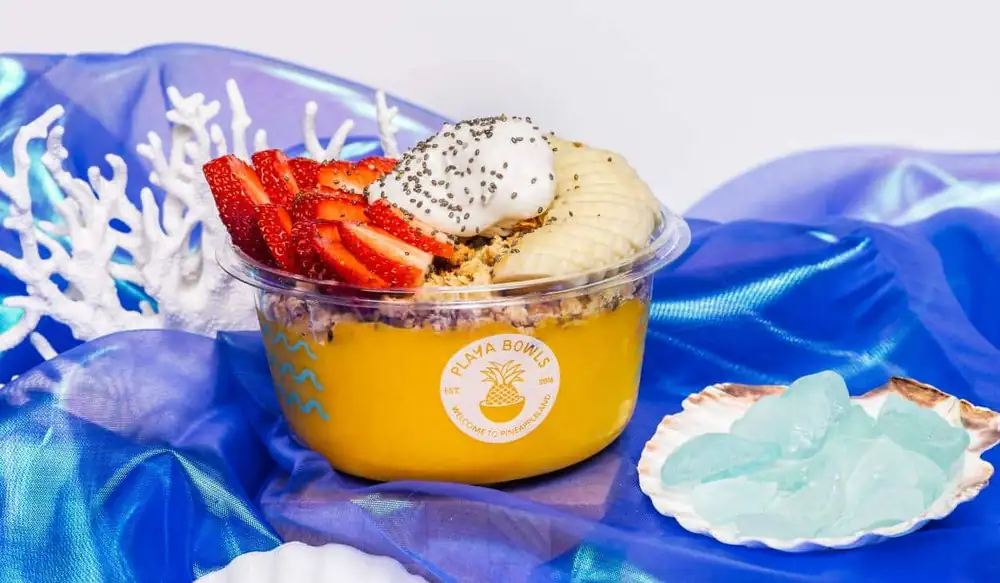
For Playa, standing out means building bowls around four things: taste, a “beneficial” ingredient story, visual appeal, and operational feasibility. The brand’s Mermaid Season promotion was designed with all four in mind. Its Mermaid Mood Bowl combined pitaya with blue spirulina for a bright purple swirl, then layered in strawberries, granola, pineapple, coconut flakes, and a Nutella-filled seashell topper. Other items in the promotion included collagen peptides and blue spirulina.
The idea is not to strip out every indulgent element. Instead, Playa aims to give most menu items a health-forward foundation while still creating food that feels fun and craveable.
“We think that almost every product that we’re creating in our menu strategy should have a beneficial story to it,” Hackbardt says. “It doesn’t mean you can’t have something like Nutella on there that’s a little indulgent.”
Customization remains part of the appeal, but it is not necessarily what drives the majority of orders. Playa offers build-your-own bowls, including the option to combine two bases, but most guests choose a signature recipe and may make smaller modifications from there.
Looking ahead, Hackbardt expects protein to remain an important conversation, alongside fiber, portion size, and calories. But the challenge will be pursuing those trends without chasing novelty for novelty’s sake—or creating menu items that cannot be executed consistently across the system.
“We want to be on the leading edge of flavor and beneficial ingredients,” he says. “Not necessarily bleeding edge, but leading edge.”
Keeping Health Simple
On the savory salad and grain bowl front, Farmside Kitchen is taking a deliberately more familiar approach to wellness. CEO and cofounder Meg Schiffman is bullish on the category, particularly in the suburban North Carolina and Virginia trade areas where the young chain operates. Demand has not eased for the brand’s mix of greens, grains, roasted vegetables, proteins, and house-made dressings amid a challenging consumer environment lately.
Schiffman sees a larger shift at work: Health-conscious eating is becoming more mainstream, and consumers are more informed about what is in their food. They are reading labels, paying attention to processing, and looking for meals that make them feel better.
But Farmside is not trying to build its menu around every emerging ingredient or wellness claim. Its approach is rooted in recognizable foods and familiar flavors—meals guests could make at home if they had the time, energy, and ingredients.
“For us, it’s all about creating and bringing to the guests simple flavors that you can eat and feel really good about,” Schiffman says.
That does not mean the menu lacks personality. Farmside’s consistent top seller is the Rancher, a Southwest-inspired bowl with greens, grains, chicken, avocado, corn, kale, and blue corn chips. Build-your-own bowls are the second-most-popular choice.
The chain is also testing a Carolina Bowl, built around chicken, corn, pickled jalapenos, gluten-free cornbread croutons, a tangy barbecue drizzle, and ranch. It is an example of how Farmside thinks about innovation: familiar, Americana-forward flavors, but delivered through high-quality ingredients, texture, and a substantial bowl format.
As wellness messaging becomes more crowded—with consumers hearing constantly about protein, fiber, supplements, and specialized diets—Schiffman sees value in keeping the proposition straightforward.
“Healthy has this wider definition,” she says. “It’s not just low calorie. It’s not just low whatever. The cleanliness and straightforwardness of the ingredients, and the fact that you’re getting your protein, your fiber, your healthy fats—those are all coming together in every bowl.”
That may be the bigger takeaway for the broader healthy bowl space, she adds. Whether it is a layered acai bowl, a blue-spirulina promotion, or a Carolina barbecue-inspired grain bowl, the brands finding traction are giving guests more than a health claim. They are offering an easy, satisfying meal that can work on an individual guest’s terms.