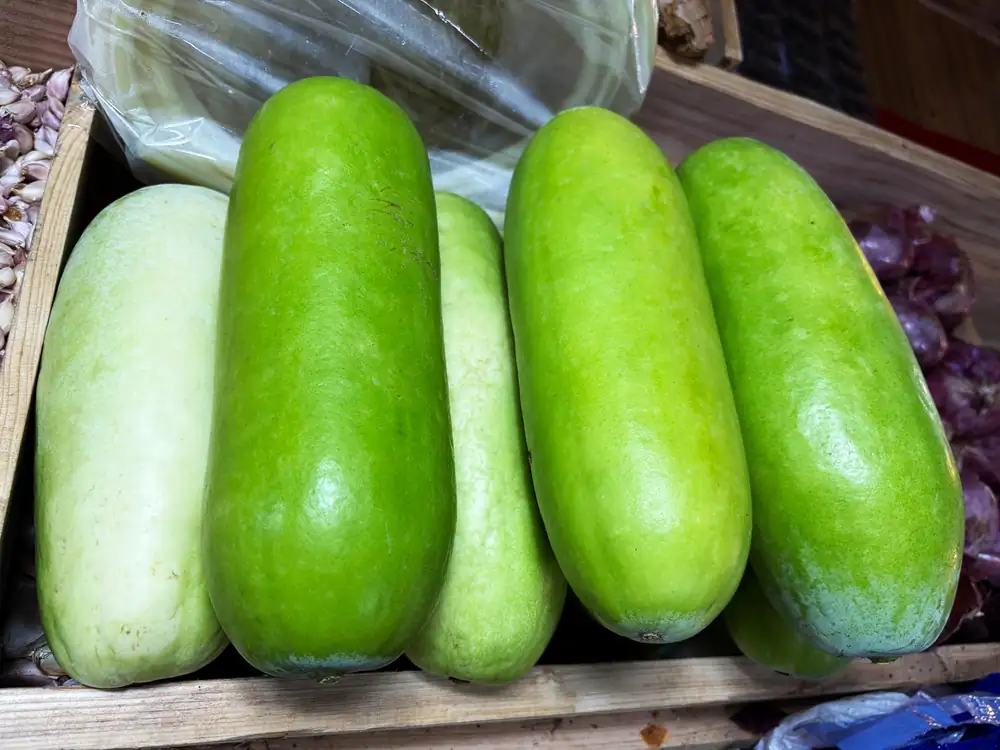
This enormous 'melon' does not taste sweet: this is what you can make with winter melon
Anyone who thinks of winter melon as an extra sweet fruit that you spoon out of the fridge in January is quite wrong.
And we haven't even talked about the size yet. A fully grown winter melon can become enormous. That is why you often don't even see it lying whole in Asian supermarkets, but in large slices wrapped in plastic.
What is a winter melon?
Winter melon is a fruit belonging to the cucumber family that is widely used in Chinese, Indian, and Southeast Asian cuisine, among others.
A ripe winter melon has a thick green rind covered with a white, waxy layer. That is also where the English name 'wax gourd' comes from.
That layer likely also plays a role in the name winter melon. The fruits are grown during warm months, but thanks to the sturdy rind and wax coating, they have a long shelf life. As a result, they could formerly be stored for months and eaten throughout the winter. Therefore, the winter melon is actually not a typical winter vegetable at all.
What does winter melon taste like?
Above all, do not expect a sweet taste from the honeydew melon. Raw, the white flesh is firm, juicy, and very mild. The taste is somewhere between cucumber and zucchini, but even more neutral. That might not sound immediately spectacular, but that is precisely why it is so popular.
During cooking, the flesh becomes soft and translucent. At the same time, it absorbs flavors from broth, herbs, and sauces incredibly easily. Think of it a bit like a culinary sponge.
As a result, winter melon is suitable for dishes where the broth actually plays the leading role, and you will find it in various Chinese baked goods.
What can you make with it?
The most classic application is soup. In Chinese cuisine, for example, winter melon is gently simmered in broth with ingredients such as pork, dried scallops, ginger, or spring onion. As the cubes cook, they absorb the flavor of the broth and develop a soft, almost velvety texture.
But it doesn't have to stop there. You can also stew, steam, or briefly stir-fry winter melon. For example, it works well in curries and dishes with a rich sauce, precisely because the fruit itself imposes so little flavor.
And then there is the sweet side. Winter melon is also candied and incorporated into pastries. For instance, it can be part of the filling of Chinese wife cakes, or lao po bing. In India, the fruit is used for petha, a translucent sweet confectionery.
Pretty versatile for something that at first glance looks mostly like a giant pale zucchini, right?
How do you clean a winter melon?
If you buy a piece of winter melon, the thick green rind must be removed first. Then, cut away the soft, spongy center with the seeds. What remains is the firm white flesh.
You can then cut it into blocks or slices. For soup, let the pieces cook gently until they are soft and slightly translucent. Depending on the size, this takes roughly ten to thirty minutes.
Did you only use part of it? You can store a cut winter melon wrapped in the refrigerator, but preferably use it within a few days. A whole, undamaged winter melon, on the other hand, keeps remarkably long.
Where do you buy winter melon?
You won't easily come across it in an average Dutch supermarket. You have a better chance at larger Asian supermarkets and Asian grocery stores.
And above all, don't be put off by the fact that it seems to have hardly any taste. You don't buy winter melon because it is so distinctive on its own, but precisely because of what it does to other flavors. Pour in a good broth, let it simmer gently, and suddenly you understand why this enormous, pale fruit has been used in so many Asian kitchens for generations.