Primary school children grind flour: Donated mills put an end to waiting times
Third-grade students from Langwedel and Etelsen visited the "Jan Wind" mill and ground grain into flour themselves. They were allowed to take the result home in small bags.
Etelsen – “They’re often a bit wound up,” says Katrin Zubrägel. “Right at the beginning, during threshing.” The chairwoman of the Etelsen village association is once again hosting the third-grade classes from the elementary schools in Langwedel and Etelsen. But not in her capacity as chairwoman, but as a trained and certified volunteer miller. Six classes in total are coming, two each morning. One after the other, of course.
This time, Katrin Zubrägel has the support of her son Linus (19). A mill rally like this is quite an undertaking. The miller and her predecessors have never settled for a simple tour around the mill. Here, history and traditional crafts are not only something to look at, but also something to touch and try out. That's how children learn best. The boys and girls aren't at "Jan Wind" just for fun, even if it might seem that way to them.
"From Grain to Bread" is a topic in the third grade. It's as meaningful as it is traditional. So, for everyone, it starts with threshing, then the grain goes into the mill and is ground. But: Pay attention! The inside of "Jan Wind" is not a playground. Katrin Zubrägel explains how the mill works, then two children at a time are allowed to watch the grinding process up top with Linus. "The grains slide down there, and it's ground down there," explains a third grader. The young boy has been paying attention.
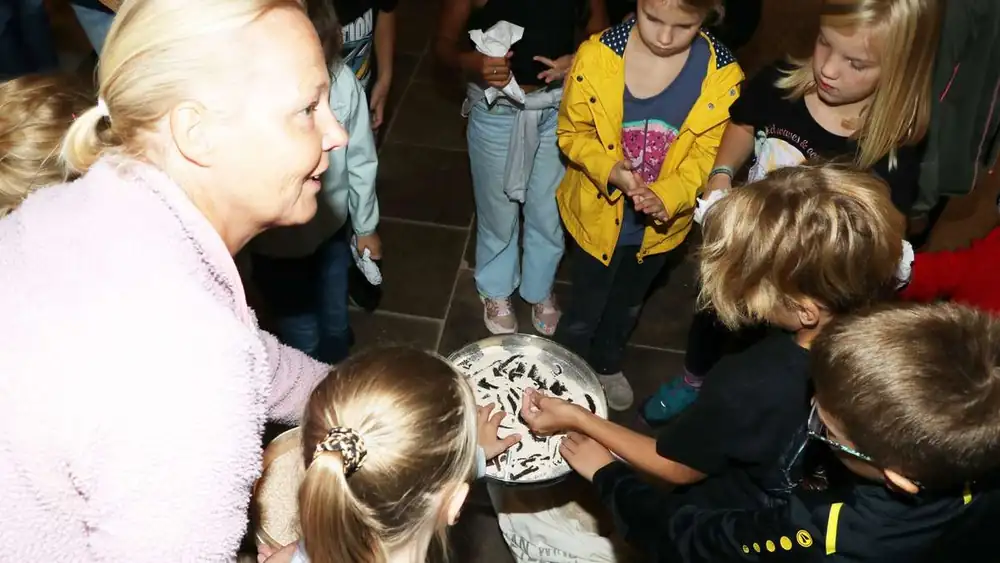
One floor down, at Katrin Zubrägel's mill, the milled grain trickles into a large sack. "Who wants to touch it?" asks the miller. The girls look at it suspiciously at first. Then they reach into the sack. Their eyes widen. "Wow! My hands are covered in flour!" "Shall we see how much flour we have already?" asks the miller. Of course! It's sifted, the fine white flour lands on a tray – and enthusiastic children draw patterns in it with their fingers.
Outside, the boys and girls can try their hand at milling again. They get to grind grain and take the flour home in small bags. The days of queuing at the two hand mills on the mill are over. Katrin Zubrägel received 14 or 15 old coffee mills as donations for the village association and the children after an appeal. "The response to the appeal was fantastic," says a grateful miller. Thanks to the new equipment, there's no longer any waiting time for the children at this station.
So: grain in and let's get to work. "Wow. This is really heavy!" Several quickly realize that it's easier if one person holds the hand mill while the other turns it. Katrin Zubrägel calls milling "hard work." And rightly so. "Let's take a look." The small box contains grist and flour. "Can we take this?" "Really?" "Yes, here in this little bag." So, in it goes, and then back to work with enthusiasm. There's still more to be done.