The cookbook thief
The stall has no sign.
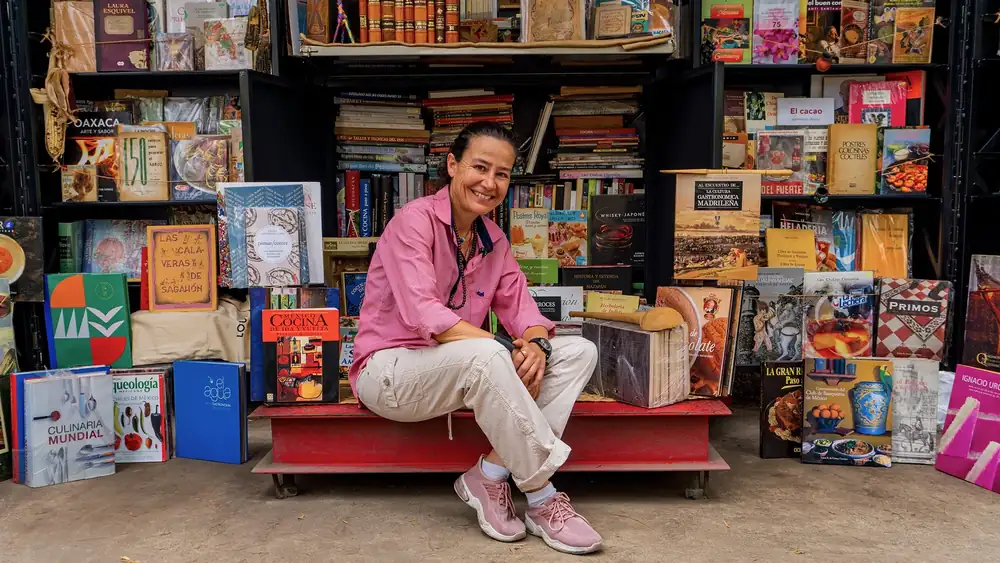
The stall has no sign. It's in the Plazuela de Balderas, amidst the noise of the avenue and the indifference of passersby. On the table, piled up with a logic only she understands, are cookbooks: treatises on French techniques, regional recipe books, pastry manuals, volumes on pre-Hispanic cuisine. And among them, always, one that isn't for sale. One that arrived and never left.
Adanari doesn't cook. She says so without apology. But she knows more about Mexican cuisine than most of those who write about it, criticize it, or cook it in Michelin-starred restaurants. What she does, with a precision no one formally taught her, is something else entirely: she decides which books circulate. Which ones reach the hands of a first-year student, which ones reach a chef searching for something they can't name, and which ones she keeps because she can't let go of them.
That last part —the confession about the books he steals— is the heart of this text.
The criterion before the customer
Before anyone even approaches her, Adanari has already made up her mind. She doesn't accept everything that's brought to her. The process is simple yet strict: if a book arrives damaged, scratched, or incomplete, it doesn't make it onto the stand. It doesn't matter how easy it would be to sell or at what price. "No matter how beautiful it is, and even if I'm sure I'll sell it today, if it's in really bad shape, I won't take it." That filter—almost editorial, almost moral—defines what she offers.
Her specialization in cookbooks wasn't a market-driven decision. It was accumulation: flea markets, libraries in the process of being dismantled, suppliers who, over time, learned to deliver their stock directly to her. "Now I don't go out looking for the material anymore, now they bring it to me." What began as a search became an authority.
The people who come to her stall aren't all the same. There are those looking for something specific—an author, a region, a technique—and those who don't know what they're looking for until they see it. There are chefs who buy in silence, without introducing themselves. There are students who ask why such a thin book can cost so much. And there are those who arrive with manuscripts: inherited recipe notebooks, scribbles in the margins, loose sheets of paper between pages that should be blank.
One of those notebooks—from the early 20th century, belonging to a cook from Tehuacán, Puebla—arrived with two loose sheets: one a recipe for tamales, the other for chiles en nogada. And a dedication. The original post office letterhead was still there. “She sent it to someone, I suppose another girl, so she could continue it.” Adanari sold it, but not before understanding what she had: not a recipe book, but an interrupted chain of transmission. A manuscript, she says, is like Tita’s in 'Like Water for Chocolate': each loose sheet that appears between its pages comes from another hand, another generation, another kitchen.
The thief
And then comes the question. Not as an accusation, but as an insinuation: Are there any books you can't sell? What's the last one you stole?
Adanari doesn't deny the verb. She embraces it, adjusts it, explains it. There's a book on the table right now, one that's taken its place and isn't going anywhere. It's a text about Mexican cuisine. She doesn't sell it—or she doesn't sell it if she only has that one copy—because the subject is personal to her, because there are still people who doubt that Mexican cuisine deserves first place on any list, even those for culinary school curricula. "The Ministry of Public Education has it as a last resort. First Italian, then Spanish, and then Mexican. I feel that's a terrible mistake."
That book stays. Not out of greed. Out of emotional necessity, out of conviction, for the same reason Markus Zusak gives Liesel Meminger for stealing words in times of war: because some books are too urgent to let go of.
The essential and the overrated
Adanari has no trouble expressing her opinion. When asked about the essential Mexican cookbook that no one seems to know, she doesn't hesitate: the work of Josefina Velázquez de León. A pioneer. She had her school on Bucareli Street. She developed collections that today fetch between six and seven thousand Mexican pesos. "Very few people have that kind of reference point."
And the most overrated? Josefina herself, she says, with a smile that's not a contradiction but a subtle nuance. Her editions are small, her current prices baffle anyone who doesn't understand why. Only those belonging to a very small circle pay for it and appreciate it without overvaluing it. The difference between knowing and revering.
She also mentions Clementina Díaz y de Ovando—a master cook who cooks up the history of Independence from the perspective of its protagonists, seating her characters at banquets with Porfirio Díaz—and Guadalupe Pérez San Vicente, who spent her life transcribing manuscripts so that others could prepare recipes that would otherwise have been lost on paper. And there's a book she fervently recommends: *Presencia de la comida prehispánica* (Presence of Pre-Hispanic Food) by Teresa Castelló Yturbide. No recipes, just photographs. Everything that was eaten in ancient Mexico. "And as proof of that," she says, "you walk into the first door of La Merced market and you'll find exactly that."
The ego that won't allow it
What Adanari would like to see exist, but doesn't, is a compendium of Mexican cuisine created by Mexican chefs. Not of their reinterpreted techniques, but of their recipes as manuscripts. A legacy. A chain of transmission moving forward. "That would be wonderful. I hope their egos will allow it someday."
The phrase falls flat, without emphasis, almost in passing. But it's sharp. In an industry where chefs receive credit for cuisines they didn't invent and sign off on dishes they learned from women no one interviews, the person who decides which books circulate—from an unmarked stall, with their own selection criteria and a warehouse in Metro Chabacano—knows exactly what they're talking about.
The inheritance
Before finishing, Adanari talks about her mother. She's from Pátzcuaro, Michoacán. She's a traditional cook. She makes dishes that Adanari describes as wonderful with the ease of someone who grew up eating them. And there are teachers, now deceased, whose work she feels continues. "It's always good to mention them even though they're gone. I feel that this project is a continuation of theirs."
The Cookbook Collection—that's the project's full name—is not a secondhand shop. It's a moving archive. An institution without walls. A curatorial project without a gallery.
And in some corner of Chabacano's warehouse, among the books that never made it to Balderas, there's one—or several—that Adanari can't let go of. They came into her hands and decided to stay. No one will buy them because she won't sell them either.
The cookbook thief knows exactly what she's stealing. And why.