Coca de Sant Joan: the taste of the shortest night
If there's one ally for pastry chefs, it's the calendar: a string of holidays and celebrations associated with cakes, breads, and desserts that, from January to December, fill shop windows, tables, and gatherings.
On a night of ancient rituals worshipping the Sun, even today, coca (a type of flatbread) and fire reign supreme. In reality, little remains of those solstice cocas that paid homage to the sun through their shape (round with a hole in the center), and which were made from leftover dough or a mixture of flour, eggs, salt, sugar, milk, and lard. Due to the significant French influence on modern pastry, to which we owe all doughs derived from brioche, the quintessential French bun became the basis for the Sant Joan coca, also changing its circular shape to an oval one that (according to many sources) must have rounded corners and be exactly twice as long as it is wide, reflecting the difference in length between Saint John's Day and night.
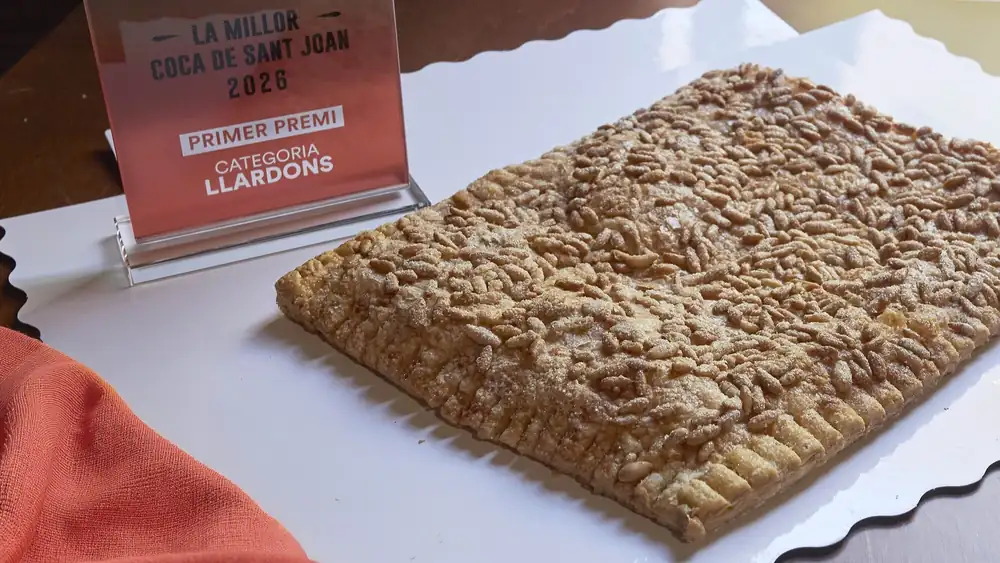
This almost standardized format was enhanced with the classic decoration of candied fruit, pine nuts, and sugar. The tradition remains intact: the estimated consumption based on last year's campaign is 2 million cocas de Sant Joan—one coca for every four inhabitants of Catalonia. Furthermore, today the coca de Sant Joan has acquired many more variations: pastry cream, marzipan, angel hair (a type of sweet pumpkin filling), cream fillings, burnt cream, or truffle; and in its more modern versions, there are major players like tiramisu (with the signature touch of the Hofmann pastry shop), the fraisier (strawberry coca, this year's creative offering from l'Atélier), and the mojito coca (a classic from Panes Creativos), or commercial products like chocolates or cookies that entice those with a sweet tooth.
Due to its enormous popularity, and the prominence it has on the shortest nights of the year, the Gremi de Flequers (Barcelona Bakers' Guild) has been promoting the competition for the best Coca de Sant Joan since 2018, a contest with five categories (traditional, cream, llardons (pork cracklings), chocolate and creative), to which some 300 candidates were presented this year, filling five large tables with aromas, colors and flavors of the festival.
The more than 100 participating bakeries and pastry shops anonymously submit their entries to the competition, on trays without logos to protect their anonymity. The rules specify the acceptable weight (between 500 and 800 grams). Everything else is left to each participant's discretion. For Claudio, head baker at Natcha, winner of the best creative coca in 2025 and a judge in 2026, this aspect is key. As he recalls from his experience: “I weighed each and every coca I made for the competition last year; in my opinion, a coca that falls outside this weight range cannot win.”
As Matthieu Atzenhoffer, the MOF (Meilleur Ouvrier de France), co-owner of Morreig and winner of the best traditional coca in 2025, explains, “A competition is one of the best ways to get people to come to your bakery wanting to try something. After last year's award, we got TV coverage, media attention, and this year we already have a lot of people asking when they can order their coca.” At Morreig, they will be making around 1,000 classic cocas and a similar number with pork cracklings for this Saint John's Eve (in addition to their coca ice cream, which they will be offering again during June, by popular demand).
The jury includes pastry and bakery professionals of the caliber of Miquel Guarro, whose resume boasts extensive experience in restaurants, pastry, training, and consulting. He offered his thoughts on the creative category, in which he serves as a judge: “However creative a coca may be, it must resemble a coca, both visually and technically. It has to be good; you have to be able to finish the whole thing… Anything outside of that would be misguided creativity.”
She will share the task of judging the more than 60 creative cocas (flatbreads) with Alba Llacera, who has distinguished herself both in restaurants (as a chef and pastry chef) and in food communication. Valuing competitions as one of the best ways to boost the sector, Alba comments that they “bring ordinary people closer to the bakeries, generating a desire to try new things and curiosity about pastry shops.” Furthermore, Alba defends the value of these competitions with another argument: “It’s important for people to understand what goes into what we eat: quality raw materials, skilled teams, dedication, hours of work… initiatives like this also help people better understand the prices of artisanal pastry and bread.”
Now, all that's left is to set the table and buy the cocas. For those who want to try this year's winning cocas, a visit to Forn El Sagà (C/ Roger de Flor, 45, Granollers) is a must; they won in two categories (Llardons and Cream and Pine Nuts). In bakeries where candied fruit is the norm, a visit to Pastelería Tornés (C/ Migdia, 51, Girona) means trying the best Traditional Coca and the second-best Chocolate Coca—and you can also indulge in the temptation of the best Xuixo of 2026 during the same visit. In the most difficult category to judge, the Creative Coca, a great classic like Hofmann (C/ Flassaders, 44, Barcelona) takes first prize with a creation that's a reinterpretation of one of its most famous products: pistachio. And, as runners-up, the coca de llardons from the Faixat pastry shop (C/Muntaner, 159, Barcelona), the creative one from La Boulangerie (C/Major, 16, Tona), the traditional one from Alejandro Pastisser (Av. d'Amèrica, 47, Mataró), or the Crema y Piñones from Arenas Molins (Av. Barcelona, 4, Molins de Rei). A very complete route to take into account for the magical night.