The best San Giuseppe zeppole to buy in Naples in 2026
It will be you and I, forever, tied at the waist.
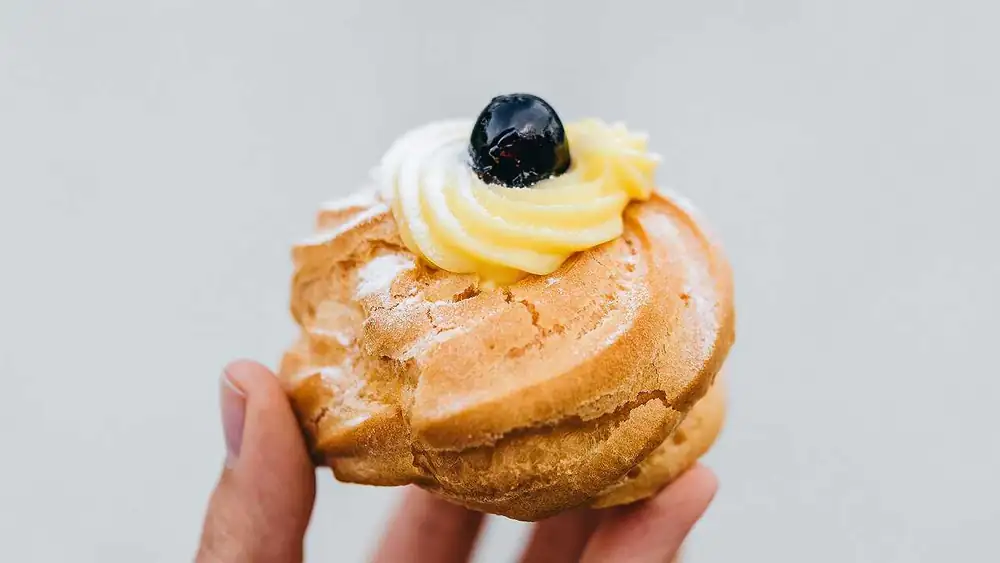
It will be you and I, forever, tied at the waist. I know you've been singing along, just as I know you love St. Joseph's zeppole. And you'd better admit it: it would be foolish to resist tasting these intricately woven choux pastry puffs bursting with custard, with the tart, juicy black cherries slowly dripping over them, shamelessly.
While much of the rest of Italy celebrates Father's Day with the usual polyester ties and poorly drawn kindergarten drawings, here in Campania the calendar demands a precise tribute, to be paid strictly in choux pastry and lard. Yet ritual doesn't save us from the truly sacrilegious practice of making these sweets with a fake cream made of powdered sugar and water.
How to distinguish a zeppola prepared with "real" cream
The zeppola di San Giuseppe is built on three pillars: a plain base of choux pastry, either fried or baked; a filling of custard, often flavored with lemon zest or vanilla; and the candied cherries that seal it all, balancing the fatty part of the dessert with their acidity and toning down the sweetness of the filling. The recipe is relatively simple; I wrote about it in depth some time ago, but for those who can't or don't want to get to work, there's a guide to finding the best ones, those made with real custard, without any extra help.
To get to the bottom of the issue of semi-finished products and fraudulent pastry products, I sought the advice of an authoritative, serious and rigorous professional, the Neapolitan pastry chef Armando Palmieri, chef, teacher and also an AMPI academic (Accademia Maestri Pasticceri Italiani).
Palmieri makes it clear right away: semi-finished products severely undermine the quality of the products. In the specific case of the fried zeppola di San Giuseppe, the quality of the choux pastry depends on the fat it's dipped in, while the deliciousness of the cream relies on the ingredients of milk, sometimes cream, egg yolks, and aromatics. Ninety percent of bakeries replace these with packets of mix. Brace yourselves, because we're talking about a mix of:
- Pre-gelatinized, dried, and then powdered modified starches: they serve to thicken the cream and have the power to gel when cold.
- Powdered milk: the only source of protein you'll find in certain creams.
- Vegetable fibers, necessary to give creaminess to this rubbish (I added rubbish).
- Colorants: natural at best, like beta-carotene or curcumin, or artificial. They're there to deceive the eye and simulate the yellowness of eggs.
The preparation is quick and easy: dilute the powdered sugar with water, without even bothering to heat it, and add an alcoholate, if desired, or rum or Strega liqueur flavoring. This helps mask the artificial flavor of the cream and mitigate the bitterness these zeppole leave in the mouth.
Doing a quick calculation, each piece has a food cost of around €0.60, and this is the gastronomic expression of its monetary value.
Luckily, distinguishing the fake from the real thing is easy, the chef reassures me, because it's enough to analyze three elements:
Appearance: The cream made with the mixture resembles a muscle pain ointment. It is sticky, translucent, and a pale yellow hue.
Consistency: rubbery, try touching it with your finger and it will bounce, turn it upside down and it won't crease.
Taste: Like sugar and cheap liquor. You're eating mastic made from powdered milk and water.
At this point, the chef tells me another story. Have you ever seen zeppole with the cream "cracked" on the surface? This happens when using low-quality canned cherries, often added with large amounts of citric acid, which ruin the structure of the topping. They should be rinsed and glazed with neutral gelatin before use, but very few people do this.
Before moving on to the reassuring part of the article, I'd like to make one thing clear: it's wrong to categorically demonize the use of modified starches, but it's important to point out their deceptive use. I myself have jars of modified starches in my kitchen, which allow me, among other things, to make ultra-crispy batters, but I would never dream of replacing the eggs and milk in a cream with a flavorless powder.
I assure you that even the historic pastry shops, the ones with high-sounding surnames and shabby chic decor, don't care about authenticity, freshness, integrity, or even you. I know the zeppola looks appetizing, beautifully puffed up, and glistening, but it's the embodiment of everything you should avoid. And it costs €3.20.
Origins of the St. Joseph's zeppola and regional variations
Let's put an uncomfortable truth on record and put aside the textbook hagiography: the tear-jerking tale of Saint Joseph forced to become a traveling fryer to finance the flight to Egypt is touching, but gastronomic philology drags us into decidedly more secular and sticky terrain.
On March 17th, in ancient Rome, the Liberalia were celebrated, festivals dedicated to Liber Pater (the god of wine and fertility) where sixteen-year-olds donned the toga of manhood and began their adult lives. How was the transition celebrated in those days? By lighting bonfires to chase away winter and frying tons of honey-dripping wheat batter in the streets. A highly glycemic bacchanal, devoid of any sense of monotheistic guilt.
Then, in a tactical move worthy of the best corporate takeovers, Christianity swallowed up the event. It pushed the date back by forty-eight hours, placed the patron saint of carpenters on the billboard, and shifted the production chain from the city squares to convent kitchens. In Naples, the research and development of the zeppola was essentially outsourced to the nuns of San Gregorio Armeno, Santa Patrizia, and the Croce di Lucca, who, in the silence of cloistered confinement, engineered its consistency.
From the monasteries' grates, the dough inevitably slipped onto the streets. Neapolitan mythology points to Pasquale Pintauro, the same marketing genius who popularized the sfogliatella, transforming it from a convent secret into a commercial asset, crediting him with the intuition of the double thermal shock to ensure a choux pastry with a thick crust and a hollow interior.
But the definitive watershed between neighborhood gossip and historiography bears the signature of Ippolito Cavalcanti, historian, gastronome, Duke of Buonvicino, and nephew of the celebrated Guido. It was he who, in 1837, ended the confusing era of oral transmission by printing the first official recipe in his Cucina teorico pratica (Theoretical and Practical Cuisine).
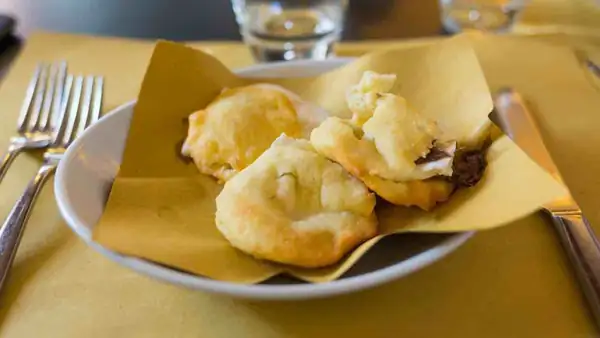
Sure, back then the dough was decidedly rougher, a rustic construct held together with splashes of Marsala or aniseed liqueur, but the dogma of deep-frying was already established. A cult that isn't limited to the Campania region, no sir. From north to south, Italy honors the patron saint of carpenters in the only sensible way: by dropping carbohydrates into boiling oil.
Sicily: Palermo is dominated by sfince di San Giuseppe, irregular fritters loaded with ricotta, candied fruit, dark chocolate, and sometimes chopped pistachios. Between Catania and Messina, crispedde are popular: savory rice balls cooked in milk and flavored with orange.
Downtown: In Rome, until the 1970s, carpenters clogged the Trionfale neighborhood with pans full of cream-filled cream puffs. In Umbria and Tuscany, sweet rice fritters, sold piping hot in paper bags, are preferred.
North: in Piacenza, they prepare farsò, rice fritters with alchermes liqueur; in Brianza, sugared turtej. The Ligurian carpenters' playfulness is curious, linked to frisciêu, sweet leavened balls: one was treacherously stuffed with cotton wool, and the unfortunate person who nearly suffocated had to buy everyone a drink.
Where to eat San Giuseppe zeppole in Naples
After a week of research, testing, and thoughtful tastings, I've selected five places where zeppole are prepared without shortcuts, without plasticized cream puffs and depressed cream puffs. Between us, I'm truly tired of the artifacts the city force-feeds tourists, who are also guilty and too often uneducated about what's good and authentic.
Di Costanzo Pastry Shop
Thick, flavorful choux pastry, the fried one is incredibly dry. The cream is dense, complex, and the natural vanilla flavor stands out on a truly hand-crafted dessert. With a filling inside as well, this zeppola is worth serving for two.
Opening hours: Every day 7:15 am – 7:45 pm (closed on Tuesdays) Price: 4 euros (both fried and baked)
The Carlotteria
An explosion of rich, fragrant cream for these hefty bombettes (about 170 grams each), filled inside and out. The shell is a thin, delicate choux pastry, with a salty finish that balances everything out. Crackling and unabashedly delicious, I recommend pre-ordering for this truly artisanal treat.
Opening hours: Tuesday to Friday, 9:00 am to 7:00 pm, Saturday 10:00 am to 7:30 pm, Sunday 9:00 am to 2:00 pm (closed on Mondays) Price: €3.50.
Salvatore Varriale Pastry Shop
Address: Via Nuova San Rocco 3 (also located at Via G. Filangieri 75 and Piazza Vanvitelli 22)
Ethereal choux pastry, whether fried or baked (I dare you to tell the difference between the fried and baked versions), with a silky, abundant cream filling the center of the zeppola. The quality of the black cherries is noticeable and memorable.
Opening hours: Open every day from 6:00 am to 9:00 pm. Price: €3 for a baked zeppola, €3.50 for a fried one.
Davide Bellavia Pastry Shop
The cream puff is thick, fried, and cooked properly, with a smooth, thicker cream than the others. Filled generously, it's topped with drier, yet extremely aromatic, black cherries. A well-made dessert with a traditional flavor.
Opening hours: Tuesday – Sunday 6:45 – 20:30 (closed on Mondays) Price: €3.50.
Augustus Gastronomy and Pastry Shop
This nostalgic zeppola has a timeless flavor. The cream puff is rustic, almost bready, and the cream is sweet and fragrant, as only certain bakeries languishing in the past can be. It's also filled inside, a journey back in time included in the price.
Opening hours: Open every day from 7am to 8:30pm Price: €4 for the baked one, €4.50 for the fried one.