Recipe of the week: Green sauces – and suddenly everything tastes better
A piece of fried fish, alongside broad beans.
A piece of fried fish, alongside broad beans. That can be a decent dinner, I think. But if you add some finely chopped parsley, capers, anchovies, garlic, a touch of acidity, and good olive oil, the situation changes considerably. Suddenly, I want to put bread on the table for dipping, not clear my plate too soon after eating, and maybe even have a glass of wine. The difference cost hardly anything, yet it made me truly happy.
The large sauce family
Some sauces occupy this somewhat unfair position in the kitchen: they're treated as an afterthought, even though they often determine whether a dish is remembered. And I'm explicitly not referring to those grand French sauces for which veal bones are roasted, stocks are made, and then liquids are reduced to a fraction of their original volume. I'm talking about the other family of sauces: pistou, chimichurri, chermoula, gremolata, salsa verde, schug. These are often just a bunch of herbs, garlic, acid, spices, oil, a few minutes of work, sometimes less.
Good sauces often only require a bunch of herbs, garlic, acid, spices, oil and a few minutes of work – sometimes less.
It's actually quite logical that almost every major culinary culture has eventually arrived at this idea. While the ingredients may vary, the principle remains strikingly similar: something fresh meets something spicy, along with acidity and fat. The result isn't cooked, but rather poured over something that has already been heated. And therein lies its effect. A long-braised piece of meat suddenly regains its freshness, roasted vegetables gain spiciness, beans acquire acidity, and a rather bland fish develops a decidedly strong character.
In Provence, one of the simplest versions is called Pistou. Strictly speaking, you need little more than basil, garlic, and olive oil, traditionally crushed in a mortar. Unlike Ligurian pesto, pine nuts and cheese are not originally essential ingredients. The "Soupe au pistou" is famous—a summery vegetable soup with beans, zucchini, and other garden vegetables, to which the raw pistou is added only at the very end. This is crucial: the basil shouldn't simmer for half an hour and lose its best qualities. Believe me, the dish sounds almost banal, but it's a real winner!
Bollito Misto: naturally low in roasted aromas
A few hundred kilometers further east, the same basic idea gives rise to the Italian salsa verde. Parsley, capers, anchovies, garlic, vinegar or lemon, and olive oil; regionally, bread or a hard-boiled egg yolk are added. In Piedmont, it's known as "bagnetto verde" and is a classic component of bollito misto. Its purpose is particularly clear in this dish. Bollito misto is mixed cooked meat, and it can be truly magnificent. However, it naturally has few roasted flavors and is also quite heavy. Capers, anchovies, and vinegar provide it with salt, acidity, and umami. Here, the sauce doesn't merely decorate the meat; it completes it.
Gremolata works similarly. The classic Milanese combination of parsley, lemon zest, and garlic is poured over the ossobuco once it has become tender, dark, and rich after long braising. Three raw ingredients against a hearty braised dish. But that's all it takes. Anyone who has ever tried gremolata on lentils, white beans, or roast chicken will never want to leave it exclusively to the Milanese again.
Our columnist
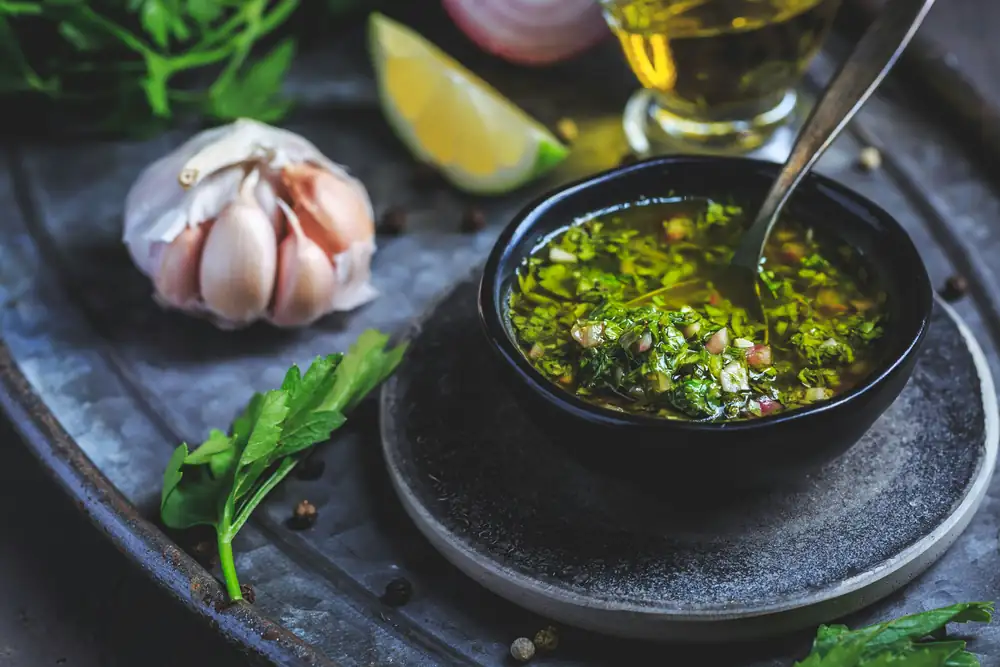
Chimichurri reaches us across the Atlantic. In Argentina and Uruguay, it's primarily served with grilled meat. Parsley, garlic, oregano, chili, vinegar, and oil form the base, though the details are probably debated with the same passion as potato salad elsewhere. For me, the vinegar is the most important ingredient. A fatty piece of grilled beef practically demands it. But chimichurri can also be served over grilled zucchini, potatoes, or a fried egg. No one in Buenos Aires is going to want to close the German embassy over it.
North Africa boasts one of my favorite sauces: chermoula. Parsley and coriander mingle with garlic, cumin, paprika, lemon, and olive oil, often with preserved lemon. Especially in Morocco, chermoula is closely associated with fish, serving not only as a sauce but also as a marinade. It also works wonderfully with roasted vegetables and chickpeas. A baking sheet of cauliflower, carrots, and onions on its own might seem a bit like a typical Tuesday evening meal. But with plenty of chermoula and some flatbread, I would happily serve it to guests.
And then there's Zhug. This Yemeni chili paste (also spelled Zhug or Zhoug) uses fresh green chilies, coriander, garlic, and spices like cumin, coriander seeds, and cardamom. It's the less diplomatic member of this sauce family. Just one spoonful can completely transform rice, eggs, grilled chicken, or roasted eggplant. Due to Yemeni-Jewish migration, Zhug later became an integral part of Israeli cuisine and has since spread far beyond its borders.
Small bowls, big impact: The right sauces and dips give snacks and side dishes the finishing touch.
What all these sauces have in common, however, is more interesting than their differences. They represent a rather old answer to a modern problem: How do you cook everyday meals with minimal effort that are still genuinely enjoyable? You don't need a new dish every night. You just need a different sauce occasionally. Lentils with a piece of meat or some halloumi and gremolata. Fish with broad beans and salsa verde. Roasted vegetables with chickpeas and chermoula. A few potatoes with chimichurri. White beans, a fried egg, and schug. The base can be remarkably inexpensive. The crucial flavor comes from a bowl whose contents are whisked together in just a few minutes.
And the repertoire is by no means exhausted by the above variations. In Mexico, there's Salsa de Tomatillo made with tart green tomatillos, chilies, and cilantro. Elsewhere, mint, nuts, roasted peppers, or fermented ingredients come into play. Essentially, the idea is universal: to combine herbs, acidity, spiciness, and spices in such a way that a sauce with character is created from just a few ingredients.
Breakfast for school children – it remains the most important meal of the day
There are virtually no limits to your imagination; anything goes. And it's worth taking a break from the blender for once. Parsley, coriander, and basil change when you process them completely into a green mush. Using a sharp knife or a mortar and pestle preserves more texture. Garlic can be crushed with salt to form a paste first. Whole herbs benefit from a brief, dry roast. And acidity should be adjusted to taste, not according to a recipe. A salsa verde can be so acidic that it almost seems too much on its own.
In the overall context, it suddenly feels just right and elevates the meal to a new level. Good olive oil certainly helps. But even with that, these sauces remain one of the most affordable ways to make a big difference in cooking. You don't have to shave truffles or buy any other luxury product. A bunch of parsley is still a bunch of parsley, and often more than enough. And that, for me, is the real luxury. You start with ingredients that don't try to impress anyone: beans, lentils, potatoes, a piece of vegetable. Then you place a small bowl of salsa verde next to them, and no one at the table feels like you've skimped on anything.
Chermoula
Ingredients (4 people): 1 bunch flat-leaf parsley, 1 bunch fresh coriander, 2 cloves garlic, 1/2 preserved lemon, 1 lemon, 1 tsp cumin seeds, 1 tsp coriander seeds, 1 tsp mild paprika powder, 1/2 tsp pul biber or chili flakes, 80 ml good olive oil, salt and pepper.
Here's where it gets aromatic: Chermoula combines fresh herbs, garlic, lemon and spices in one sauce.
Preparation: Briefly toast cumin and coriander seeds in a dry pan until fragrant, then finely grind them in a mortar. Finely chop the parsley and coriander, including the tender stems. Crush the garlic with a little salt to form a paste and very finely chop the preserved lemon. Combine everything with the spices, the zest of half a lemon, 2 tablespoons of lemon juice, and the olive oil. Season to taste with salt, pepper, and more lemon juice if needed. The chermoula should taste fresh, robust, distinctly lemony, and spicy, and can be a bit more intense than you would eat it on its own. Let it rest for at least 15 minutes before serving. It goes perfectly with fried or grilled fish, lamb, chicken, chickpeas, and almost any roasted vegetables.
Felix' Salsa Verde Special
Ingredients (4 people): 1 bunch flat-leaf parsley, 2 anchovy fillets in oil, 1 tbsp capers, 1 small clove of garlic, 1 tsp Dijon mustard, 1 tbsp red wine vinegar, 1/2 lime, a few dashes of green Tabasco, 80 ml good olive oil, salt and pepper.
Here's a generous helping of green on your plate – with the perfect salsa verde. (Symbolic image)
Preparation: Finely chop the parsley, including the stems. Finely chop the anchovies, capers, and garlic as well, and mix them with the parsley. Add the Dijon mustard, red wine vinegar, the finely grated zest of half a lime, 1 tablespoon of lime juice, and the green Tabasco sauce. Gradually stir in the olive oil until a loose, still noticeably textured sauce forms; it should not become a smooth purée. Season with black pepper, a little salt if needed, and more lime juice. Let it sit for about 15 minutes before serving. The salsa should taste robust, fresh, and distinctly acidic. Final tip: If you have it, use smoked olive oil.