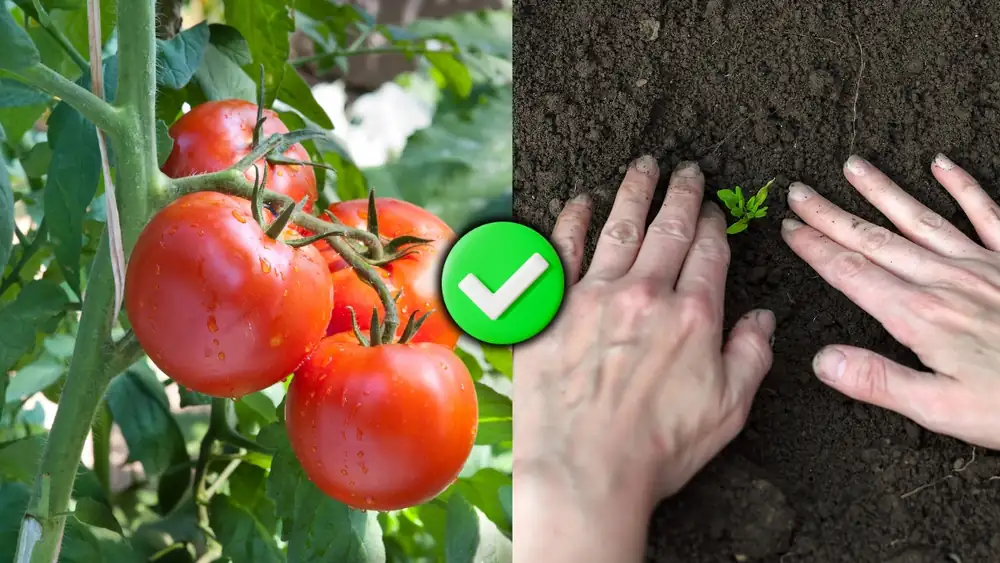
What you should do to help your tomato plant develop more roots and grow stronger
To encourage a tomato plant to develop more roots and grow more vigorously, one technique that can be used during transplanting is to remove the leaves from the lower part of the stem and bury a section of it in the soil.
“Stop sending me your garbage!”; Ninel Conde reacts to José Manuel Figueroa’s comments against her
Specialists from agricultural extension services, such as the University of Minnesota Extension and Oklahoma State University Extension, recommend planting tomatoes deep in the ground or in a sloping trench. This is because they can develop roots along the buried portion of the stem.
How to bury the tomato stem to encourage it to produce more roots?
The key is to take advantage of the tomato plant's natural ability to produce adventitious roots from the stem, but without burying leaves, branches, or an excessive amount of plant tissue. Before transplanting, remove the lower leaves that would be in contact with the soil.
When the plant is still relatively small, you can follow this procedure:
- Remove the lower leaves: remove the leaves from the lowest part of the stem that would be buried to prevent them from remaining in contact with the substrate.
- Prepare a deep hole: dig a hole approximately 15 to 20 centimeters deep, depending on the size of the plant and the container or ground where it will be placed.
- Bury part of the stem: during transplanting, approximately 10 centimeters of the stem can remain underground, keeping the leaves and the top of the plant above the substrate.
- Cover the stem with soil without compacting it excessively: the goal is for the buried area to be in contact with the substrate, but without preventing the circulation of water and air.
- Water after transplanting: provide enough water to settle the soil around the roots, avoiding leaving it permanently saturated.
When a tomato plant has grown too large to be placed vertically in a hole, there is another alternative. Oklahoma State University Extension notes that tomatoes can be planted in a shallow trench by placing the root ball and part of the stem horizontally or at a slight angle, leaving the top of the plant above ground level.
In that case, a section of approximately 20 to 30 centimeters from the main branch or stem can be used, and a trench about 10 centimeters deep can be prepared. The plant is carefully placed horizontally, leaving the part with the upper leaves above ground.
This technique is particularly useful for seedlings that have grown too long. Over time, the buried section can develop additional roots and contribute to a more extensive root system.
Care that the tomato plant needs to develop strong roots
- Use well-draining soil: roots need water, but also oxygen. Constantly waterlogged soil can cause root problems.
- Provides sufficient sunlight: tomatoes need a sunny location to properly photosynthesize and develop stems, leaves, and fruit.
- Maintain relatively stable humidity: extreme changes between drought and excess water can stress the plant.
- Avoid compacting the soil: excessively compacted soil hinders root expansion and the movement of water and air.
- It provides nutrients in a balanced way: fertile soil promotes the overall development of the plant, but excess fertilizer is not recommended either.
Another important point is to perform the transplant with as little stress as possible. If the plant is already established, handle the stem carefully when placing it horizontally to avoid breaking it. After transplanting, maintain a proper watering routine while it settles into its new location.