What does it take to establish a cult bakery following?
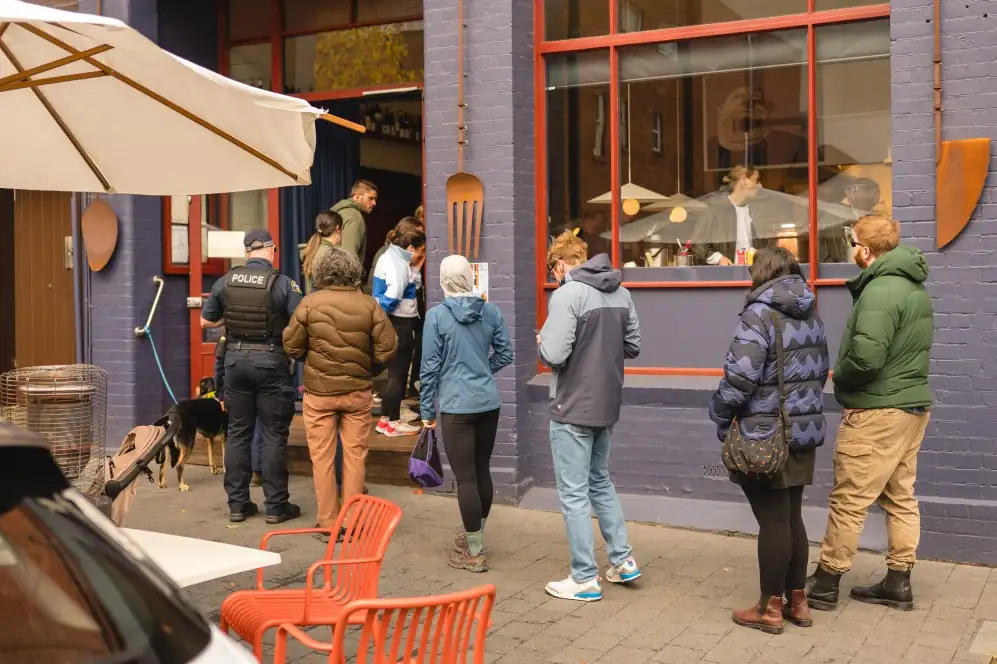
The first day that Roberto Mele opened his artisanal bakery popup in Hobart, a line of customers stretched from the shopfront, down the street, and around the corner.
“We believe that time makes things better and good things come to those who wait. We found that 12 to 15 hour overnight fermentation takes longer and there’s more effort, but there’s more care which makes a difference.”
“Our first pop-up was like something I’ve never imagined in my life, the queue was going around the block, and people were queuing for more than an hour to try our croissants, which was pretty astonishing,” says Mele.
Prior to moving to Hobart, the chef had spent 12 years working in pastry shops and kitchens around the world. During a stint living in Melbourne (where he worked at Baker Bleu), he visited Tasmania and fell in love with the state’s unique culinary scene, and eventually he decided to move to Hobart.
Once there, he spent time working with Federica Andrisani and Oskar Rossi, the duo behind contemporary European restaurant Fico and Italian pizza bar Pitzi. It was during this period that he noticed a gap the city’s culinary scene. “I was struggling to find a very good croissant in Hobart. I do love croissants, even though I’m Italian,” he admits.
Mele asked Andrisani and Rossi if he could use the Pitzi venue some Sundays, when the restaurant is closed, to run a popup. And so he founded Mama Artisanal Bakery. It’s a win-win for both parties: Mele doesn’t have to pay the outgoings on a permanent venue, or deal with the stress that comes with finding permanent staff, while Pitzi has an additional purpose on the day it sits quiet.
The name stems from the Italian word for mother, Madre, which also refers to sourdough starter (lievito madre) – the main ingredient that sets Mele’s croissants apart.
“We concentrate on 100 per cent sourdough croissants and we keep it simple with local ingredients, a 20-year-old sourdough starter, and a long fermentation – time is our secret ingredient,” says Mele.
Mele calls cooking with sourdough “a gentle way to bake”. “We believe that time makes things better and good things come to those who wait. We found that 12 to 15 hour overnight fermentation takes longer and there’s more effort, but there’s more care which makes a difference.” The result is a croissant that is slightly denser than usual, and Mele likes to bake them quite dark, which is helped along by the addition of malt syrup. “It’s basically magic. There’s more flakiness, the crumb is denser, but the flavour itself is way richer than a normal croissant,” he says.
This slow process, he says, reflects the attitude in Hobart. Drawing on the essence of the region has been a large part of his process and reflects Mama’s values.
“Hobart is not a big city, you can literally breathe in that slow life. This resonates with Mama’s values of using sourdough and a slow approach to fermentation. I believe Mama is a very unique Tasmanian example of a bakery,” says Mele.
This Tasmanian focus is reflected in the produce Mele uses, from local Lenah Valley honey to a mix of mainland flour and flour from a mill in Launceston.
He also operates with a zero-waste mentality and makes the most of fruit from friends’ and family’s backyards – much of which would otherwise go to waste. “Our neighbour, Theresa, has massive lemon and orange trees and she doesn’t know what to do with the fruit, and she just gives it away,” says Mele, who used homemade candied orange peels for hot cross buns during Easter. “I would definitely buy these oranges and make orange peels again, because they’re organic, they haven’t been sprayed, they’re beautiful.”
Mele puts his popup’s initial popularity down to word of mouth in the tight-knit Hobart hospitality scene, but the crowds have continued to materialise every second Sunday for over a year now.
The chef says the key to his following is trifold: ingredients, consistency, and technique. “We try to be consistent with the ingredients we use, which might seem a cliché thing to say, but its’s a key part of production. If you use a different flour, or a different butter, or more or less water, it might not be right. Technique is very important. Every time I make a new batch, I try and understand what went wrong last time and what could be better,” he says. “But technique without ingredients is nothing – you can use the same technique with different ingredients and have a different result.”
He adds that the help of his family and friends has been crucial for making the venture possible. “Most of the time I’m solo in the kitchen, but it’s not just about that. It’s also the people that serve croissants and make your coffee. They’re part of what Mama is and what people resonate with. So I want to say thank you.”
Mele’s following caught the eye of Dark Mofo Food Curator Amanda Vallis, and it led her to program him as an core part of the Winter Feast lineup. The feast is the festival’s culinary centrepiece, and it will run over eight days between 11 and 21 June.
“His offering has a cult following here in Hobart,” says Vallis. “Whenever he has one of his pop-ups, there’s a line around the corner with everyone wanting to try his traditional sourdough pastries.
“The idea of putting him on the centre stage of the feast for this year really appealed to me, knowing that he’s so loved here locally. Throughout Dark Mofo, we have such large visitations from interstate, so being able to showcase what he does to visitors outside of Hobart was quite appealing.”
When Vallis sat down with Mele to discuss collaborating with an international chef for the event, the chef immediately said he wanted to work with someone from Puglia, where he’s originally from. Floriano Pellegrino and Isabella Potì of Michelin starred Italian restaurant Bros’ were the first to come to mind – and although Potì can’t make it (she’s recently given birth), Pellegrino jumped on board.
Mele says his work with Pellegrino will be an “ode to Puglia”, as they’re both from the region. “We believe our region is one of the most beautiful, bountiful regions in Italy, especially in the food scene. [At Dark Mofo] it’s going to be a few Apulian dishes, Apulian techniques, blended with Tasmanian ingredients.”
For Jose Silva, the chef who runs renowned pastel de nata (Portuguese custard tart) bakery Sweet Belem in Sydney’s Petersham, as well as Fich at Petersham, Lunas Petersham, and Bibo Wine Bar in Double Bay, ingredients, consistency, and staff are also central to his philosophy.
Silva took over Sweet Belem from Founder João De Almeida in 2014, and its success has been enduring – even through the pandemic, when they were selling over 2000 pasteis de nata per day. This June, he’s set to open a second store in Barangaroo. Silva says this enduring success, and now expansion, comes down to cooking with “the best possible quality we can, with the best ingredients we can get, and doing it with love”.
Every product they use is fresh, from the vanilla bean to the lemon zest, and doesn’t come from an essence. They’ve also had the same egg supplier for around nine years, says Silva. He opts for free range eggs, a decision which he says makes a difference to the flavour, colour, and consistency of the custard. All the pastries are made with butter to ensure they achieve a specific mouthfeel. Having a cult following means that any change to the core product offering – in this case the Portuguese tarts – is risky business, and it’s why a reliable product is crucial.
“One of the keys is consistency and sticking to your guns,” says Silva. He says that when new chefs come on board, it’s particularly important to conduct intensive training to retain the product’s uniformity. “When new chefs come through, we make sure they’re doing exactly what we did before to keep quality and consistency,” says Silva.
“Chefs are creative, they like to change things. Sometimes you can improve on something, but this is what we do, [Portuguese tarts are] what we’re known for. I allow chefs the freedom to get creative on other things, like specials or the seasonal changing flavours. You don’t want them to get bored, because chefs are creative and they want to stay interested.”
Over the years, Silva and his chefs have developed a range of Portuguese tart varieties, from flourless and seasonal fruit flavours to an increasingly popular vegan option, in order to entice as many customers with as many dietary requirements as possible. Silva says that while the Portuguese tart has been a key to their success, having a subsidiary range of high-quality pastries, such as doughnuts, vanilla slice, and Portuguese-style brioche croissants, encourages higher spend.
The new Barangaroo venue came during a quest for his “next adventure”, says Silva. When the site emerged, the opportunity felt promising. “You’ve got your corporates on the weekdays, and then tourists on the weekends. So we thought it was a good spot to expand the brand.”
He plans to bring over some older staff from Petersham to train his new staff and bring the brand’s philosophy into the new space. “We don’t want to change the process. We’re still going to cook everything on site, not in a factory and bring it in. Especially the Portuguese tarts. You want to cook them fresh for the day. The Portuguese tarts are great for one day, but then the next they’re not as good. It’s edible, but it’s not the same,” says Silva. Silva says he isn’t worried about competition threatening Sweet Belem’s cult following.
“Competition is good. If someone else comes along, you’ve got to stick to your guns and do what you do well. If someone else comes along with a better product, it keeps everyone on their toes and makes you strive to be better, so I think it’s healthy.” ■