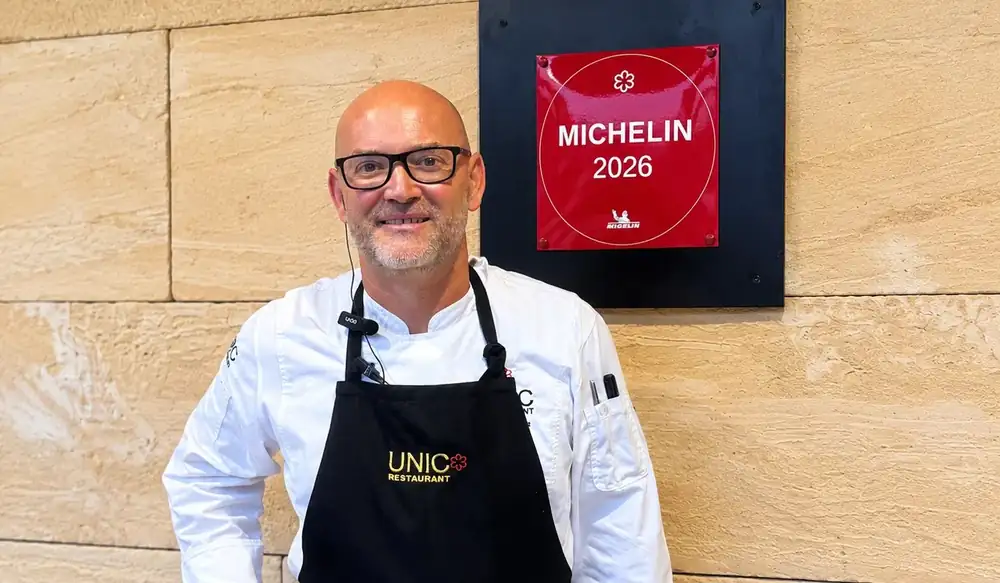
David Grussaute French cuisine of training, ibicenca of inspiration
Based in Ibiza for nearly thirty years, Bordeaux-born chef David Grussaute has made the island his home away from home.
From Bordeaux to Ibiza, nearly thirty years to build UNIC
Born in Bordeaux in 1972, David Grussaute is the son and grandson of butchers and delicatessen owners. At the age of 12, when his parents left Bordeaux to take over the Hostellerie du Pont d'Espagne in the Hautes-Pyrénées, his father introduced him to the trade without any shortcuts: first washing dishes, then potatoes, and gradually moving on to cooking. Alongside his studies, he trained and, after graduating from high school and attending university where he studied English, Spanish, and Korean, he enrolled at the Bordeaux-Talence Hotel School. Three years and a BTS (Advanced Vocational Diploma) in Hotel and Restaurant Management, specializing in table service and culinary arts, provided him with the technical foundations of a profession he then explored through several internships, notably at the Relais de Brantôme in the Dordogne, then part of the Relais & Châteaux network and awarded a Michelin star.
After his military service, he chose to broaden his horizons rather than remain exclusively in haute cuisine. His journey took him to Africa, the Comoros Islands, and then Scotland. In 1997, while considering other opportunities, such as the United States or Japan, an uncle living in Ibiza encouraged him to come to the island, and he participated in the opening of Sant Rafel, creating his own menu for the first time. Five years later, he joined the Casino group at the Ibiza Gran Hotel, where he rose to the position of head chef.
In 2008, he took over the management of the Migjorn Ibiza Suites & Spa. This stability would prove crucial: it gave him what his cuisine needed to become truly personal – time.
"The beginnings were a bit complicated because I was warned: You won't be able to do what you want right away, like haute cuisine. But if you're patient, little by little, you'll achieve what you want. With a lot of patience, I've reached what UNIC is today, a Michelin star. But these fifteen years have also allowed me to get to know a lot of people, to meet suppliers, to get to know the island better and to draw more inspiration from it."
Today, UNIC occupies two glass cubes open to the vegetation in the inner courtyard of the Migjorn, in Playa d'en Bossa, some 150 meters from the sea. A contemporary and hushed setting, almost removed from the hustle and bustle of the neighborhood, in which the chef has finally given precise form to what he wanted to say.
“There was a personal and mental turning point. I told myself that I had to do something truly extraordinary, so that people would come and taste my cuisine, but without forgetting who I am and where I come from. Because ultimately, I am French. Behind me, there is a culinary background, training, and education. Today, I feel truly fulfilled, like a small child who has achieved his dream.”
This French influence remains evident in the construction of sauces, stocks, cooking methods, charcuterie, and pastries, but David Grussaute does not seek to reproduce in Ibiza a repertoire learned in France. Island products now constitute the vocabulary of his cuisine: fish and shellfish, black pork, kid, xeixa wheat, carob, wild herbs, honey, figs, almonds, pine trees, and posidonia seagrass.
The producers, fishermen, and farmers met over the years have become essential partners. The menu is also built around their constraints, what they grow, fish, or raise, and sometimes products that have fallen out of favor, which the chef chooses to bring back into the spotlight.
At UNIC, the meal is designed as a journey in several stages. The 2026 menu includes around twenty small dishes, and each plate has its own origin, sometimes personal, sometimes historical, geographical, or simply born from an encounter.
"It would make no sense for me to create a dish that doesn't work emotionally. Behind every creation, there is a lot of thought. Every dish has its 'why'."
Three months of research each winter
This succession of dishes is prepared long before the arrival of the first customers of the season. When the restaurant closes towards the end of October, David Grussaute takes a few weeks off before returning to the kitchen in January. For nearly three months, he and his team work on the new products, combinations, and techniques that will define the following season. Trial and error, and adjustments are all part of the process. Some research culminates in a few weeks; other ideas take several seasons to develop. The work done with Posidonia seagrass, for example, took almost two years to reach its final form. By the time of reopening in April, the new creations must be sufficiently refined to allow the focus to shift from the research phase to the much more demanding task of ensuring consistent service.
In the dining room as in the kitchen, David Grussaute emphasizes the collaborative nature of the experience. He specifically mentions Jacopo and Yaël, reminding them that, in the eyes of the guests, they become "the face" of his cuisine. In the pastry section, he can rely on Moku, his Japanese chef de partie. This origin amuses him, as Japan regularly features in his work, even though he himself has never traveled there.
When trying to define what he would like guests to take away from this experience, David Grussaute finally finds the simplest words: "I want them to feel like they've eaten the island." This sentence provides the key to understanding the menu. Behind the plates appear nearly thirty years spent in Ibiza, but also the Arcachon Basin of his childhood, his French training, Japanese influences, the fishermen, farmers, market gardeners, beekeepers, and artisans he has met over time.
However, the chef is wary of stories artificially imposed on the dishes. The narrative is only worthwhile if the food confirms it. "That means I've told you the truth." This desire for coherence allows him to approach the menu differently: not as a succession of technical demonstrations, but as the culinary story of an island observed, explored, and worked with for nearly three decades.