Sweet potato season starts with encouraging quality prospects
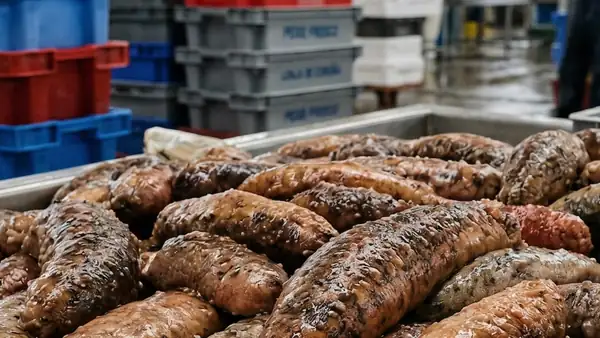
Favorable conditions during the growing and early harvest period have given the Portuguese sweet potato season a promising start, says Pedro Marques, Export Manager at Portuguese fresh fruit exporter Frutas Classe: “The season has begun with very promising signs for Portuguese sweet potatoes.
Focus on consistency across the entire supply chain. Instead of simply aiming for higher volumes, the development of the sweet potato operation, according to Marques, focuses on improving consistency and strengthening various stages of production and post-harvest treatment: “Our most important development is not simply an increase in volume. It is the professionalization of the entire sweet potato operation. In recent years, we have invested in production planning, grower support, quality control, traceability, and post-harvest technology. This allows us to achieve greater uniformity in size, appearance, and quality, while also offering retailers a much more flexible product range. We grow both organic and conventional sweet potatoes. In conventional production, we place particular emphasis on responsible crop protection, water management, environmental standards, and social responsibility. Our goal is clear: to deliver a safe, reliable, and responsibly produced Portuguese sweet potato.”
Favorable weather has boosted cultivation so far, but managing increasingly limited natural resources remains a long-term challenge for producers, explains Marques: “Overall, the weather conditions have been favorable. The dry conditions at the end of the growing season helped us maintain the health and quality of the plants. At the same time, water is becoming an increasingly vital resource, especially in Southern Europe, so efficient irrigation management has become an essential part of modern agriculture. Sustainability isn't just a marketing promise. Monitoring resources, improving production efficiency, and reducing unnecessary inputs are all part of our farming practices. Portugal's climate gives us a significant natural advantage, but it's the combination of this climate with professional agricultural management that allows us to deliver a consistent product.”
Meeting increasingly demanding retail requirements. The challenge extends beyond cultivating a good harvest, as retailers, according to Marques, are making ever more detailed demands on the product and its presentation: “One of the biggest challenges is meeting the increasingly demanding requirements of retailers. Supermarkets want uniform sizes, good visual quality, reliable residue control, complete traceability, and packaging formats adapted to different consumer groups. At the same time, producers and packers have to cope with rising production costs, pressure on natural resources, and the need for continuous improvement in their environmental footprint. Our response has been to integrate a larger part of the value chain. By controlling production, sorting, washing, packaging, and logistics, we are able to react faster and ensure greater consistency throughout the entire process.”
This integrated approach also allows the exporter to leverage Portugal's geographical location when supplying European customers, explains Marques: "This is particularly important for European customers, as one of our biggest competitive advantages is geographical proximity. A sweet potato can be sorted, washed, and packed in Portugal and reach many European markets approximately two days later. For retailers, this translates into freshness, flexibility, and a significantly shorter supply chain."
New Infrastructure for Sorting and Packaging With sweet potatoes becoming a strategic category, recent investments have focused on improving both handling and the packaging options available to customers, explains Marques: “Sweet potatoes are now a strategic category for us. We have therefore made a significant investment in a new, purpose-built facility and a modern optical sorting system. This technology allows us to classify the product more precisely and integrate sorting, washing, and packaging into a more efficient process. It also gives us significantly more flexibility in presentation. We can supply the product loose, in net bags, flow packs, and trays of 500g or 1kg, depending on the requirements of individual retailers and markets.”
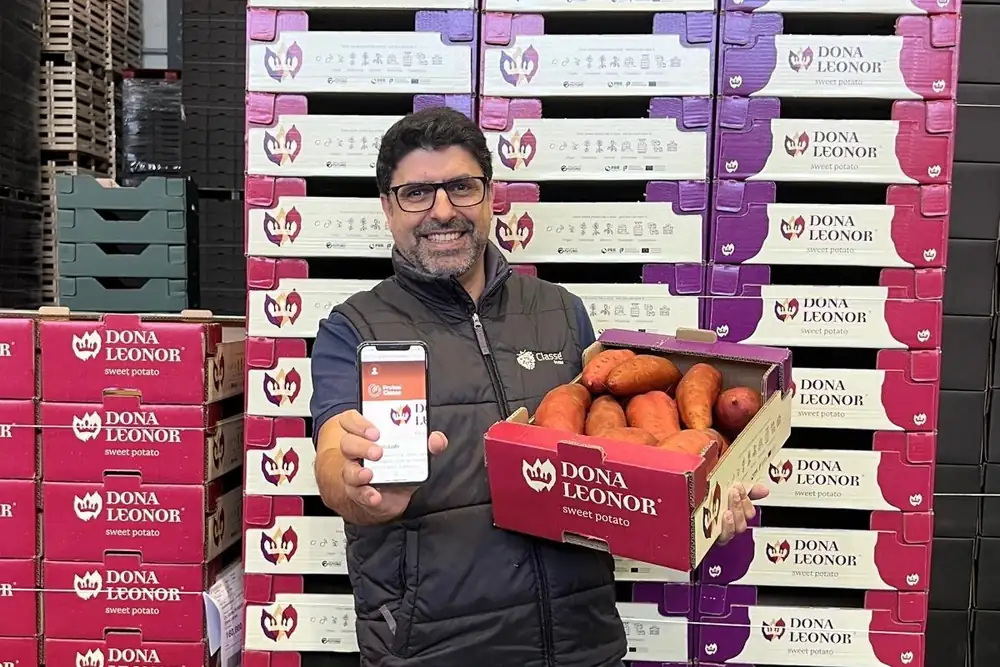
The company also plans to unveil a new sweet potato brand at Fruit Attraction, whose packaging will offer consumers better access to information about the product's origin and supply chain, according to Marques: "At the next Fruit Attraction, we will also be presenting 'Dona Leonor,' our sweet potato brand, which incorporates the technology developed as part of the Portuguese project 'Embalagem do Futuro – Packaging of the Future.' Dona Leonor represents the next step in how we want to bring Portuguese sweet potatoes closer to consumers."
“Digital traceability technology transforms packaging into more than just a simple container,” Marques continues. “A digital link, accessible via a QR code, can give consumers access to information about the product and its journey through the supply chain. The goal is to create a stronger connection between the field, the retailer, and the end consumer, uniting traceability, transparency, sustainability, and product information into a single concept. For us, this is precisely what the packaging of the future should do: not only protect the product but also tell its story.”
“We are very optimistic about the rest of the season. Product quality is promising, our new infrastructure gives us more capacity and flexibility, and we believe there is growing potential for Portuguese sweet potatoes in Europe. Portugal has a very strong offering. We can provide European retailers with a high-quality product produced close to their markets under strict food safety and environmental standards, with short delivery times and a wide range of packaging options. With ‘Dona Leonor,’ we now want to add another dimension: to offer consumers more information and greater transparency about the product's origin and journey. For us, the future of Portuguese sweet potatoes is therefore based on four elements: quality, proximity, sustainability, and traceability,” Marques summarizes.
Frutas Classe will be exhibiting at Fruit Attraction. You can find their stand in Hall 8, Stand D08.