“Difficult growing conditions could improve market prospects for quality fruit”
It's a busy time for LemBi Fruit, which, in addition to the traditional harvest taking place in the coming weeks at its Ranst-based top fruit company, is also celebrating its 30th anniversary. "Despite a very challenging growing year, there are positive prospects for the upcoming season," says Director Kris Lemmens.
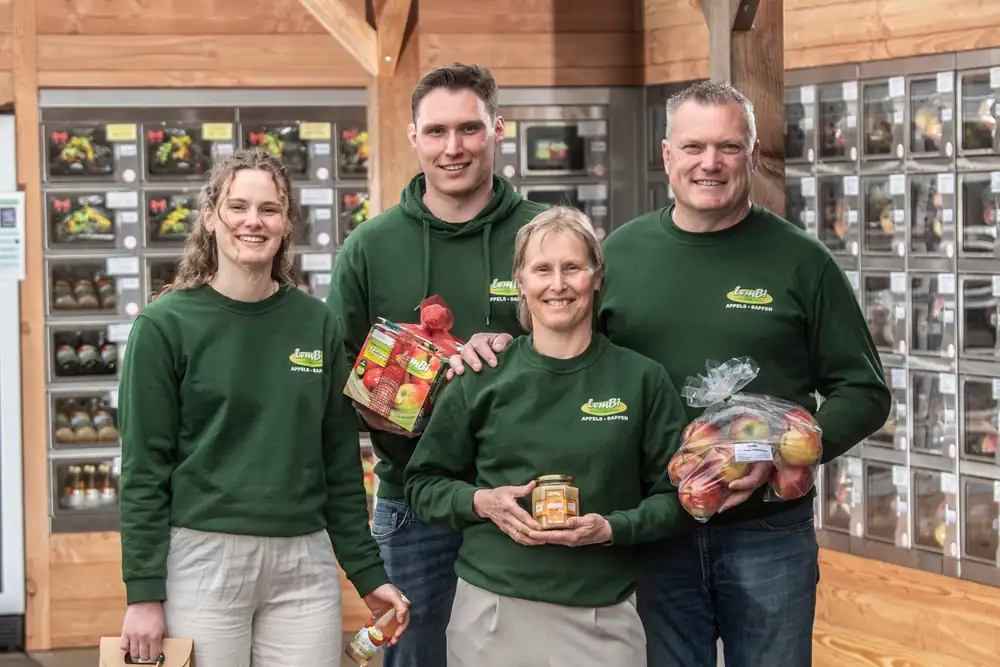
Kris and Ingrid Lemmens-Bierinckx founded LemBi Fruit 30 years ago, choosing a name that combines their surnames: Lemmens and Bierinckx. Sixteen years ago, they were looking for an effective way to offer their fruit directly to the general public and found the solution in LemBi vending machines. Through these machines, they sell 100% pure fruit and juice directly to consumers. The offerings have since expanded to include seasonal products from other growers, including berries.
Kris is optimistic about the upcoming season. Cultivation has been particularly challenging. "The combination of heat and drought, in particular, has put the plants to the test. The strong solar radiation has also been a problem. Thanks to the constant investments made in recent years to mitigate climate change risks as much as possible, we can now talk about a return on investment."
"For example, to protect the fruit from hailstorms, we covered our younger plants with anti-hail nets. Thanks to their shading effect and light diffusion, these nets offer protection even from intense sun, minimizing sunburn damage to the skin. Furthermore, this year, the investment in our anti-frost irrigation system, used against spring night frosts, has proven particularly useful, allowing us to cool the plants during the hottest days. Finally, thanks to the rainwater collection tank and drip irrigation system, the plants have continued to grow thriving: a factor that has really made a difference this year," says Kris.
Difficult growing conditions could also have repercussions on the market. "It's difficult to predict market trends precisely. However, adverse growing conditions could lead to a reduction in the availability of Class 1 fruit, thus improving the marketing prospects for quality fruit. This is a promising prospect. If the European harvest were to be lower, this could positively impact prices. I therefore believe that Class 1 fruit could achieve good prices this year."
From hail to vending machines Direct sales to consumers now play an important role in the company's business. According to Kris, this evolution arose following a difficult period. "On our farm, we suffered hail damage to our crops several times. In 2008, for example, the entire harvest was ruined, preventing us from supplying our customers with quality fruit. As a solution, we decided to produce apple juice. From there, the idea of installing vending machines to sell our products directly was born."
The initiative has been so successful that the short supply chain is now centered around this model. LemBi Fruit sells its products directly to consumers through vending machines. "That's why we chose the slogan 'Because taste comes first'. We leave the fruit on the plant for as long as possible, so it can develop its full flavor. It's really nice to hear our customers appreciate this aspect too," Kris emphasizes.
Direct sales also give the company the opportunity to better communicate the story behind its products. According to Kris, this is crucial at a time when consumers don't always realize how much work goes into growing fruit. "We believe it's important to share firsthand everything that goes into our crisp apples."
Producers must tell their story. According to Kris, this also entails a significant responsibility for the industry itself. He believes that consumers are increasingly interested in the provenance of their food, but that the story must be told directly by the producers. "I believe we producers must take on this responsibility. We must explain to consumers how we work and the challenges we face. I'm sad to see how, these days, statements from interest groups seem to be gaining more and more traction. We believe it's important to tell our story based on the facts."
According to Kris, Agriculture Day on September 13th was the perfect opportunity to strengthen the connection with consumers. "People can see firsthand what happens here. It's a labor-intensive operation, as well as investment in technology and innovation. This makes them realize that our apples and pears are truly healthy and accessible."
Agriculture Day For LemBi Fruit, the anniversary year began early with a stroll through the blossoming apple orchards. Visitors were able to wander among the blossoming trees and learn how the company addresses issues like night frosts. "We wanted to organize several activities to mark our anniversary. Ten years ago, we participated in Agricultural Day, which was a huge success; years later, people were still talking about it. However, organizing such an event during the busiest time of year requires a lot of work," Kris emphasizes.
On Agriculture Day, September 13th, dozens of farms opened their doors, offering visitors a behind-the-scenes look at fruit growing. The program included guided tours that illustrated, among other things, the various techniques used in orchards. Visitors were able, for example, to observe the use of special fans to protect crops from spring night frosts.
In addition to guided tours, LemBi Fruit has organized numerous activities for children and visitors, including a bouncy castle, a rope pyramid, and rides on the harvest train. Traditional specialties, such as sausages served with their own applesauce, and beverages, including the company's own juice line, are also available.
The advantage of its small size LemBi Fruit aims to stand out thanks to its relatively small size. "The advantage of a small company is the ability to adapt quickly. If we need to intervene or make a decision, we can do so very quickly."
In recent years, fruit growing has focused on new, more resistant varieties. LemBi Fruit is also following these developments with interest, but favors open-pollinated varieties over licensed ones. "This way, we maintain control over the price of our fruit, which I believe is important. At the same time, we've focused on growing more exclusive varieties, not available in large-scale retail outlets but highly valued in direct sales from farms. Sissired, Wellant, and Santana are excellent examples," concludes Kris.