Fig cake, the most delicious unknown
For 8 people, 1€/person. 290kcal/100g
- 350 g de higos frescos maduros pero firmes
- 220 g de harina de trigo de todo uso
- 60 g de almendra molida
- 140 g de azúcar blanco
- 15 g de azúcar blanco para terminar la superficie
- 3 huevos L
- 125 g de yogur natural entero
- 80 ml de aceite de oliva suave
- 12 g de levadura química o polvo de hornear
- La ralladura fina de 1 limón
- 5 ml de extracto de vainilla, opcional
- 2 g de sal
- Precalentamos el horno a 175 ºC, con calor arriba y abajo. Forramos la base de un molde desmontable de 22 cm con papel de horno y engrasamos ligeramente la base y las paredes.
- Lavamos los higos bajo un hilo suave de agua y los secamos muy bien. Retiramos el pedúnculo. Separamos aproximadamente 150 g para el interior y los cortamos en dados de 1,5 cm. Cortamos los 200 g restantes en cuartos, de arriba abajo, y los reservamos para la superficie.
- En un bol mezclamos la harina, la almendra molida, la levadura química y la sal. Removemos con unas varillas para repartir bien el impulsor y deshacer cualquier pequeño grumo de almendra.
- En otro bol batimos los huevos con los 140 g de azúcar durante 2 o 3 minutos, hasta que la mezcla esté algo más clara y haya ganado volumen. No necesitamos montar los huevos como para un bizcocho genovés; solo incorporar aire y disolver buena parte del azúcar.
- Añadimos el yogur, el aceite de oliva, la ralladura de limón y la vainilla, si la usamos. Batimos a velocidad baja o a mano hasta tener una mezcla homogénea.
- Incorporamos los ingredientes secos en dos tandas y mezclamos con una espátula, justo hasta que desaparezca la harina visible. No seguimos batiendo por costumbre: en cuanto la masa esté uniforme, paramos.
- Añadimos los 150 g de higo cortado y los repartimos con dos o tres movimientos envolventes. Vertemos la masa en el molde y alisamos ligeramente la superficie. Colocamos encima los cuartos de higo con la pulpa hacia arriba, repartiéndolos sin cubrir por completo la masa. Los hundimos apenas unos milímetros; durante el horneado bajarán un poco por sí solos.
- Espolvoreamos los 15 g de azúcar restantes sobre la superficie y llevamos el molde a la zona central del horno. Horneamos durante 45-50 minutos. A partir de los 42 minutos empezamos a comprobar: la superficie debe estar dorada, el centro firme y una brocheta introducida en una zona de miga, no atravesando un higo, debe salir sin masa cruda, aunque pueda llevar alguna miga húmeda.
- Sacamos el bizcocho y lo dejamos 15 minutos dentro del molde, sobre una rejilla. Después pasamos un cuchillo fino por el perímetro, abrimos el aro y dejamos que se enfríe por completo. Si lo cortamos caliente, la miga todavía estará asentándose y las zonas de fruta pueden romperse y parecer más húmedas de lo que realmente están.
Ingredients
- 350g of fresh, ripe but firm figs
- 220g of all-purpose wheat flour
- 60g of ground almonds
- 140g of white sugar
- 15g of white sugar to finish the surface
- 3 large eggs
- 125g of whole natural yogurt
- 80 ml of mild olive oil
- 12 g of baking powder or chemical yeast
- The finely grated zest of 1 lemon
- 5 ml of vanilla extract, optional
- 2 g of salt
We've been really going all out with figs these last few weeks. They've ended up in a galette, a no-bake tart, on a pizza, with burrata, with Camembert, roasted with goat cheese, in syrup… and there was one obvious use missing for a fruit that, when truly ripe, seems to have jam inside: making a cake.
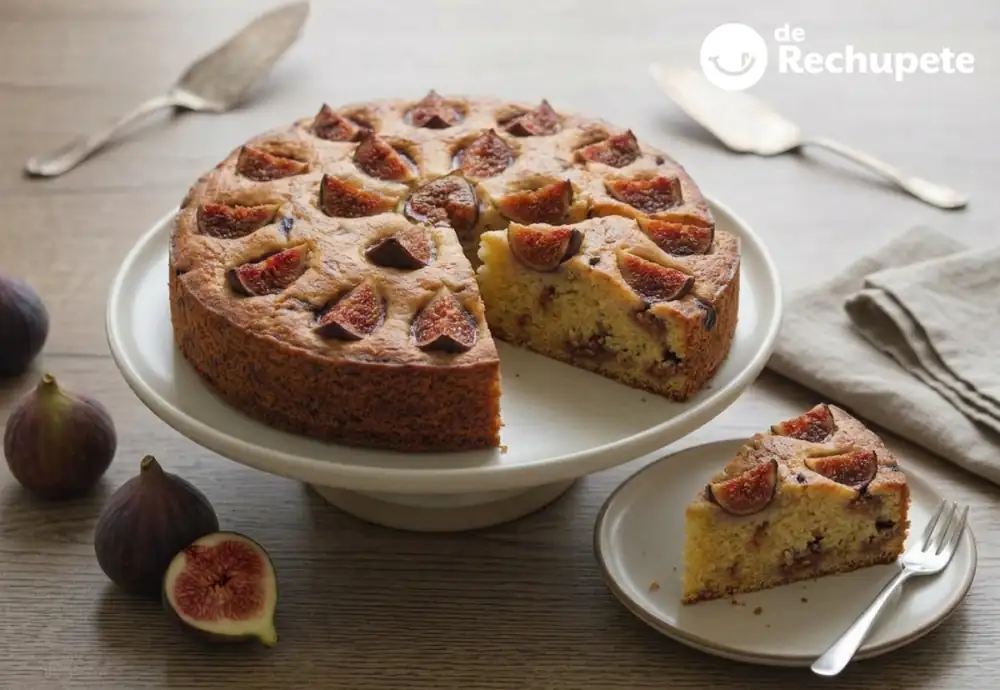
We could solve this by simply placing a few pretty figs on a basic pastry and calling it a day, but it wouldn't be enough. In this fig cake, we want to find the fruit even when we cut into it. That's why some of the figs are chopped and embedded in the pastry, while the rest are quartered and placed on top, where the oven concentrates the sweetness and makes the pulp even more tender.
We're not looking for a hidden compote or a cake decorated with figs: we want both at once, crumb and fruit. The dough contains yogurt, olive oil, and some ground almonds.
We want a tender, moist crumb, but one with enough body to support the fruit. Figs add quite a bit of water, and if we use too many or choose ones that are already falling apart when picked, we can end up with damp pockets around the fruit.
They're best here when they're ripe, aromatic, and soft to the touch, but still able to hold a clean cut. And there's another advantage: we don't have to peel them.
If the fruit is healthy and well washed, the skin is edible and becomes very tender in the oven. Remove the stem, dry the figs well, and continue.
Waiting for the cake to cool is hard enough without having to start peeling the figs one by one.
Step-by-step preparation
- Preheat the oven to 175°C (350°F), using the conventional setting (top and bottom heat). Line the base of a 22cm (9-inch) springform tin with baking paper and lightly grease the base and sides.
- Wash the figs under a gentle stream of water and dry them thoroughly. Remove the stems. Set aside approximately 150g for the filling and dice them into 1.5cm cubes. Cut the remaining 200g into quarters, from top to bottom, and set them aside for the topping.
- In a bowl, mix the flour, ground almonds, baking powder, and salt. Stir with a whisk to distribute the baking powder evenly and break up any small lumps of almond.
- In another bowl, whisk the eggs with the 140g of sugar for 2 or 3 minutes, until the mixture is slightly lighter in color and has increased in volume. We don't need to whip the eggs as much as for a Genoise sponge; just incorporate air and dissolve a good portion of the sugar.
- Add the yogurt, olive oil, lemon zest, and vanilla, if using. Beat at low speed or by hand until you have a smooth mixture.
- We add the dry ingredients in two batches and mix with a spatula, just until the visible flour disappears. We don't keep mixing out of habit: as soon as the batter is smooth, we stop.
- Add the 150g of sliced figs and fold them in gently with two or three movements. Pour the batter into the tin and smooth the surface slightly. Arrange the fig quarters on top, cut-side up, spacing them out without completely covering the batter. Press them in just a few millimeters; they will sink a little more during baking.
- Sprinkle the remaining 15g of sugar over the surface and place the tin in the center of the oven. Bake for 45-50 minutes. After 42 minutes, start checking: the surface should be golden brown, the center firm, and a skewer inserted into a crumbly area (not piercing a fig) should come out clean, although it may have a few moist crumbs.
- Remove the cake from the oven and let it cool in the pan for 15 minutes on a wire rack. Then run a thin knife around the edge, loosen the springform pan, and let it cool completely. If you cut it while it's still warm, the crumb will still be settling, and the fruit pieces may break and appear moister than they actually are.
Tips for a delicious fig cake
We don't need the most perfect figs in the box, but we do need healthy fruit.
Very ripe figs are perfect as long as they're still slicing easy; if they're falling apart or releasing too much juice, save them for homemade fig jam or another recipe where shape isn't important. The arrangement of the fruit is intentional.
The diced figs inside allow the flavor to show through the crumb, while the quartered figs on top concentrate the flavor without releasing all their juice at once. Adding all 350g of chopped figs inside would make even baking more difficult. The yogurt and almonds help create a tender crumb, but the cake shouldn't be undercooked around the fruit.
To check if it's done, we poke two or three spots in the crumb. If we hit a fig, the skewer will come out moist even if the cake is perfectly baked.
There's no need to aim for a very dark surface. If the cake is already nicely browned but the center still needs a few minutes, loosely cover the top with aluminum foil and continue baking.
Once cooled, store it well covered. The fresh fruit gives it a particularly moist crumb, but that same moisture means it's not a good idea to leave it uncovered on the counter for several days.
In a cool kitchen, it will keep well for a day or two; for longer, store it in the refrigerator and let it come to room temperature before eating. If you'd like to continue with cakes where the fruit is truly an integral part of the crumb, the cherry cake, the pear cake, and the apple and walnut cake take quite different approaches. They are three good continuations if you feel like continuing to bake with fruit.
Some questions about fig cake
Will the figs sink and make the cake soggy? They might sink a little during baking, and that's perfectly fine.
What we want to avoid is a large concentration of very watery fruit at the bottom. That's why we use a fairly thick dough, limit the amount of chopped fig inside, and leave the rest on top.
It's also a good idea to dry the fruit well and not use figs that are practically mushy. Do you have to peel the figs before adding them to the cake?
No. The peel is edible if the fruit is healthy and well washed and, after baking, remains tender.
We only remove the stem. Peeling them makes the pieces more delicate and causes them to lose pulp and juice while we handle them.
Can I make the cake with dried figs? I wouldn't replace them one by one with fresh ones.
Dried figs have much less water, a more concentrated sweetness, and a much denser texture. We can certainly make a cake with dried figs, but we'd need to adjust the quantity, and it's usually best to rehydrate or chop them in a different way. In this recipe, fresh figs contribute to the final texture, not just the flavor.
Once completely cooled, this cake doesn't need icing, honey, or powdered sugar to work. The fig quarters on the surface remain visible and slightly sunken, and when cut, small pieces also appear within a moist, soft crumb with an almond and lemon undertone that complements the flavors without overpowering the recipe.
Last revision: September 4, 2026
We've worked 3 hours and 00 minutes to bring you this recipe. How is that calculated?
70 minutes cooking, 30 minutes taking and editing photos, 45 minutes writing, and 35 minutes organizing and publishing everything on the website and social media. 😊 Not counting the time we spend researching how to make the best recipe, buying the ingredients, eating it (and making it again if it wasn't perfect), reading your comments, and answering your questions.
Categories: Cooking Recipes, Cake Recipes, Fruit Dessert Recipes, Dessert and Sweet Recipes