Is Gesha losing its grip on coffee competitions?
Estimated reading time: 8 minutes
Key takeaways
- Gesha still dominates coffee competitions, but its lead is narrowing.
- Competitors increasingly blend Gesha with other coffee varieties.
- Non-Gesha varieties now win major competitions, including Global Coffee Awards and Cup of Excellence.
- Local terroir and careful processing help other varieties beat Gesha.
Gesha has dominated global coffee competitions for the past two years.
Most finalists used the variety at the 2025 World Barista Championship and the 2026 World Brewers Cup. A newer trend has emerged alongside that dominance: competitors are increasingly blending Gesha with other varieties rather than relying on it alone.
Meanwhile, at the Global Coffee Awards and Cup of Excellence competitions, non-Gesha varieties are taking the top spots. Gesha still holds the most category titles overall and remains the highest-performing variety in competition circles. But other native and locally adapted varieties are now beating it.
You may also like our article on why there’s no best origin for Gesha.
Gesha blends become more prominent
Gesha is a darling of specialty coffee and has broken numerous records at major coffee auctions. Panamanian Gesha is renowned for its exceptional quality and distinctive flavour profile, while the Gesha coffees grown at Gesha Village in Ethiopia are equally prized, and Colombia has also built a reputation for growing the variety.
Once Gesha became highly sought after, World Coffee Championship competitors moved quickly to source exceptional lots. It is now one of the most used varieties at global coffee competitions, thanks to its consistent ability to score well.
Other high-scoring varieties are now challenging that dominance. Competitions in the early 2020s already showcased finalists using lesser-known varieties with equally exceptional tasting notes, including eugenioides, Pink Bourbon, Ombligon, and Typica Mejorado. World Barista Championship and World Brewers Cup competitors are also increasingly blending Gesha with other coffees.
These blends give competitors a way to combine the strengths of each variety and create new flavour experiences. At the 2023 World Barista Championship, winner Boram Um blended Gesha with Pink Bourbon to give his drinks both complexity and body.
A year later, Japan’s Takayuki Ishitani used a blend of Gesha and Caturra, pairing Gesha’s floral character with Caturra’s fruit notes. In 2025, Malaysia’s Jason Loo continued the trend, blending a delicate Panamanian Gesha with a bold Malaysian liberica.
Other varieties are challenging Gesha’s dominance
Blending is not the only story, though.
At the 2025 Global Coffee Awards World Championship, only six of the top 25 coffees were Gesha. A Parainema from Honduras scored highest, and varieties including Purple Caturra, Sidra, Pink Bourbon, Ombligon, Typica Oxy, Sarchimor, and SL28 also scored strongly.
Non-Gesha varieties are winning Cup of Excellence competitions too. Parainema proved itself again at the Honduras Cup of Excellence, while a Washed Java topped the Cup of Excellence Costa Rica. At the 2026 Cup of Excellence in El Salvador, the winner was Bernardina, a rare Ethiopian landrace arabica variety grown in the country.
Maria Pacas, Commercial Director at Café Pacas, says winning first place at Cup of Excellence means more than producing a remarkable variety. “It is the result of years of observation, research, patience, and the collective effort,” she says. Bernardina’s story began in 2012, when Maria’s family acquired Finca Los Bellotos in the Cerro Verde region of El Salvador. Farm manager Ruperto Bernardino Merche identified 13 coffee trees growing among the farm’s Bourbon and Pacas plants that seemed different from the rest.
Cherries from those trees produced a distinctly different taste, with vibrant tropical fruit characteristics reminiscent of papaya and passion fruit. “We processed the coffee as a separate lot and were immediately amazed by the cup,” Maria says. “It revealed an extraordinary sensory profile unlike anything we had experienced before.”
The family sent samples to a genetics laboratory in Italy for DNA analysis, which confirmed the trees did not match any documented coffee variety. Maria believes Bernardina performs so well in competitions because of its clarity and precision. “Many exceptional coffee varieties are complex, but what makes Bernardina stand out is how clearly its aromas and flavour attributes can be identified.”
Competitions are opening up to alternatives
Competitors at the World Barista Championship and World Brewers Cup still feel pressure to use Gesha, given its track record.
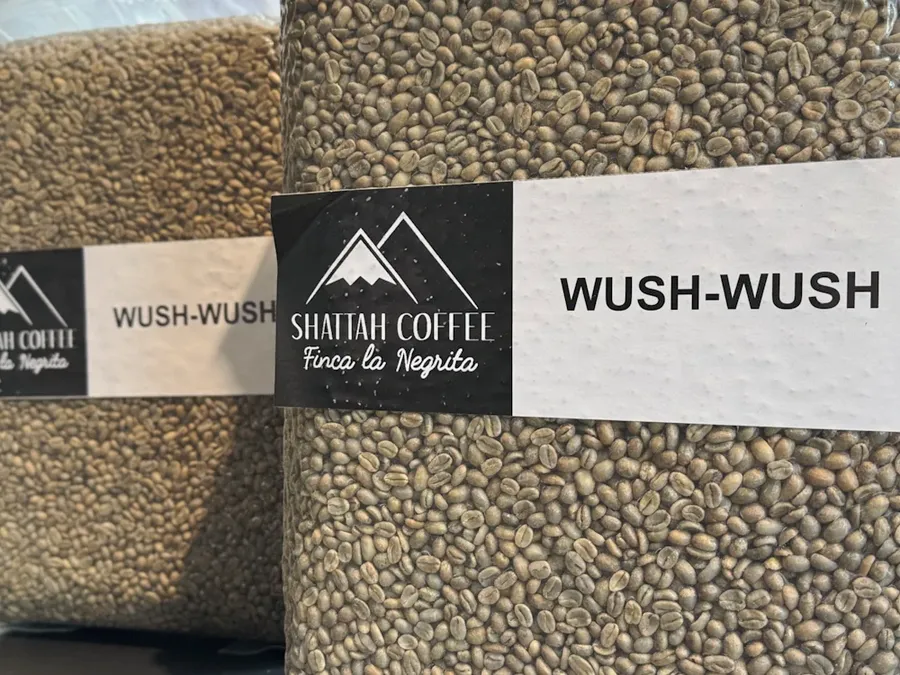
Christopher Hoff, Academy and Customer Experience Specialist at Rebel Denmark, chose a different path for his 2025 World Barista Championship routine, using the Wush Wush variety instead. Christopher worked with Mauricio Shattah at Finca La Negrita, who had spent years perfecting his Wush Wush production. “What elevated this particular coffee was the combination of the terroir at La Negrita and Mauricio’s processing,” Christopher says. “The nuruk inoculation and the two-stage natural process brought out what was already there in the variety, while adding a level of sweetness, fruit character, and complexity I had never experienced in another Wush Wush.”
Finca La Negrita’s work with Wush Wush shows how a push for something new can open opportunities for varieties beyond Gesha. When these varieties adapt well to local terroir and receive the right processing, they can perform strongly in competitions and auctions.
“When people hear Gesha, they are already primed to expect something beautiful. With Wush Wush, they come in with more uncertainty,” Christopher says. “That can work against you, but in a competition setting, it can also become an opportunity. If you hand someone a coffee they think they already understand, and then give them something that completely changes that understanding, it becomes memorable in a different way.”
What comes next
Coffee competitions may loosen their pull toward Gesha as more organisers reward clarity and terroir expression over variety alone.
The Global Coffee Awards and Cup of Excellence results already suggest judges respond to distinctiveness rather than reputation. If this approach spreads to the World Barista Championship and World Brewers Cup, producers growing native or locally adapted varieties gain a more realistic route to recognition. Christopher Hoff’s Wush Wush routine points to where this could lead: competitors choosing coffees for what they express, not what judges expect, and producers gaining visibility they previously lacked.
Maria remains optimistic about the opportunities still ahead. “As coffee producers, we often focus on improving what we already know. But sometimes the greatest opportunities come from slowing down, observing, and being curious enough to ask why one tree looks or tastes different from another.”
She believes coffee still holds countless discoveries. “In a world that often expects immediate results, Bernardina has taught us that meaningful innovation takes time. It takes years of observation, research, investment, and continuous learning before the full potential of something can be understood.”
Gesha remains coffee’s most decorated competition variety, but its dominance no longer goes unchallenged. Parainema, Bernardina, Wush Wush, and other locally adapted varieties are proving that terroir and careful processing can rival even Gesha’s reputation. For producers, this shift signals opportunity: success in competition no longer depends on growing the same celebrated variety as everyone else.
Need more leads for your coffee business? Get in touch with PDG Media, our marketing agency dedicated to specialty coffee, here.
Gesha FAQs
Why has Gesha dominated coffee competitions?
Gesha built its reputation through consistently high cupping scores and record-breaking auction prices, particularly from Panama and Ethiopia’s Gesha Village. Competitors trust it to perform, so they source exceptional lots for their World Barista Championship and World Brewers Cup routines.
Which varieties are challenging Gesha’s dominance? Parainema, Bernardina, Pink Bourbon, Sidra, Ombligon, and Wush Wush have all scored highly or won outright at recent competitions, including the Global Coffee Awards World Championship and Cup of Excellence events in Honduras, Costa Rica, and El Salvador.
Why do competitors blend Gesha with other varieties? Blending lets baristas combine strengths from different varieties, creating layered flavour profiles that a single variety cannot achieve alone. World Barista Championship competitors such as Boram Um, Takayuki Ishitani, and Jason Loo have paired Gesha with Pink Bourbon, Caturra, and liberica for added complexity.
- Who: Gesha · World Barista Championship · Wush Wush · World Brewers Cup