Salt in pasta: when should you add it? The eternal dilemma, answered by science
We're back to talking about cooking pasta: when should you add salt? It's an eternal dilemma, and even science has been involved in trying to provide a concrete answer.
One of the aspects we tend to overlook when we talk about cooking is the ease with which we create our dishes. We think it's simply a matter of assembling the various ingredients, but in reality, it's much more.
In a certain sense, we can define the preparation of a dessert as a chemical experiment that must be carried out to ensure that all the ingredients can be assimilated in the best possible way and thus obtain the desired result.
The same can be said for pasta, not only regarding the preparation of the recipe, but also regarding the cooking, given that numerous mistakes are still made in this regard today.
Salt in pasta: don't make this mistake
When we talk about salt in pasta, therefore, we're not just referring to a flavor enhancer, but also to that secret ingredient that will allow us to achieve the desired flavor.
A practical example to illustrate what we're talking about is the type of sauce we choose for pasta. Indeed, one of the most common mistakes involves the amount of salt. Even when the sauce is particularly flavorful, salt should be added to pasta in this way: rather than using 4 g of salt per 200 g of pasta, we reduce it to 3 g.
But it doesn't end there: the timing of salt addition is also crucial for cooking. It may seem trivial, but it's important to pay close attention if we want to avoid salt damage to the food.
When should you actually add salt to pasta?
We can safely say that it makes no difference when you add salt to pasta during cooking. Let's say that, to a certain extent, it's a matter of habit, because the food will be flavorful regardless of whether you add it before or after the water begins to boil.
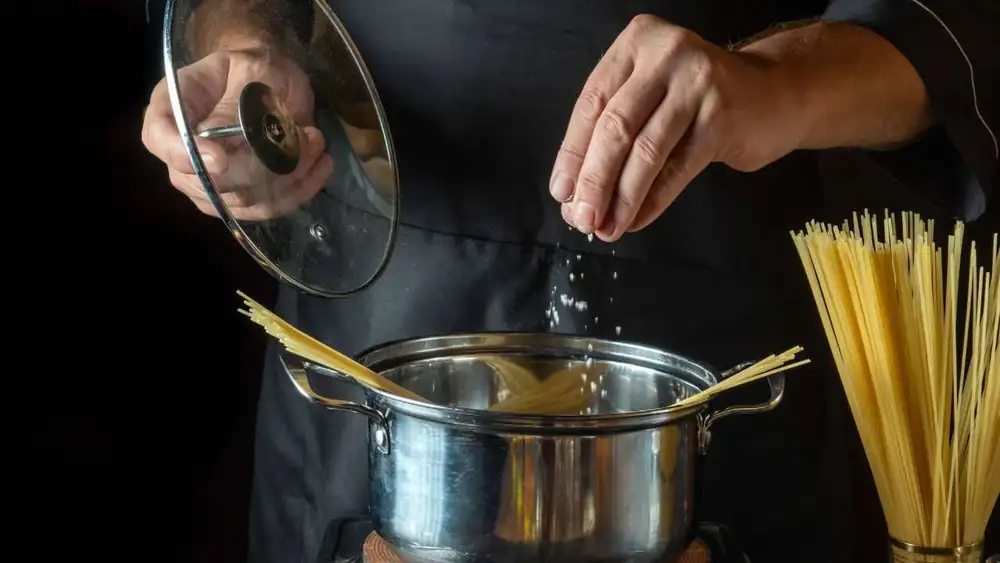
If you want to cook your pasta perfectly, we recommend adding salt to the water as soon as it starts to boil. This way, the water will heat up more quickly and the pasta will cook just as quickly. And that's not all, because having flavorful water automatically results in a more evenly flavored pasta, which will cook evenly if drained at the right time.