Grappa is Alpine culture: it is not in a hurry and rewards those who take their time
In autumn, the Trentino trails empty and the woods turn coppery. We climb slowly to the refuge, where a burning stove awaits those who hike. Here, Trentino grappa becomes a ritual of hospitality and sharing: a measured tasting, high-altitude pairings, and the rediscovered time spent together in front of the fire.
There are moments in autumn when the Trentino woods seem to hold their breath. The larches have turned the color of honey, the beeches that of copper, the grass in the pastures has stopped growing vigorously. The air is so clear that the peaks, kilometers away, seem within reach. You walk, and every sound has an echo: footsteps on leaves, the clinking of a water bottle, a crow moving from one slope to the other.
Then, around mid-afternoon, after the climb, the refuge appears. A wisp of smoke from the chimney, fogged windows, a door opening onto the smell of wood, broth, and bread. You take off your boots, reach toward the stove, and somewhere, on a shelf, there's almost always a clear bottle. At that precise point in the day, the trail and the Trentino grappa meet. This is where this story aims to take the reader, step by step.
Autumn, the slow season of hiking in Trentino
The outdoors is, without further ado, Trentino's most authentic tourist attraction. The Dolomites, a UNESCO World Heritage Site, the Brenta and Adamello massifs, the long, wild ridge of the Lagorai: a region crisscrossed by a dense network of trails, mountain huts, and refuges, where you can hike for a day or a week. Summer has its rituals and its crowds. Autumn has more to offer.
In autumn, the trails empty and the colors come alive. The light is lower and more grazing, the days grow shorter, and this dictates a different pace: we set out early, we climb slowly, we calculate to reach the refuge while the sun is still high. It's the time for slow walking, a time that measures not only kilometers but also rest stops. We stop to gaze at a valley changing colors, to fill our water bottles at a fountain, to listen to the wind in the fir trees. And meanwhile, without saying it, we prepare for the pleasure to come, because every flavor is more distinct when earned with our own legs.
The journey thus also prepares for the next moment. After a climb, the body seeks refreshment, and the landscape seems to spontaneously suggest a warm place to rest. The refuge then becomes a sort of natural landing place: not just a shelter, but a space in which to rediscover the pleasures of food and conversation.
And it's here that grappa takes on a special meaning. The same grappa tasted at the end of an autumn hike takes on a different meaning. It comes after hours spent outdoors, after the effort of the climb and the satisfaction of the descent. Outside, there are the forest, the wind, and the mountains; inside, a burning stove, the aroma of cooking, and the voices of those who have just sat down to dinner.
It's at this point that the spirit becomes part of a broader experience. Grappa isn't just what's in the glass, but also the moment in which that glass is shared.
Grappa, the last step of the journey
The relationship between mountains and distillate is deeply rooted in an ancient familiarity. Trentino grappa is made from a raw material deeply rooted in the winemaking region and brings with it a culture of gestures, skills, and expectations. At high altitude, however, its value is not limited to its sensory characteristics. A small glass can become a sign that the journey is entering its most convivial phase.
It's not necessarily about drinking a lot, nor about turning grappa into a reward in and of itself. On the contrary, its charm lies precisely in moderation: a thoughtful sip, perhaps shared after a meal, capable of accompanying a conversation while the temperature drops outside and the fire continues to crackle inside the refuge.
It's a mountain experience that's part of Trentino's culture of hospitality: welcoming guests, offering them something warm, serving local produce, and taking the time to spend time together.
Trentino Grappa is a recognized Geographical Indication, a formal link between the spirit and its land. The Trentino Grappa Protection Institute preserves and narrates its identity, because behind every bottle are valleys, grapes, and dedicated hands.
High-altitude pairings
At the refuge, the cuisine is generous, and grappa finds its place naturally. You don't need a sommelier: just listen to the dish.
Young grappas are those that have never been aged in wood: clear as spring water, with distinct grape aromas and a palate-cleansing freshness. Served chilled, between 8 and 10 degrees Celsius, they are the natural companions for hearty traditional dishes: dumplings, polenta with mushrooms and melted cheese, luganega with sauerkraut, stew, and barley soup. The richness and savory flavors of these dishes find a lively counterpoint in the spirit, and the meal concludes in balance.
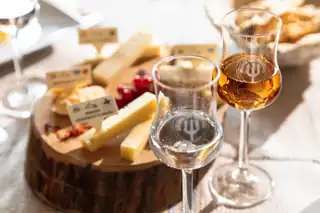
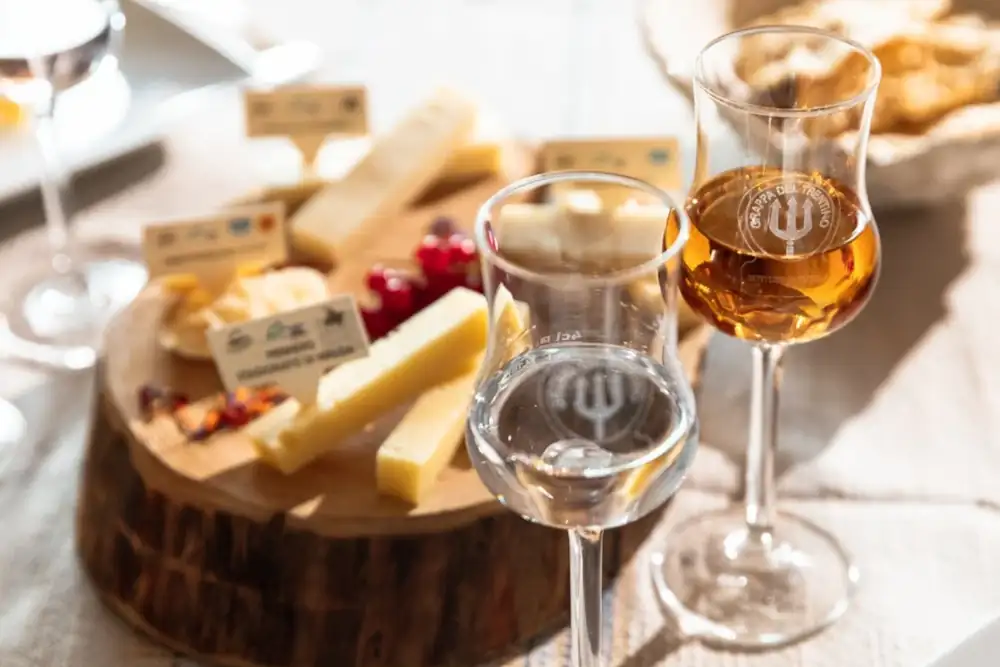
Grappas made from aromatic grapes, such as Moscato and Traminer, are more elegant and nuanced. With medium-aged mountain cheeses, they play on the contrast between the floral sweetness of the distillate and the savory flavor of the mountain milk.
The straw-yellow, wood-aged grappas have spent a few months in barrels, endowing them with smoothness and a hint of vanilla. These grappas are perfect for mid-afternoon breaks, pairing well with mature cheeses, walnuts, and roasted chestnuts.
Then come the aged grappas and the barrique-aged reserves. According to Italian regulations, aged grappa rests at least twelve months in wood, while the reserve or extra-aged grappa ages for at least eighteen. During those years, the color turns amber and the aroma takes on dried fruit, vanilla, sweet spices, and cocoa. It's time for warm apple strudel, with cinnamon, raisins, and still-warm pine nuts, but also for zelten, buckwheat cake, and a square of dark chocolate. The dessert brings the cinnamon, the grappa brings the wood, and together they warm the end of the day.
The stove ritual: grappa is conviviality
What grappa conveys at high altitude is, above all, a gesture. In the refuge, you don't drink alone: the glass is passed around, you pour in turns, often the manager brings it at the end of the meal as a farewell, a way of saying that the day was a good one. You speak softly, you exchange trails you've completed and those still to be tackled, you watch the lights come on in the valley. Whoever was a stranger at midday is a dining companion by evening.
In this, grappa resembles the mountains: it takes its time and rewards those who take their time. The social ritual of sharing is a form of hospitality that has been part of Alpine culture since long before anyone called it experiential tourism.
The return, with the heat on your back
Then we set off again. The light is already low, a smell of resin and humidity rises from the woods, and down in the valley the windows begin to light up. The warmth of the stove accompanies us for a stretch of the trail, then melts away and becomes a memory. The flavor remains, a phrase spoken at the table remains, the desire to return when the snow whitens the peaks and the refuge will be, for a few months, just a distant speck of light.
Walking in Trentino in autumn means moving slowly through time. Trentino grappa stops it for a moment: a glass of Trentino grappa, surrounded by people who have just walked a stretch of life together. True luxury, after all, is giving yourself time for these rituals.
Key points:
- Autumn, the slow season: emptier trails, low light, and a calm pace transform the hike into a journey through the Trentino landscape.
- The refuge as a landing place: after the climb, it is the place where you can find the table, the warmth of the stove, and conversation.
- A recognized bond: Grappa del Trentino is a Geographical Indication, protected and described by the Istituto Tutela Grappa del Trentino.
- High-altitude pairings: young grappas, served chilled between 8 and 10 degrees, with dumplings and polenta; aged grappas and reserves with strudel, zelten, and dark chocolate.
- The ritual of sharing: a conscious tasting is more of a gesture of hospitality than a reward.