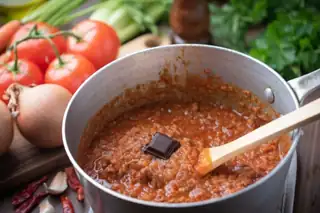
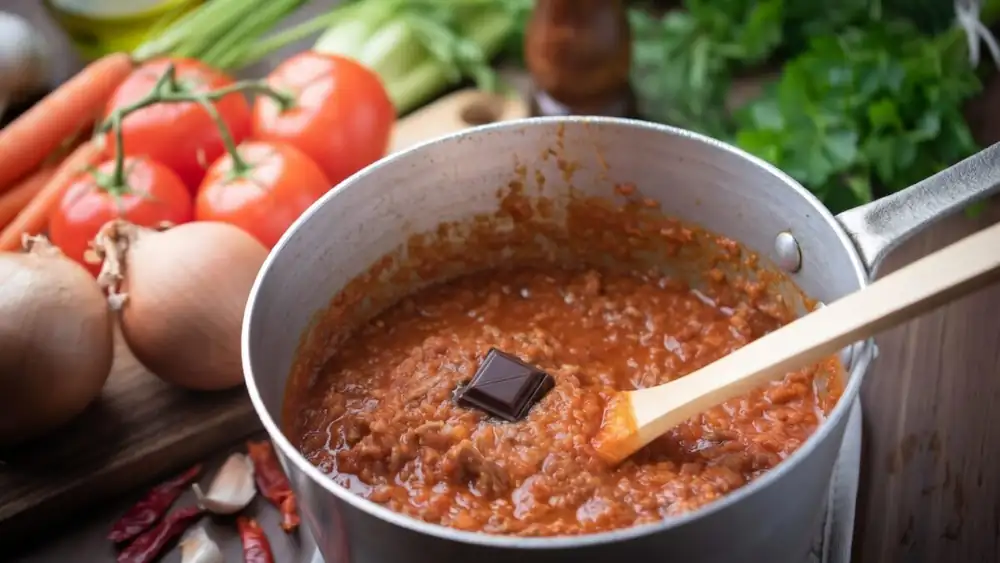
Why do we add chocolate to ragù or sauce? Where is it used and why is it done?
Social media provocation or grandmother's secret? You've probably seen videos recently of foreign men and women putting a square of chocolate in their Italian partner's ragù, causing a similar reaction to pineapple pizza.
Why do we put chocolate in ragù?
Contrary to popular belief, chocolate isn't meant to sweeten ragù or meat stews. Its historical use is to balance the intense flavor of gamey meats with its bitter note, creating a deeper, more aromatic flavor and also lending density to the sauce's structure. It's not usually used alone, but in tandem with other ingredients that serve the same purpose, such as spices. Chocolate in sauces doesn't reduce the actual acidity of tomatoes, but rounds out the perception on the palate thanks to the fat content of cocoa butter and the harmony of its bitter notes.
Chocolate in Meat: Here's Where to Find Them Together
It is the recipes of late Renaissance and Baroque banquets that help us understand the best combinations with chocolate or cocoa: the chocolate bar as we know it today, in fact, had not yet appeared (it would do so in the 19th century) between the 17th and 18th centuries and this exclusive food was consumed mainly as a drink, enriched with spices such as anise, cinnamon, pepper, and chili pepper.
The blend works not only in the cup, but also to lend a luxurious touch to dishes served at court: the most sumptuous meals featured mainly game and wild fowl, the spoils of hunting expeditions organized by the nobility. A recipe that comes from an ancient tradition, dating back to the Medici, is that of Tuscan wild boar in dolceforte: a stew in which the meat is first marinated in red wine, pepper, and cinnamon, then slowly cooked, and finally embellished with chopped dark chocolate, pine nuts, and candied fruit. Another dish, a very high-quality French royal dish, aptly named lièvre à la royale, appeared in 1775: it features a hare roll stuffed with pork, foie gras, mushrooms, and truffles, whose thick red wine sauce was traditionally enriched with spices and a touch of cocoa or bitter chocolate to balance the strong gamey notes.
And in ragù, where did our research begin? In Bolognese ragù there is no trace of this "secret" ingredient, but it is mentioned in some versions of Neapolitan ragù, which originated as a leftover recipe that includes tomato puree, beef, and pork (from sausage to pork rind), as well as pine nuts and raisins found inside the chops, cooked together with the sauce. Melting a small square of dark chocolate harmonizes the whole thing, and it's not Michelin-starred chefs who say so, but popular tradition.
Which chocolate to choose?
We've mentioned it several times: dark chocolate is best suited to enhancing savory recipes. Its bitter note pairs perfectly with the strong flavors of meat and the acidity of tomatoes. We recommend using its most versatile version, 70% dark chocolate, as it's made up of 70% cocoa mass and the remaining 30% sugars and cocoa butter. The flavor is rich and bold, but not pungent, and the texture is velvety, ideal for adding body to sauces when melted. How much should you use? A small square, equivalent to about 5-6 grams, is enough for ragùs: the flavor shouldn't be noticeable. In stews, however, especially if based solely on game, you can use up to 20-30 grams per 1 kg of meat, finding the right balance with spices and nuts. Finally, add it only when cooking is practically finished, mix and let it rest before seasoning the pasta or serving the second course.