Juan Fuster, of Celler Quantic: The vineyard is a laboratory of life
A particle physicist, researcher at the Spanish National Research Council (CSIC), and one of the driving forces behind the ALMA project (an ion accelerator with medical applications), Juan Fuster has dedicated much of his life to understanding nature through science.
Talking to Juan Fuster about wine inevitably leads to talking about science, but also about family, landscape, depopulation, climate change, people, and that wisdom which, as he himself explains, does not always have to do with how much we know, but with how much we have learned to live.
In Agres, where the sound of cicadas accompanies our conversation, we talk about physics and viticulture, the recovery of small plots, the difficulty of making a way in the market, their crowdfunding campaign and a project that, beyond making wine, tries to preserve a way of relating to the land.
From physics to the vineyard: returning to the roots
Most people know you for your work as a physicist and for projects like ALMA, which is developing an ion accelerator with medical applications. How did that shift, that journey, from particle physics to viticulture happen?
We considered returning to the region, and it was a way to reconnect with family, friends, and the roots we came from.
It was also a way to harmonize the dialogue with everyone I interacted with here. When you're talking about particle physics on a Sunday, over a paella, the discussion lasts only a few seconds, and I'm the only one talking. But if we're talking about vineyards, land, whether it rains or not, when it's best to plant... then everyone has an opinion, everyone chimes in. It's a way to connect.
We had a plot of land that wasn't exactly well-maintained, and José Ignacio Latorre, whom I had met at several physics schools, and I discovered that we both enjoyed the world of wine. It was a way to step outside our professional fields and, at the same time, create moments we could share with our families. That's how this hobby was born.
We reclaimed that land, and now I'm especially pleased because the vineyard has even become a great firebreak. We're right below Montcabrer, in the Sierra de Mariola, in an area full of houses, and keeping that land cultivated also serves to protect the landscape.
So, what weighed more heavily: the emotion of recovering a family vineyard, the scientific curiosity to better understand nature, or a little of both?
I believe it's a complementarity of everything. As a scientist, and more specifically a physicist, what drives me is understanding nature. All of that has ultimately been reflected in the vineyard.
It could have been olive oil, perhaps, but wine has something different. The culture of wine captivates you because it's not just about cultivating the vine; then you have to make the wine.
And in wine, often the differences lie in small details.
One of the most appreciated aspects is precisely the complexity: achieving harmony among all those flavors that interact and ultimately result in a product that is often unique. Even if you do exactly the same thing the following year, it won't turn out the same.
Even the same wine, made in different vats following the same process, tastes different when you taste it.
It would be impossible to describe wine in a single sentence.
For me, wine is impossible to describe in a single sentence; it has many adjectives.
It is complexity, it is balance, it is nature, it is also science, it is overcoming challenges, it is being in contact with nature… It is all that and more.
You say that wine is a science, but science works with provisional certainties, which keep changing until another researcher establishes a new hypothesis, while wine works with permanent uncertainties. Are you comfortable with that balance?
That's part of the scientific method.
Progress consists of being self-critical, being modest, dedicating your whole soul to achieving something and, once you have achieved it, knowing that there is still more to come.
I think wine sums up that spirit very well.
We put in a lot of effort, we believe we make a good wine, but we will definitely continue trying to improve it.
What can wine learn from science, and what can science learn from viticulture and oenology?
I try to avoid overly simplistic arguments. For me, balance lies precisely in putting arguments from both sides on the table, weighing them up, and trying to get the best of both worlds. That's what I try to do.
Sometimes you succeed, and sometimes you don't.
Would you say, then, that a vineyard can become an open-air laboratory?
Undoubtedly. But not only in the technical sense of the word. The vineyard is also a laboratory for the individual.
The vineyard we have up here is a part of my life. I planted it with my father, who passed away last year, and I still get emotional thinking about the moments we shared there, about how excited he was to see it grow.
My children, my nephews… I have photographs of my nephew in the vineyard, when he was a very small child and now he is a grown man.
That's why I assure you that the vineyard is a laboratory of life, a laboratory of science as well.
I want my fellow researchers to be able to use it to learn, to study how to farm better, with more balance, and also with more respect for nature. And we have to do this by preparing for what's coming. Climate change is here, whether we want to accept it or not.
Historically, changes in nature have been slower, allowing it to adapt more gradually. Now they are happening very quickly, and we will probably even have to help nature through this process of change.
But can we really help a nature that constantly shows us that it is much wiser than we are?
Nature is not only incredibly wise, it will surely outlive us because it seeks balance. It may be us who don't survive.
We now have technologies capable of impacting nature itself, and that's a fact we need to understand and better grasp, and try to find a balance. We can't think that we're on an island and nature is somewhere else. We are also part of nature, and we have to learn to coexist with it.
Field and memory
Those of us who live in a big city go to the countryside and think "how beautiful", but many times we are completely removed from the effort required to maintain that landscape.
I completely agree. The life we lead in cities makes us quite ignorant of the real needs of the countryside, of vineyards, and of the balance we want to achieve.
It's easy to say, "I like nature in balance." Finding it is another matter entirely.
Everyone wants to go to the supermarket and find cherries in spring, summer, winter, and autumn. But here, cherries only grow in spring; if you want them year-round, you have to import them.
When you live close to the land, you understand these circumstances better. If we want to respect nature, we have to understand it. And our land can't produce cherries all year round.
There is something that appears constantly in your project: territory and origin. Did your father also come from the agricultural world?
My father always had a field, although I think he also discovered it relatively late.
She worked in a factory in Alcoy and her whole life had been connected to the industrial world. But when she bought the house, she became increasingly rooted in it. She started her own small vegetable garden and used the produce the land gave her, making preserves, jams, the quince paste my mother used to make… All sorts of things that you would later eat, all made from produce grown within a little over 200 meters of her house.
And, of course, everything is prepared in a traditional and healthy way.
These are skills that disappear if they are not passed on, right?
They've already been passed on to me, and even though I come from a scientific and highly technological world, it's within me; I feel it. And I also try to pass it on, not because I consciously set out to do so, but because I live it. You transmit what you live.
When we describe a wine and talk about varieties, barrels, scores, etc., aren't we reducing to measurable parameters something that contains many things that cannot be expressed with numbers?
Absolutely. Wine has a tangible and an intangible aspect, and the intangible aspects have a value that depends on each person. In our case, for example, wine represents a connection to family, an attempt to recover lands that are being lost and that, otherwise, probably wouldn't be recovered.
It also signifies that rural world that is becoming increasingly abandoned. There are young people who even ask themselves: Why did I have to live here? And that's terrible because they have the opportunity to live in privileged places, but external pressure makes them feel different or that they lack the necessary resources to live a life in keeping with the times.
For me, among the intangible aspects of wine is also the ability to help those people, to restore the landscape and to maintain it.
It may seem beautiful to see a forest full of pine trees, but we already have far too many pine trees. The forest is proliferating, and if the land isn't cared for, the risk of fires also increases. Looking after the countryside is important not only for those who live there, but also for everyone else; otherwise, we lose nature, landscape, and wealth. For me, wine represents everything that can be done to help people in rural areas and to restore that landscape.
The diversity of ways of living and understanding the world, if not nurtured, will eventually be lost. Ultimately, the complexity of wine is also reflected in our lives: if we don't cultivate it, we'll all end up the same, all shopping at supermarkets.
Don't you also think that this return to one's roots has something to do with the life cycle? At twenty, you want to go out, see the world, travel… and then perhaps you need to return, to reconnect with your homeland.
Yes, certainly. But I also believe that there are young people, fortunately, who already have that need to care for the land and to revitalize rural life. The important thing is that the conditions exist for them to do so.
Celler Quàntic: learn, try and not settle
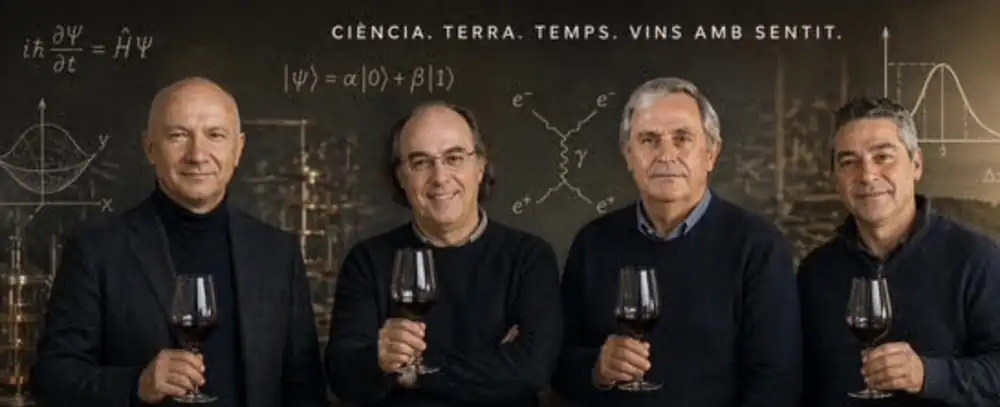
How do José Ignacio Latorre, a prominent theoretical physicist and researcher, and Artur Ekert, a cryptophysicist and professor at Oxford University, as well as your brother-in-law Jordi Miguel, become involved in the project?
José Ignacio and I knew each other from the field of physics and shared that curiosity about wine, and from it this project was born, in which my father and my brother-in-law Jordi, a great defender of artisanal work, also embarked.
Jose Ignacio kept talking about the project and, at some point, mentioned to Artur what we were doing. I didn't know him until he came one summer and we met in Agres, and he also became captivated by the project.
Now he comes every year. He travels a lot because his professional life is divided between Oxford, Singapore, Okinawa, and other places, but I can see that he's very passionate about this project. I think that, in addition to the challenge of making a great wine, he really appreciates the roots of it all—finding a house and an old warehouse where oil and wine were made, reclaiming a space that had lost that function decades ago, and bringing it back to life. That has something very special about it.
And then there's the challenge of making a really good wine.
Yes. We want to make a good wine, and when I say good, I mean top-quality. We want to achieve the highest possible quality and, moreover, for it to truly reflect the grape and our terroir.
We are scientists, and I believe we are top-level scientists, so we want the wine to be at that same level. It's a challenge because we've never done it before, but that's the goal.
Do you also apply the scientific method to the manufacturing process?
We have a methodology and a way of thinking, but above all we have a way of learning.
You try something and immediately ask yourself: - What have we learned?
If something works, we continue down that path; if not, we abandon it. We do this analysis continuously. And I believe that, precisely as scientists, we are always willing to learn. We listen to any person or entity that can help us or contribute ideas, and then we try to apply what we've learned using our own judgment.
You're a small winery. How are you defining your range?
Precisely because we are small, we can't make a huge number of wines. We have to discover which wine we can make the most of within our limited resources.
In our red wines, we're defining two lines. One would be a full-bodied red, with the potential to become a great wine and have aging potential, based on Syrah, accompanied by Tintorera and other nuances from different varieties in the region. But we've also learned that this isn't enough and that we're in a time when less wine is being consumed and there's a demand for lighter, more accessible wines. That's why we've started working on what will be our second line: a slightly lighter wine, but one that's still very good.
In this case, we focus on the world of micro-vineyards. Some are ours, and others we lease. Many originated with people who simply wanted a few vines and planted a little Garnacha, a little Monastrell, Cabernet Sauvignon... This gives us a diversity of grapes that, although some are widespread varieties, have a different expression here. They have this soil, this sun, and this Mediterranean character. And that blend forms part of the line of our lighter wines.
The idea is that someone accustomed to more traditional wines will try it and like it, but that it will also be attractive to someone who doesn't usually drink wine.
And for white wines, we're working especially with Garnacha Blanca. It's not a very common variety in our area; it's more associated with Catalonia or Aragon. But we've discovered that here it acquires character and flavors that make it different, and that's important—we have to bring something different to the table.
Last year we produced approximately 12,000 liters. About 6,000 or 7,000 liters of red wine and around 5,000 or 6,000 liters of white wine.
Crowdfunding and the desire to be part of the territory
The vineyard that is the origin of your current crowdfunding campaign was practically abandoned. What did you find?
It's our largest vineyard, between five and six hectares, but it was in very bad condition. When we arrived, you could barely see the vines; it was all overgrown with weeds. The undergrowth had completely covered them, and some had even been cut back to the rootstock, perhaps with the intention that they would sprout again. We started restoring it last year.
This year some vines are already starting to sprout, although others have been completely lost. Our intention is to continue recovering them and getting them producing again, but always in accordance with our understanding of recovery.
There are currently quite a few projects in Spain working on the recovery of land, historic vineyards, or grape varieties. Have you exchanged experiences with others?
We would love to, but we only have so much time. Our scientific pursuits and our jobs, which also allow us to finance the vineyard, practically take up 120% of our time.
There are so many things we'd like to do, but we simply can't do everything.
Within the project, do you have clearly defined roles?
Quite a lot.
José Ignacio and Artur are constantly traveling the world and are perhaps the ones making the largest financial contributions. They're increasingly involved and feel more and more ownership of the project. I think it also serves as a kind of anchor for them. When someone travels constantly, being able to come back and say, "Here's something that's mine, something that keeps me grounded," is incredibly valuable.
Jordi and I are the ones who do most of the day-to-day and fieldwork. I mainly handle the day-to-day running of the winery: purchases, investments, processes, wine tastings… And I'm helped by Carlos Leal, who works full-time at the winery.
The strategy is clearly shared. We have our meetings and make decisions together.
We also have a winemaker, Oscar Priego, who comes periodically, and with him we analyze how the wines are evolving and decide what we can obtain from each one.
You have chosen to finance part of the recovery through crowdfunding. Why this approach and not exclusively traditional financing?
We test everything we can. It's like in science: every crack or crevice must be explored.
Crowdfunding emerged as a possibility, and Juan Cascant (Celler del Minifundi) played a significant role in its origin. We felt we should publicize it. Perhaps some people might resonate with this spirit and want to contribute, and at the same time, we can raise awareness of the project.
It serves both of those purposes. It has allowed us to get this far and set things in motion. And, of course, it also provides financial assistance.
Starting out involves a lot of expenses and investments, and for quite some time there's no return on everything you're putting in. This might not be the best time to invest in the wine world, but it's where we are. And I'm convinced there must be people who like the wine we make and, above all, how we make it.
You use a very nice expression: turning those who participate into “guardians” or “custodians” of the project.
Yes, the idea is for them to feel like they belong. To tell them:
This is our project. We do it because we believe in this way of understanding nature and our interaction with it. If you'd like, you can also be a part of it, contributing in any way you can.
And what would you say to someone reading this interview who is wondering why they should support your project?
I don't know if I could convince him. In fact, I practically learned what crowdfunding is by doing this.
The only thing I would say to them is: come, get to know us and what we're doing. Everyone who has had that experience has left amazed. Going to the Agres vineyard is like suddenly finding yourself in harmony with nature, with a silence that makes you think:
I want to be a part of this. I want to feel like something of mine is here. Those moments give you so much.
I'm friends with Barry Barish, Nobel Prize winner in Physics, and this year he and his wife came to visit the vineyard. Afterwards, they were going to the Basque Country, to a five-star hotel with a Michelin-starred restaurant, and I simply said to them, "Come along, let's spend a morning at the vineyard."
We had breakfast there admiring the scenery, opened a bottle of wine, some cheeses, a bit of ham… and his wife said to me: Juan, this is the best gift you could have given us. We'd never had this experience before. And you can imagine how proud I felt.
Because around that landscape, the wine, and those circumstances, conversations and inner feelings begin to emerge. That's why I don't know how to convince anyone; I prefer to tell them: come and experience it for yourselves.
You talk about the vineyard almost as you talk about science.
There are commonalities. When students come to work with us, they have to discover for themselves if they really like science, which is a difficult path.
Today, young people are taking longer and longer to establish their careers, taking more risks, and living with considerable insecurity. That's why the desire to pursue science must be deeply felt. It's a calling, and you have to discover that calling within yourself.
Something similar happens with the vineyard.
Those who come will be welcomed with open arms and I am convinced that they will discover something here that they may not have known about themselves.
The SOUL of wine
Let's take you on a more personal note for a moment. If ALMA were to save the life of a cancer patient, which bottle would you open to celebrate?
I think any of our wines. Because they are imbued with precisely those values. You would feel that when you open the bottle.
And not because he's white, or lighter, or has a bigger build. It would be because of the passion and motivation that all three of them possess.
What have you learned about wine that has later been useful to you as a scientist?
I've always thought about a distinction Ortega y Gasset made between a learned person and a wise person. A learned person may be extraordinarily well-educated and possess great knowledge, but that doesn't necessarily make them wise. A wise person is someone who knows how to live, who learns from nature, who learns from those around them. They may be more or less learned, but they reason in a wise way.
I believe I have experienced that especially through wine.
Wine brings you closer to wise people, not necessarily the most learned. It brings you to those people you want to sit and listen to, because they know, and not just the technical aspects, but also the human condition.
Imagine twenty years have passed. Someone visits your vineyard, drinks a glass of your wine, admires the landscape you're restoring, and leaves. What would you like them to say?
It was worth it.
There's something else I'd like to highlight through this interview. We know so many footballers and singers, yet we know so little about scientists who have made enormous contributions to our lives.
That would be fantastic. We're practically unknown.
I have a friend who, when he gives talks, shows pictures of soccer players, singers, or other well-known figures, and everyone knows who they are. Then he shows pictures of scientists who have made great contributions to science, and nobody knows them. And some of their work has saved lives.
That's a sign of society.
And what does your scientific project, ALMA, entail?
We have to believe in what we do, and that leads you to get into messy situations where you say, "Well, I've gotten myself into this, and I don't exactly know how I'm going to get out." But we have to get out. It's about truly facing the unknown. Uncharted territory that you have to tread.
I am convinced that ALMA will be a good technological and scientific contribution, and that it will have results with an impact on society.
I, for example, study the physics of the top quark (it's the heaviest known elementary particle within the Standard Model of particle physics). It's often more difficult to visualize what the direct impact of that knowledge will be on society.
But all the technology we develop to study these issues can end up being used to create new tools and new accelerators that help us understand and fight cancer.
Will we see ALMA up and running before you retire?
That's my intention. In principle, the accelerator should be operational in 2028, although we have to be realistic: in projects of this complexity, things never start exactly when you want them to.
Perhaps it will be 2029 or 2030. But this will be a laboratory with a trajectory of twenty years or more.
After more than an hour talking with Juan Fuster, one gets the feeling that science and wine are not, in his case, two separate worlds. Both involve observation, learning, uncertainty, patience, and a constant desire to better understand what is in front of us.