2026 Harvest, Accelerated Ripening: The Winery Relies More and More on Data
The 2026 harvest is proceeding early in many Italian regions, with harvests starting a week or two earlier than usual and, in some areas, up to 20 days earlier. Heat and drought have accelerated ripening, resulting in higher-than-average sugar levels and lower acidity in several areas.
Accelerated maturation, pre-established schemes are not enough
"It's a vintage where it's difficult to rely on pre-established patterns," explains Antonino La Placa, commercial director for Italy and Southern Europe at Vinventions. Accelerated ripening is altering some of the parameters normally used to assess grape development. This situation, La Placa emphasizes, doesn't necessarily mean a loss of quality. Grape quality may be impressive, but the increased sugar concentration and reduced acidity require greater attention to winemaking decisions. In this scenario, it's crucial to accurately understand what's happening during ripening and the subsequent stages of transformation. This requires not only the producer's experience, but also tools capable of measuring changes in real time.
Measuring grapes, must and wine to guide decisions
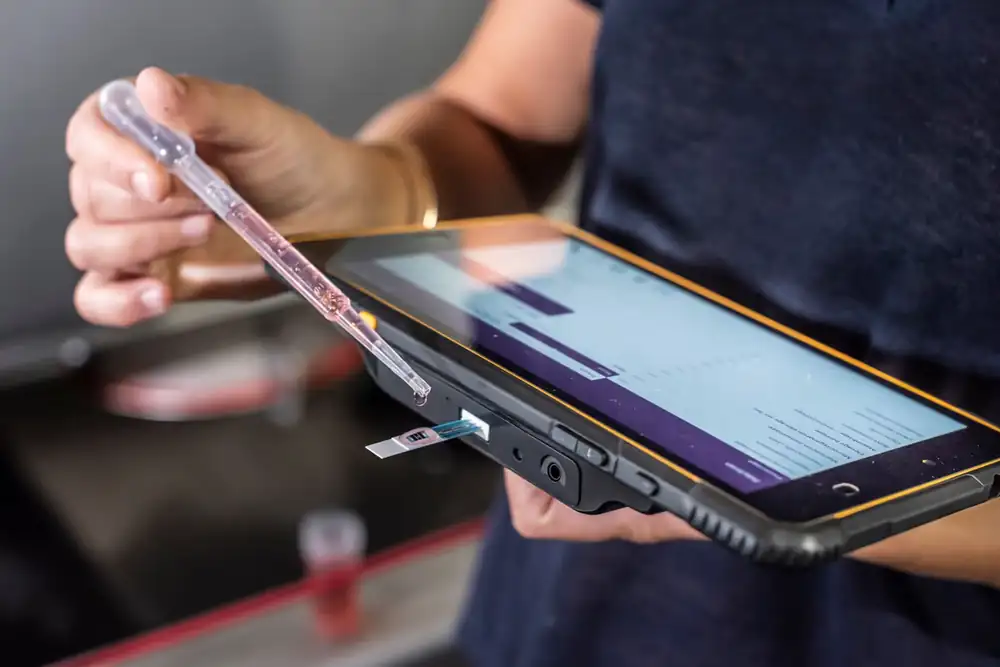
This is the focus of Vinventions' technical offering. Measurement accompanies the process from harvest to vinification, providing information that can help the winemaker understand the evolution of the product. Among the tools cited by the company is PolyScan, which analyzes oxidizable compounds in real time. The goal is to provide winemakers with useful information for decision-making at various stages of the process.
This is complemented by the Enology Portal, a platform that organizes and interprets data from the vineyard and the winery. The principle is therefore to have a more accurate understanding of what is happening throughout the production process. "Experience remains crucial, but it can be supported by tools that allow us to measure what is happening," La Placa explains. In a vintage characterized by greater variability, knowing the data becomes part of the decision-making process.
Oxygen among the variables to keep under control
Measurement also plays a key role in oxygen management, which Vinventions has identified as one of the aspects to carefully consider during the 2026 harvest. The goal is to preserve the wine's freshness, aromas, color, and balance by monitoring its oxygen-related evolution throughout the various stages of production. Management doesn't end with winemaking. It continues after bottling, when the choice of closure and, in particular, its oxygen permeability come into play.
The closure depends on the characteristics of the wine
Again, according to La Placa, there's no universally ideal closure. The choice must be based on the producer's goal and the characteristics of the wine. If the characteristics of the grapes and the wine change, the closure strategy may also change. It's a choice that comes at the end of the process, but it must be consistent with the decisions made in the previous phases. "The closure is the last real winemaking choice before the wine reaches the consumer," La Placa emphasizes.
The 2026 harvest thus becomes, in Vinventions' interpretation, an example of how the greater variability of starting conditions makes it increasingly important to measure, understand, and decide. Technology, from the company's perspective, should not replace the winemaker's role, but rather provide more precise information to guide their decisions, from harvest to bottling.