Ben Shai's classic, fresh white fish ceviche
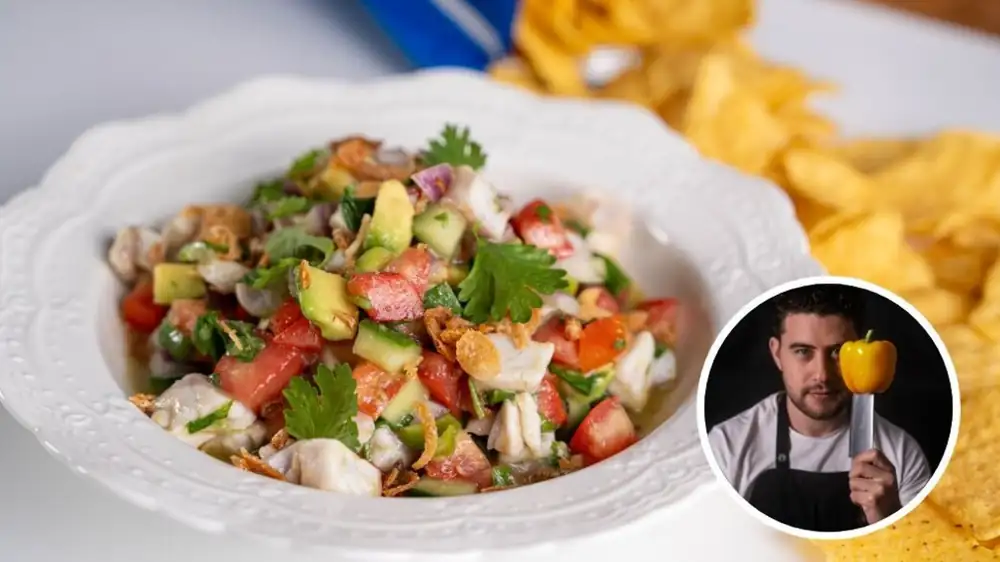
Classic white fish ceviche, fresh and crisp with finely chopped vegetables
When you pour lemon over raw fish, is it really "cooking" it, or just a sour illusion? I dove into the biochemistry of ceviche to understand what the acid does to the fish, what it doesn't do, and why it's so important that you know the difference. And of course, there's a recipe for homemade ceviche
Working time
Total time
Difficulty level
kashrut
Anyone who has made ceviche at home knows this magic: pour freshly squeezed lemon juice over cubes of raw fish, and within a few minutes the texture changes, the translucent color turns to opaque white, and the fish looks exactly as if it came out of a light cooking.
But does the acid from lemon really cook the fish, or is it just an unfounded statement? To understand this, you need to dive into the biochemistry of food and two concepts that every cooking enthusiast must be familiar with: denaturation and coagulation.
What happens to a protein when it comes into contact with heat or acid?
Samin Nosrat explains in her iconic book Salt Fat Acid Heat what happens to proteins in food when they encounter cooking. The proteins in fish are naturally composed of coiled and folded helices, think of closed springs. When we apply cooking mechanics, such as heat or acid, to the protein, two key steps occur:
- Denaturation: Changing the original structure. When we apply high heat (using thermal energy) or add acid (lowering the pH, which changes the electrical charge of the protein), the protein molecules begin to break down, open up, and lose their original shape.
- Coagulation: Coagulation and reconnection. After the springs have opened, the free molecules begin to form new bonds with each other, connecting into a dense network structure and trapping water within it.
If you take two glasses, one with boiling water and one with vinegar, and put a piece of raw fish (or even an egg) into each of them, you will see that in both the protein undergoes almost the same process: the original texture changes and the transparent-pinkish color turns into a cooked white. In both cases, the protein has undergone denaturation and coagulation. That is, in the dry chemical sense – acid completely cooks the fish.
So what is the difference between heat and acid anyway?
If both acid and heat change protein in a similar way, why don't we "cook" steak in lemon juice?
The main difference lies in safety and penetration:
Destroying contaminants and bacteria: High heat effectively kills bacteria and parasites (such as salmonella or E. coli). Acid, on the other hand, does inhibit the growth of some bacteria, but it does not kill parasites or resistant bacteria definitively and safely.
Depth of penetration: Heat easily penetrates deep into the cut. Acid, on the other hand, works primarily on the outer surface. If you leave fish in acid for too long in an attempt to "cook" it to the core, the outside will soften and become mushy, while the center of the cut will take much longer to cook.
Temperature: Heat, of course, warms the dish, while ceviche is served chilled and fresh.
The conclusion: When making ceviche, we must use fresh, high-quality sashimi-grade fish, the kind you would eat completely raw without fear, because acid alone is no substitute for thermal sterilization.
- Fresh white fish (sea bass, bream or sea bream), cut into small cubes
- Tomato, peeled and seeded, cut into small cubes, half the amount of fish
- Cucumber, cored and seedless, cut into small cubes, half the amount of fish
- Avocado, diced
- Red onion, finely chopped
- Jalapeño pepper, finely chopped (to taste)
- Fresh coriander, chopped
- Lime or lemon juice, freshly squeezed
- High-quality olive oil
- Atlantic sea salt, to taste
How to prepare
Place the white fish cubes in a bowl and squeeze lime or lemon juice over them. Mix and soak for about 10 minutes (no longer, to maintain a perfect texture).
Add the diced tomatoes, cucumber, purple onion, jalapeño and avocado.
Add chopped cilantro, a generous drizzle of olive oil and Atlantic sea salt.
Mix gently until all ingredients are coated and uniform. Taste and add lemon, salt, and olive oil to taste.
Serve immediately with crispy nachos or a toasted tortilla.