How to Refresh Sourdough: The Complete Guide
Anyone who uses sourdough starter knows it: it's not just an ingredient, but a living thing that needs to be cared for and nurtured over time.
What is refreshment and what is it for?
Before delving into the various rules and proportions to follow, let's briefly explain the purpose of refreshing and why it's so important. To understand this, it's necessary, once again, to understand what sourdough is: it's a dough made of water and flour, left to mature and ferment spontaneously. During the rising process, the dough is "attacked"—or, more precisely, colonized—by microorganisms contained both in the raw material and in the surrounding environment, triggering a fermentation process in which yeasts and bacteria contribute both to the leavening and to the development of particular aromas and flavors. Refreshment serves precisely to nourish and keep these microorganisms alive and to encourage new ones to thrive and replace those that have become weakened or less active.
Depending on the type of yeast used, the refreshment process also varies slightly: sourdough starter can be either solid or liquid, and as the name suggests, the former has a lower percentage of water than the latter, which is made up of equal parts water and flour and must therefore maintain this ratio.
Refreshing the solid sourdough starter
Let's start with solid sourdough starter, the most common but also the one that requires the most attention. This type of starter, if stored in the refrigerator, generally needs to be refreshed a couple of times a week following a very simple procedure. First, remove the top part, the so-called excess, which is usually dry, and remove the core. Then, add the same amount of flour and about 45-50% water: the ratio will be 1:1:0.5, so 1 part yeast, 1 part flour and 1/2 part water. In practice, if you have 100 grams of yeast, add 100 grams of flour and 45-50 grams of water. Adjust the water amount based on the consistency of the dough, keeping in mind that it should be smooth, compact, and homogeneous. Once you've achieved the desired consistency, shape it into a ball, place it in its container, make a slit on the top, and close the container. At this point, leave it at room temperature, to allow the leavening to activate, for 3 to 5 hours, then place it in the refrigerator.
Refreshing the liquid sourdough starter
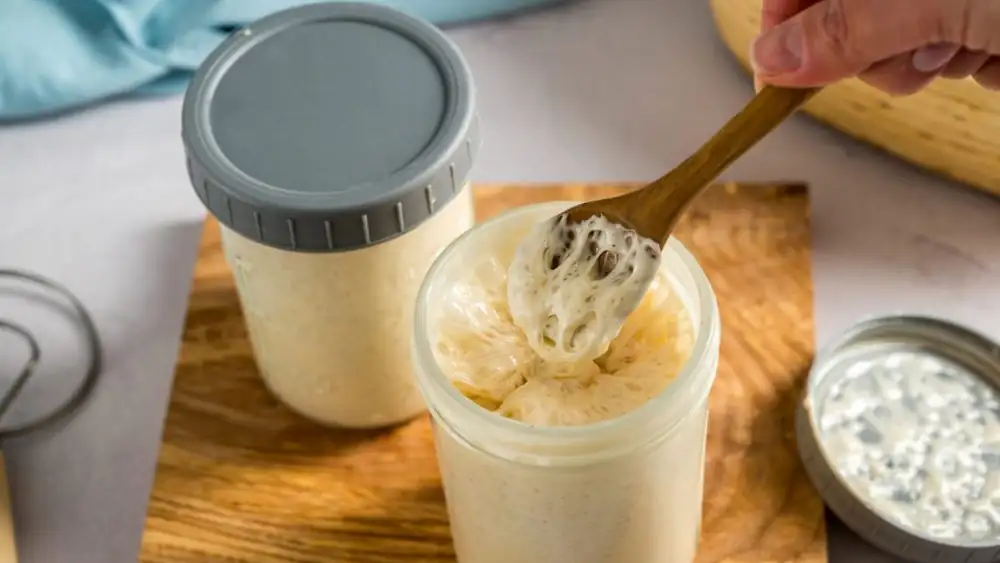
As for the licoli, the procedure isn't much different: what's different is the proportions. In this case, the ratio is 1:1:1, meaning the same amount of yeast, flour, and water. So, weigh the amount of licoli you have available and, for example, if you have 100 grams, add 100 grams of flour and 100 grams of water. Then, mix until you obtain a more liquid and sticky consistency than that of solid yeast. Then, pour it into the container, let it come to room temperature for a while, and then refrigerate.
Compared to solid sourdough starter, however, licoli can be refreshed even after several days: in fact, thanks to its greater hydration, it ferments more quickly and remains stable for longer. For this reason, it can be refreshed every 5-7 days, even up to 10.
Water and flour: what to watch out for
At this point, it's important to briefly discuss the two ingredients that make up sourdough starter: water and flour. Although they are among the most common and simple ingredients on the planet, there are some details to pay particular attention to. As for the water, it's best not to use excessively hot water, as it could damage the yeast and bacteria present. Conversely, if it's too cold, it could slow the fermentation process. For this reason, the ideal temperature is between 22 and 26°C.
As for flour, however, there's no single type to use: it depends greatly on the desired result. Several studies have shown that, depending on the type of flour, the lactic acid bacteria within the yeast can also vary, giving the final product different flavor profiles. In any case, it's advisable to always use the same type of flour: if you decide to use, for example, type 0 flour, it's best to stick with the same type (and possibly the same brand) even for refreshments, to achieve a more stable result.
Bonus tip: bath time
We've figured out how and when to refresh sourdough starter, which, as we know, produces lactic and acetic notes due to fermentation. However, it can happen that our starter is too acidic or has lost some of its strength: well, in this case, all is not lost. There's a very simple way to get your starter beautiful, active, and strengthened again: we're talking about soaking, a type of washing that serves precisely to rebalance the microflora, reduce residual acidity, and make the yeast more stable. The process is very simple: just place the starter in a container with a liter of water, about 20-22°C, and a teaspoon of sugar. Let the dough soak for 15-20 minutes, then squeeze it well and proceed with the refreshment as usual.