Mallorcan Tumbet: traditional recipe and all its secrets
What is Mallorcan tumbet?
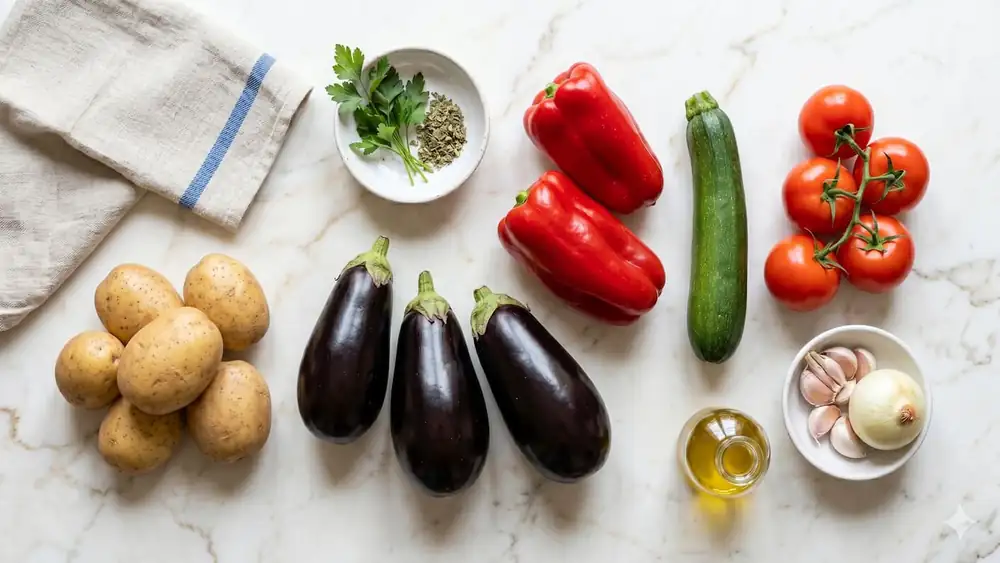
Mallorcan tumbet is one of those dishes that encapsulates the essence of Mediterranean cuisine in a single bite. It's a preparation of seasonal vegetables—potatoes, eggplant, red peppers, and, in some versions, zucchini—that are fried separately in olive oil and then layered, covered with a generous homemade tomato sauce. The result is a dish with vibrant color, intense flavor, and a smooth texture that can easily take center stage.
Although tumbet is now known throughout Spain, its origins are firmly rooted in the Balearic Islands, and Mallorca in particular. It's a summer dish by definition: it's prepared when tomatoes are at their peak ripeness, peppers are at their sweetest, and eggplants are bursting with flavor in every market on the island. Out of season, it's simply not the same.
Tombet—as it's also spelled in Balearic Catalan—can be eaten on its own, as a side dish, or as a base for other preparations. Its versatility is part of its charm: it can accompany breaded fish or serve as a bed for fried eggs. We'll talk more about all of this later.
Mallorcan tumbet is more than just a recipe: it's a way of understanding seasonal cuisine and making the most of local produce. Every time Mallorcan tumbet is prepared at home, a culinary ritual is recreated that has been passed down for generations in the kitchens of the Balearic Islands, with slight variations depending on the family and the ingredients available. Few recipes have the ability to be both so simple and so rich in nuances.
History and origin of the Mallorcan tumbet
The history of Mallorcan tumbet, like that of so many Mediterranean dishes, is the story of the vegetable garden and what was available. Understanding this origin helps explain why Mallorcan tumbet remains so true to itself generation after generation. According to Balearic culinary tradition, Mallorcan tumbet arose as a way to make use of seasonal vegetables from the Mallorcan gardens: potatoes, eggplants, peppers, and tomatoes—all ingredients that arrived in Europe from the Americas and that Balearic cuisine embraced with enthusiasm.
There is evidence that similar dishes—fried vegetables layered with tomato sauce—existed in Mallorca at least in the 19th century, passed down through generations within the island's families. It's no coincidence that each Mallorcan family has its own version, with slight variations in frying time, the order of the layers, or the amount of garlic in the sauce. In that sense, tumbet is a living dish.
Today, it's part of the list of recognized traditional dishes of the Balearic Islands, along with sobrasada, ensaimada, and frit mallorquí. It's a constant presence in the island's restaurants, and in Palma's markets, it's hard to go a summer without seeing it in some food display.
Mallorcan tumbet vs. Balearic tumbet: are they the same?
This is one of the most frequently asked questions among those who are trying this dish for the first time. The short answer is that they are not exactly the same, although the difference is subtle.
The term "tumbet balear" is the broadest: it refers to the preparation of layered fried vegetables with tomato, as made throughout the archipelago, including Ibiza, Menorca, and Formentera. Each island has its own slight variations. "Tumbet mallorquín"—or "tumbet mallorquí" in Catalan—is the specific version from Mallorca and is generally the best known outside the islands.
A common difference between the two versions concerns zucchini: in some Balearic recipes, zucchini is a regular ingredient, while in the more traditional Mallorcan version, it doesn't always appear. Some households also add onion or garlic between the layers, while others don't. In any case, the heart of the dish—potatoes, eggplant, peppers, and tomato sauce—remains unchanged.
It is also worth noting that some gastronomic texts refer to tumbet as "Mallorcan ratatouille", although this name is not the most accurate: ratatouille is a different preparation, without the process of frying each ingredient individually or the layering that characterizes tumbet.
Key ingredients of authentic Mallorcan tumbet
The quality of the ingredients makes all the difference in Mallorcan tumbet more than in any other dish. Since Mallorcan tumbet is fundamentally a tribute to seasonal vegetables, there's no room for shortcuts.
The eggplants should be firm and shiny, without blemishes or soft spots. The potatoes should preferably be a floury variety so they are tender inside and have a lightly golden skin. The red peppers should be fleshy and sweet—thin-skinned ones work best, as they don't fall apart as much during frying. And the tomatoes for the sauce must be ripe: without good tomatoes, the sauce loses its appeal.
Extra virgin olive oil is the other essential ingredient. The amount may seem generous—each vegetable is fried separately in plenty of oil—but it is precisely this technique that gives tumbet its characteristic flavor. The trick is to drain the excess oil well on absorbent paper before assembling the layers, so that the final dish is flavorful and juicy, not heavy.
Some recipes add garlic to the tomato sauce, others a few fresh basil leaves, others a pinch of paprika. All are valid variations; the core of the dish stands on its own.
Mallorcan tumbet without frying: the lightest version
For those who prefer a less oily version or simply want to reduce cooking time, there is an adaptation of Mallorcan tumbet that does not require frying, replacing frying with baking or grilling.
The procedure changes significantly: the vegetables are sliced, brushed with olive oil, and roasted in a hot oven (200–220 °C) until tender and lightly toasted. The result isn't exactly the same as the original—the texture is drier and less creamy—but it retains the dish's flavor profile and allows you to enjoy it with fewer calories and less effort.
For this version, it's recommended to bake each vegetable separately, as the cooking times vary: potatoes need more time than eggplant, and bell peppers less than both. Once all the vegetables are roasted, layer them in a baking dish with the tomato sauce and bake for another 15 minutes to allow the flavors to meld.
It's important to note that this version isn't considered authentic Mallorcan tumbet: frying is part of the dish's identity and makes a difference in texture and flavor. But as a practical, everyday adaptation of Mallorcan tumbet, it works very well.
What do you eat Mallorcan tumbet with?
Mallorcan tumbet is, above all, a standalone dish. It can be served on its own, as a first course or a light main course, and has enough character to stand alone as a meal. But it's also one of the great accompaniments to Balearic cuisine.
The most classic pairing is with fried eggs: the eggs are fried in very hot oil so that the whites are crispy at the edges, and then placed directly on top of the tumbet. The runny yolk, which blends with the tomato sauce and vegetables, is, according to lovers of the dish, the best possible sauce.
It also pairs very well with breaded fish—cod, dogfish, or anchovies—grilled lamb or pork chops, and meats in general. In some Mallorcan homes, it's served with pork loin cooked between the layers of the tumbet itself, a variation that adds protein to the dish and makes it a complete meal.
It's not recommended to serve tumbet straight from the pan. Like many vegetable stews, it improves the next day: the flavors meld and the sauce blends more harmoniously. If prepared in advance, simply reheat it gently before serving.
Variations of Mallorcan tumbet that are worth knowing
As with all dishes with a long tradition, tumbet has as many versions as there are families in Mallorca. Beyond the basic recipe, some variations of tumbet have gained prominence and deserve a mention.
Tumbet with a baked egg is perhaps the most popular variation: the tumbet is prepared in individual earthenware dishes, an egg is cracked on top, and it's baked until the white is set. The result is a hearty, comforting dish. Tumbet with cod is another classic combination, especially during Easter and the colder months: the desalted cod is placed on top of layers of vegetables before baking, and the tomato sauce infuses the fish with its full flavor.
There's also a version of tumbet prepared from scratch in an earthenware casserole dish: the vegetables are fried and then placed directly into the casserole, which is then simmered over very low heat or in the oven with the tomato sauce. This technique allows the vegetables to absorb the sauce more evenly. And for those wondering if tumbet can be prepared in an air fryer: the answer is yes, although the texture of the vegetables will be somewhat drier, similar to the non-fried version described above.
Tips for a perfect Mallorcan tumbet
Preparing Mallorcan tumbet for the first time might seem daunting, but with a few tricks, the process flows smoothly. Here are the most useful tips to ensure your Mallorcan tumbet turns out perfectly the first time:
- Fry each vegetable separately. This is the most important step in making Mallorcan tumbet. Mixing the vegetables in the pan lowers the oil temperature and results in uneven cooking. Patience here will pay off.
- Drain the excess oil well. Mallorcan tumbet should not be oily. Paper towels are your best friend: place the fried vegetables in several layers and let them drain for a few minutes before layering.
- The tomato sauce should be homemade. A store-bought tomato sauce can ruin Mallorcan tumbet. With ripe tomatoes, garlic, onion, and olive oil, homemade sauce is simple and makes all the difference.
- Respect the order of the layers. The traditional Mallorcan tumbet recipe dictates: potato at the base, eggplant on top, pepper (and zucchini, if using) on top of the eggplant, and tomato sauce covering everything. This order is not arbitrary: the absorption time of the sauce varies with each layer.
- Serve lukewarm, not hot. Mallorcan tumbet—like many roasted vegetable dishes—develops more flavor when it cools for a few minutes before serving. Neither straight from the oven nor cold from the refrigerator: lukewarm is ideal.
Traditional Mallorcan tumbet recipe: step by step
Below is the recipe for Mallorcan tumbet in its most traditional version, faithful to the original Balearic dish. Each step can be done simultaneously to reduce overall cooking time.
- Preparation time: 30 min |
- Cooking time: 1 hr 10 min | Total: 1 hr 30 min |
- Servings: 4–5 people.
Ingredients
- 4 medium potatoes
- 2 medium eggplants
- 2 red peppers
- 1 zucchini (optional, depending on the version)
- Sunflower oil (plenty, for frying)
- Coarse salt as needed
- For the tomato sauce:
- 400g of ripe tomatoes (or natural crushed tomatoes)
- 2 cloves of garlic
- 1 small onion
- 1 splash of olive or sunflower oil
- Salt and a pinch of sugar.
Elaboration
- To prepare the homemade tomato sauce: Finely chop the onion and garlic. Heat a drizzle of oil in a pan over medium heat and sauté the onion and garlic until translucent, about 8 minutes. Add the crushed tomatoes or peeled and chopped tomatoes, season with salt and pepper, add a pinch of sugar, and simmer for 15-20 minutes, stirring occasionally, until you have a thick sauce. Set aside.
- Prepare the eggplants: Wash the eggplants and slice them very thinly, without peeling. Place them in a colander, sprinkle with coarse salt, and let them sit for 15 minutes to release their bitter juices. Dry them very well with paper towels before frying. Set aside.
- Prepare the potatoes: Peel the potatoes and slice them very thinly. Place them in cold water to prevent oxidation; dry well before frying. Set aside.
- Prepare the peppers: Wash the peppers, remove the stem and seeds, and cut them into long strips about 2 cm wide. If using zucchini, also cut it into thin slices, without peeling.
- Fry the potatoes: Heat plenty of sunflower oil in a deep frying pan over medium-high heat. Fry the potatoes in batches until golden brown and tender, about 8–10 minutes per batch. Remove and drain on paper towels. Season lightly with salt. Set aside.
- Fry the eggplant: In the same oil, fry the eggplant slices until golden brown on both sides, about 3–4 minutes per side. Remove and drain on paper towels. Season lightly with salt. Set aside.
- Fry the peppers: Fry the pepper strips in the same oil until tender and lightly browned at the edges, about 5–6 minutes. Remove and drain. If using zucchini, fry it at this stage as well, 3 minutes per side. Set aside.
- To assemble the tumbet: In an ovenproof dish or earthenware casserole, first arrange a layer of potatoes, cover with a layer of eggplant, add the peppers (and zucchini if using) and pour the tomato sauce over all the layers. Repeat the process if there are enough ingredients for a second set of layers.
- Bake: Preheat the oven to 180°C (350°F). Place the casserole dish or baking dish in the oven and bake for 15–20 minutes, until the sauce is just bubbling. Serve directly from the casserole dish or carefully plate to keep the layers visible.
Tip: Mallorcan tumbet improves from one day to the next. Preparing it a few hours in advance—or even the night before—and reheating it in the oven before serving enhances its flavors considerably.
More recipes with eggplant and vegetables
If Mallorcan tumbet has sparked enthusiasm for fried vegetables and seasonal Mediterranean dishes, there's much more to explore in the kitchen. Stuffed eggplants are another great way to showcase this ingredient in all its glory: they can be filled with meat, vegetables, or cheese, and baked until tender and golden brown. For lovers of Eastern Mediterranean cuisine, eggplant babaganoush is a creamy and aromatic alternative that starts with the same ingredient but completely transforms it.
And if the idea of layering vegetables with sauce is irresistible, classic ratatouille is the French cousin of tumbet: same philosophy, slightly different technique, equally spectacular result. To complete the picture, roasted peppers are the perfect complement to any of these Mediterranean dishes.
Can you make tumbet with pork loin?
Yes. In some Mallorcan families, it's common to add sliced pork loin between the layers of vegetables, making tumbet a more substantial dish. The slices of loin—previously seared in a pan—are layered between the eggplant and bell pepper, and covered with tomato sauce along with the other vegetables. The result is a complete one-pot meal. This version isn't the most common in restaurants, but it has a long tradition in the island's home kitchens.
Is Mallorcan tumbet suitable for vegetarians?
In its classic version, yes: Mallorcan tumbet is a 100% vegetarian and vegan dish, as it contains no animal products in the basic recipe. Only vegetables, olive oil, tomato, and salt. It is, in fact, one of the tastiest ways to demonstrate that vegetarian cuisine doesn't have to be boring or limited.
How long does it take to prepare tumbet?
Mallorcan tumbet isn't a quick dish, but it's not complicated either. The total cooking time is usually around an hour and a half, most of which is spent frying each vegetable individually. Using two pans simultaneously can significantly reduce the time. Homemade tomato sauce requires an additional 20 to 30 minutes. It's a dish that rewards patience.
Is tumbet a summer dish?
Traditionally, yes: tumbet is prepared when its ingredients—tomatoes, eggplant, peppers, and zucchini—are at their peak, which is during the summer and early autumn. Out of season, it can be made with greenhouse vegetables, but the result isn't quite the same. True tumbet lovers wait for summer to make it with freshly grown produce.