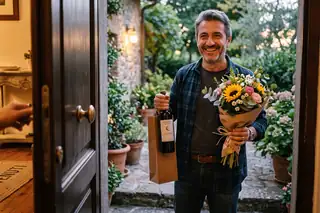
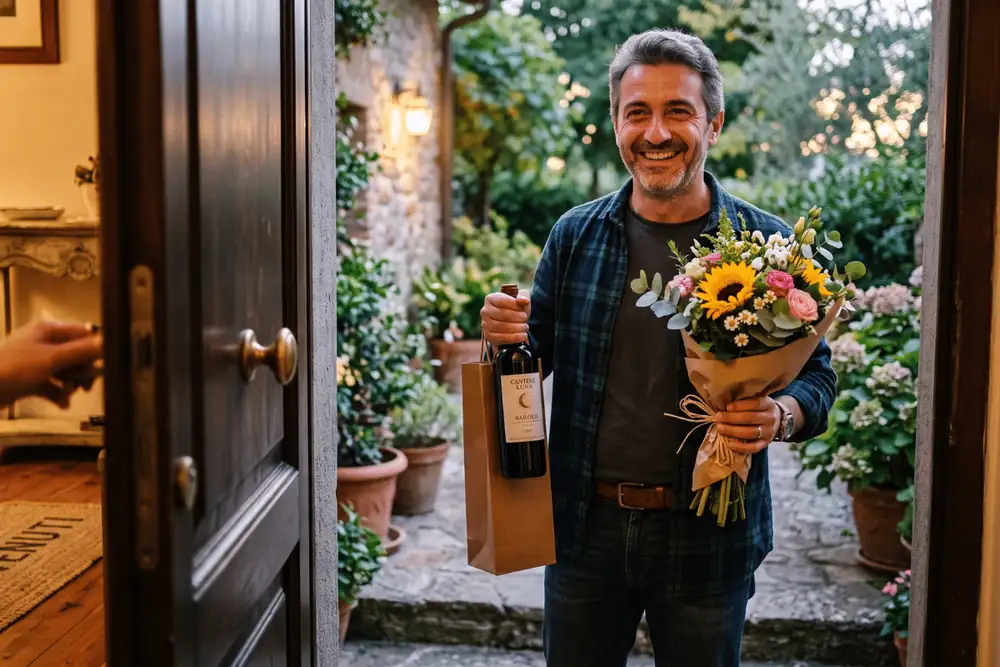
Giving wine as a gift: why is it scarier than giving flowers?
Why does giving wine as a gift generate more anxiety than giving flowers? An anecdote by critic Robert Joseph introduces the question, and behavioral science explains the reason: fear of social judgment, choice overload, and the fear of disappointing the recipient.
When it comes to giving flowers as a gift, we generally have no doubts other than "what type of flowers does the person I want to give them to prefer?"
All it takes is a colorful bouquet, perhaps chosen with the advice of a particularly skilled florist, and the matter is settled: no one spends the evening wondering whether those roses were poor quality, whether the color was the wrong one, or whether the recipient will find them worthy.
Can the same be said when, at a dinner party you're invited to, you choose to bring wine instead of a bouquet of flowers?
Things are probably getting complicated. You stand in front of the shelf, read one label, put another down, and still have that nagging feeling of not being sure you've made the right choice.
Why do two gifts that are supposed to address the same need—saying “I was thinking of you”—generate such different levels of anxiety?
Flowers simply convey a message: affection, care, the memory of an occasion. No one judges whether they're quality flowers, because "quality flowers" aren't part of the common language of those who receive them. Wine, on the other hand, also carries an implicit judgment about the person who chose it: how much they know, how much flavor it has, how much effort they put into it.
And it is precisely here that the gift of wine stops being a simple gesture and becomes a test, complete with performance anxiety.
If Robert Joseph struggles, imagine us.
Robert Joseph, a longtime wine critic and author of a reference book on French wine, recounts an episode in his article on Substack (Science Explains Why Wine Buying Makes People Nervous. One Retailer Profitably Took Notes) that, upon reading, is almost comforting.
Or maybe not too much…
On vacation at a ski resort in Savoy, he found himself faced with a shelf of unfamiliar local wines, a wide price range, and a manager incapable of offering advice. He bought two bottles of medium-priced wines, hoping they would be enough, wondering the entire way home whether he'd made the right choice.
If a professional wine journalist struggles to choose a bottle without help, what should we expect from someone who only enjoys wine in company, without claiming to truly know anything about it? This is where the issue touches on the profound nature of wine, which is, first and foremost, a social beverage, meant to be shared. But precisely because wine thrives on conviviality, every poor choice isn't a private matter; it becomes public, sitting at the table, in front of the person enjoying that bottle with us.
In his article, Joseph also cites behavioral research and speaks of "choice overload," the phenomenon whereby more options don't mean more freedom, but rather more decision-making effort. But overload, studies explain, manifests itself especially when a specific factor comes into play: the pressure of having to answer for one's choices to someone else.
Buying wine for yourself is already an exercise rife with variables. Buying wine as a gift activates precisely that additional condition. It's no longer enough to please yourself; you have to gauge the recipient's taste, calibrate the occasion, and do so knowing that the verdict will come from someone else, not yourself.
Then there's a second, more subtle level. The behavioral psychology studies cited by Joseph show that people fear the loss of social status much more than they desire equivalent gain. This fear is heightened precisely by non-essential goods, consumed in public. Gifted wine meets both conditions: it's not essential and will be consumed in full view of others.
It's no surprise, then, that those looking to buy a gift at a wine shelf look for shortcuts: a recognizable brand, a rating, or the seller's recommendation. These are all ways to pass judgment on to someone else. If a bottle disappoints, the blame can fall on the critic who awarded it, the brand, or the seller who recommended it. Certainly not on the person who chose it.
A question for the sector
Those who communicate and sell wine, however, seem almost always to think of those who drink it, rarely of those who choose it for someone else, two audiences with different anxieties, who would require different reassurances.
So why not provide the tools to help those who don't know much about it give a bottle of wine as a gift without fear of making a mistake?
What if labels were designed for those who choose them without knowing anything about them, not just for those who uncork them?
Key points
- The gift of wine triggers a social anxiety that is absent in the gift of flowers, because it implies a judgment on the person who chooses it.
- Even experts struggle: even a wine critic admits to choosing a bottle without knowing for sure.
- Choice overload increases when you have to answer for your purchase in front of another person.
- The fear of losing social status weighs more than the pleasure of a successful gift, especially for public and superfluous goods.
- The wine sector communicates primarily to those who drink, neglecting those who buy as a gift.