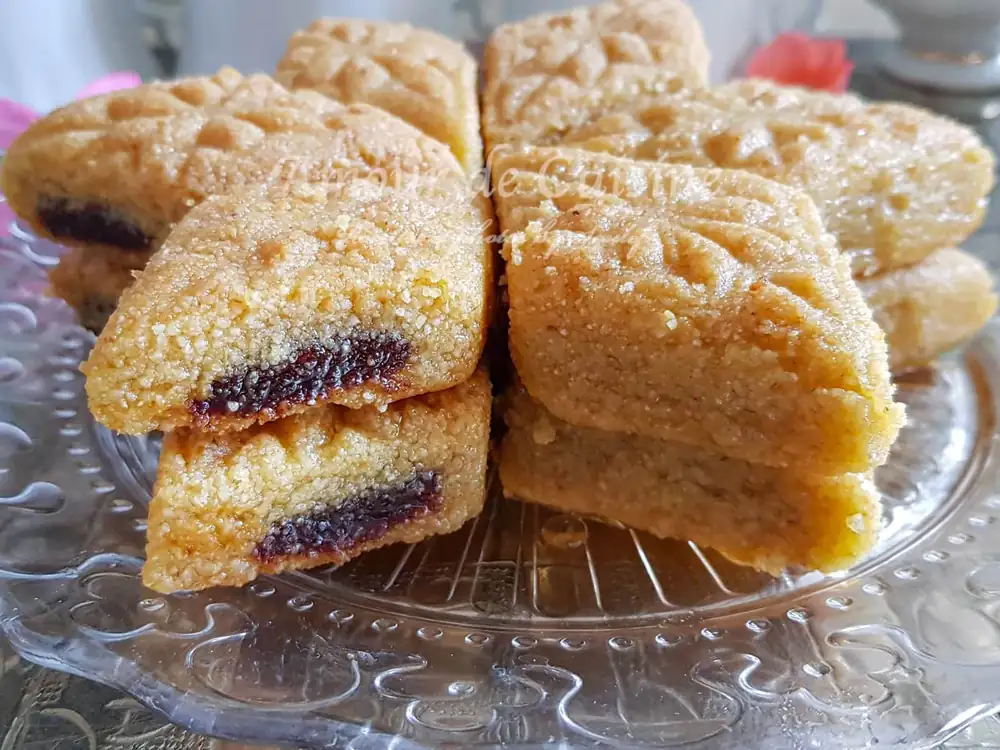
Makrout baked in the oven, Algerian cake, love of cooking
The Algerian makrout baked cake, also called makroud el koucha, is a true treasure of traditional Algerian pastry.
- 1200g of coarse semolina (not too coarse, okay)
- 400g of ghee (smen, or clarified butter)
- a little salt
- Orange blossom water
- Water
- 500g of date paste
- 1/2 teaspoon of cinnamon
- 1/2 teaspoon ground cloves
- 2 teaspoons of butter
- 2 tsp of jam (optional, I added some because I had poor quality date paste, and I was afraid the filling would become hard when cooked; I added fig jam, which will make the pastry soft)
- orange blossom water.
- Work the date paste with the indicated ingredients until you obtain a soft and homogeneous ball.
- Shape into rolls approximately 15 cm long and 3 cm thick and set aside.
- In a large bowl, pour the semolina and salt, then mix.
- Make a well in the flour and pour in the melted clarified butter. Mix well so that the semolina fully absorbs the fat.
- Let it rest for at least 2 hours.
- Gradually moisten with a mixture of water and orange blossom water. Mix with your fingertips, without kneading, so as not to develop the gluten.
- Form a compact ball, cover it with cling film and let it rest.
- Take a portion of dough and shape it into a sausage.
- Using your index finger, dig a groove along its entire length.
- Place a small roll of date paste in this slit.
- Gently close the edges of the pastry to cover the filling.
- Roll again to obtain a regular roll approximately 2 cm thick.
- Using an imprint mold, mark a decorative pattern by pressing lightly on the top.
- Cut into diamond shapes and arrange them in an ovenproof dish, packed tightly together to prevent the filling from burning.
- Repeat the process until all the dough is used up.
- Preheat the oven to 175°C.
- Bake for about 30 minutes, until the makrouts are golden brown on top and underneath.
- Keep a close eye on the cooking: start with the heat from the bottom, then finish by activating the heat from the top for a nice even color.
Made from semolina and date paste flavored with orange blossom, it impresses with its crunchy texture, lightness and authentic taste.
Maqrout al-Kusha
Hello everyone, Among the sweet treasures that we gladly share over mint tea or coffee, makrout holds a special place in the hearts of gourmands.
Originating from eastern Algeria, it has conquered all regions thanks to its perfect balance between simplicity and refinement.
This carefully crafted semolina cake impresses with its contrast of textures: a delicately golden shell that encloses a generous heart of dates flavored with spices.
Each bite reveals warm and comforting notes, reminiscent of family celebrations and traditions passed down from generation to generation.
Its diamond shape, which has become iconic, is not only aesthetic: it allows for even cooking and an elegant presentation.
Makrout is a term that varies slightly in pronunciation and spelling depending on the region, but the most common version remains "makrout" with a T (مقروط). It is also called makroud, maqroudh, or maqrouth (in Arabic: المقروض and المقروط).
Dipped in delicately flavored honey, the baked makrout becomes an irresistible treat that can be kept for several days.
It is ideal for treating loved ones or accompanying a festive table.
History and origin of Algerian makrout
Makrout has its roots in the Maghreb, and more specifically in Algeria, where it is lovingly prepared for special occasions.
Eid celebrations, weddings, and other festivities are all occasions where Makrout shines as a symbol of conviviality and tradition.
To prepare an authentic Makrout, I use the method passed down by my grandmother from Constantine, who excelled in the art of this pastry.
His recipe, inherited from a long tradition, was so appreciated that at our neighbors' weddings, he was often asked to make his famous Makrout el koucha (oven-baked) to order, a true reference in the field.
I fondly remember the period before Ramadan, when my grandmother would carefully prepare a large tray of Makrout in the oven, accompanied by a huge tray of baklava.
These traditional Algerian cakes were essential for getting through this holy month. The trays in question were not just ordinary dishes, but true centerpieces measuring approximately one meter by 40 cm, very popular in Algeria.
These large trays of Makrout and Baklawa could not be baked in a home oven. So my grandmother took them to the local baker, where they were baked to perfection.
For the dough
– 1200 g of coarse semolina. Ideal for giving the characteristic sandy and crumbly texture of makrout.
A mixture of coarse and medium semolina is recommended to avoid a result that is too dry or too hard.
When we say coarse semolina, we're not talking about couscous semolina. Many people confuse the two and tell me they've messed up their makrout.
When I start talking with them and we start discussing semolina and its quality, to my surprise I find that the person would have used couscous grains.
You can see the comments under this article and see that there are people who confuse coarse semolina and couscous grains.
– 400 g of ghee (smen or clarified butter) This aromatic fat coats the semolina and gives it a melt-in-your-mouth texture.
Homemade smen is preferable to guarantee an authentic and balanced taste.
– ½ tsp salt. Essential for enhancing the flavor, even in sweet pastries. It balances the sweetness of the honey and dates.
– Water + orange blossom water: When mixed, they help to bring the dough together without kneading. The orange blossom water adds a delicate fragrance typical of oriental pastries.
For the joke
– 500g of date paste. Use ripe, soft and sweet dates. They can be homemade (washed, pitted, pureed).
– ½ tsp ground cinnamon Offers an aromatic warmth that enhances the stuffing.
– ½ tsp ground cloves. Use with caution as their flavor is strong. They enhance the date paste with intense spicy notes.
– 2 tsp of butter or ghee Makes the stuffing smoother and more pliable.
– 2 tsp of jam (optional) Helpful if the date paste is too dry. Fig jam, for example, softens the texture and enriches the flavor.
– Orange blossom water is used to soften and flavor date paste for a fragrant and easy-to-work stuffing.
Preparing the stuffing
- Place the date paste in a bowl.
- Add the cinnamon, ground cloves, butter (or smen), a little orange blossom water and possibly jam if the dough is too dry.
- Work the mixture well with your hands until you obtain a soft and homogeneous ball.
- Next, form regular rolls about 15 cm long and 3 cm thick and set aside.
Preparing the makrout dough
- Make a well in the center and incorporate the melted clarified butter. Mix with your hands until the semolina has completely absorbed the fat.
- Let it rest for at least 2 hours, so that the semolina soaks up the liquid properly.
- Gradually add a mixture of water and orange blossom water. Gather the dough without kneading, simply using your fingertips, to avoid developing gluten.
Shaping the makrout
- Take a portion of dough and roll it into a log a few centimeters thick.
- With your finger, dig a groove along the entire length.
- Place a roll of date paste in this slit, then gently close the edges of the paste over it.
- Using an imprint mold or special tweezers, imprint a decorative pattern on the top.
- Cut into diamond shapes and arrange them on a baking sheet, close together so the filling doesn't burn.
Baking the makrout
- Monitor the cooking: start with the heat from the bottom, then turn on the top grill at the end for a nice even color.