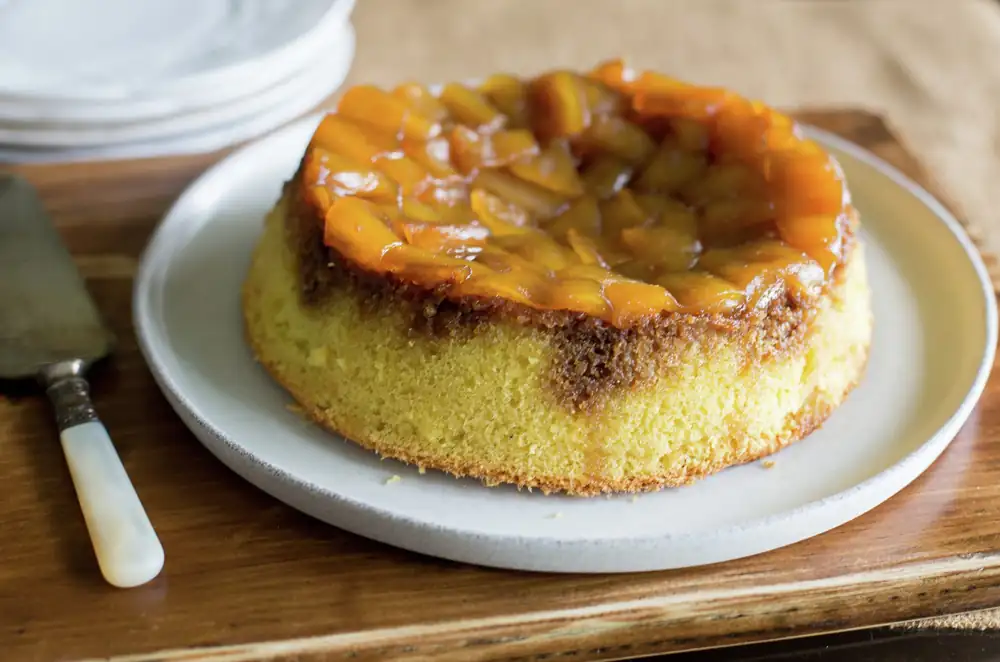
Chilean papaya cake - Pilar Hernández's Chilean Kitchen
It's graduation season in the US, and my husband has a few students, so he invited one of them, who just received her PhD, to dinner with her husband and sister. One of the guests is gluten intolerant, but as Julia Child said, "a party without cake is just a meeting," so we had to have some kind of cake to celebrate.
- 115 grams of butter
- 1 cup of brown cane or turbinado sugar
- 300 grams of papaya in juice
- 6 eggs
- 1/2 cup of sugar
- 1 teaspoon of vanilla
- 1 1/2 cups almond flour
- shall
- In a small saucepan, melt the butter over medium heat. Add the sugar and a pinch of salt, stirring constantly until fully incorporated and no butter remains floating. Stop stirring and cook for 5 more minutes over medium-low heat; it should come to a boil.
- Meanwhile, drain the papayas and cut them in a way that allows you to create an interesting pattern. My papayas came in small pieces, but if you have whole ones, you can arrange them like a flower at the bottom of the 23 cm diameter mold.
- Preheat the oven to 180C or 350F
- As soon as the caramel is ready, pour it over the papayas arranged in the mold. Don't touch it, as it's easy to burn yourself; it's best to let it fall and tap the mold against the counter to distribute it.
- In the bowl of a stand mixer, combine the eggs, sugar, a pinch of salt, and vanilla. Heat over a double boiler, stirring constantly, until the mixture feels warm but is not hot enough to burn when tested with a finger. Remove from the heat and, using the mixer at maximum speed, beat for 10 minutes to incorporate plenty of air.
- Sprinkle the ground almonds and gently fold them into the smoothie.
- Pour the milkshake over the caramel and papayas.
- Bake for 35-40 minutes until the cake looks golden brown and a toothpick inserted into the center comes out clean.
- Let cool for 15 minutes on a wire rack.
- Run a table knife around the edge of the mold, between the cake and the mold. Cover the mold with the serving plate and invert it; it should fall out smoothly on its own.
- Serve with ice cream, fruit or Chantilly whipped cream.
Since I also wanted to make something Chilean and I had these papayas in juice in the pantry, I decided to make a Chilean version of this cake that is very popular here in the USA, usually made with pineapple slices.
The rest of the menu was roast chicken and quinoa stew with chard.
As you can see, I've once again used the method of heating the eggs with the sugar and then whisking for several minutes. This method is equivalent to first whisking the yolks with the sugar until light and fluffy, adding the flour (in this case, almond flour), and then folding in the stiffly beaten egg whites. I prefer this method because it only requires one bowl, and the eggs don't need to be at room temperature, unlike when you're whisking egg whites, especially to achieve stiff peaks, where they need to be at room temperature. Whichever method you prefer, the end result is the same.
Almonds and papaya complement each other very well, but if you don't need to make it gluten-free, you can use 1 cup of all-purpose flour and 1/2 cup of almond flour. Chilean papaya is from the same family as Caribbean papaya; it's also known as carica in the US. In Chile, buy whole papayas in juice, and if you cut them lengthwise, you can create a flower-like design—it will look beautiful. I only had them in pieces.
With this recipe I am participating in the June 2015 challenge of
Description
A fluffy and different cake.


