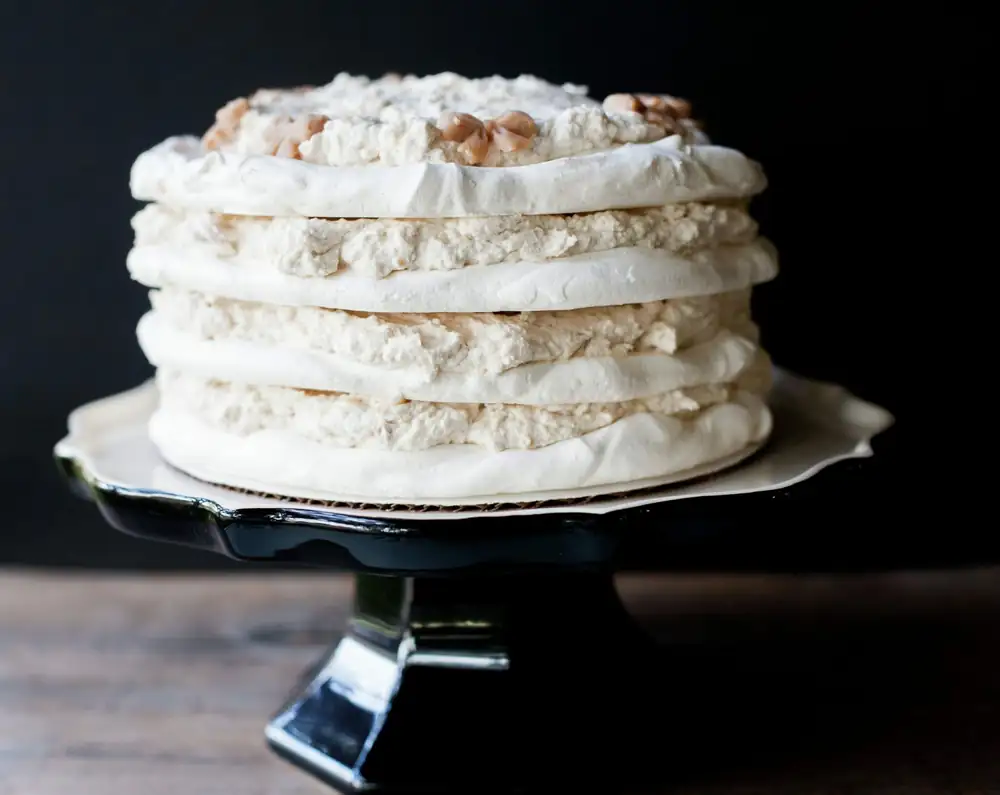
Meringue discs - Pilar Hernández's Chilean Kitchen
Another staple of Chilean baking. If you don't live in Chile, learning to make meringue discs is essential for human life, or at least it has been for me.
- 6 large egg whites at room temperature (240 grams)
- 1 cup of granulated sugar plus 5 tablespoons (260 grams)
- a pinch of salt
- Before making the meringue, draw 4 circles of 20-22 cm in diameter on parchment paper or silicone baking paper (do not use parchment paper, it doesn't work; if you can use Silpat or aluminum foil), cut them out leaving a handle and place them on the baking tray.
- Preheat the oven to 200F or 100 C.
- Place the egg whites in a large bowl with the salt and beat at medium speed until soft peaks form and hold their shape when lifted (do not bend). Add the sugar slowly while continuing to beat at medium speed, then continue beating at high speed for about 8-10 minutes, until the mixture is silky smooth and no sugar granules are felt when you take a small amount and rub it between your fingers.
- Put the meringue in a Ziploc bag or piping bag with a round tip. If using a bag, cut off one of the corners, leaving a 1 cm opening. Pipe concentric circles of meringue onto the pre-cut circles, working from the outside in.
- Smooth with a knife or leave as is. You can also place the meringue by spoonfuls on the circles and spread with a knife.
- Bake for 1 1/2 hours; the discs should feel dry to the touch but not brown. Let them cool in the oven. Once cool, peel them off the parchment paper and place them on clean parchment paper. Wrap them in plastic wrap and store for up to 2-3 days, or use immediately and freeze the entire cake up to 2 hours before serving—my favorite alternative.
- Meringue is fragile and should be handled with care.
- Don't get discouraged if they don't work the first time; they can be tricky.
- Never do them on rainy days.
- Use old egg whites; you can separate the eggs one day and refrigerate the whites for two days, so they dehydrate a little and make a better meringue.
- The egg whites should be at room temperature before beating. Keep an eye on them in the oven so they don't brown.
- If you live in a humid climate, freeze them until ready to use. Never refrigerate them.
- Peel them off the paper as soon as they cool down a little, otherwise they will stick forever.
Note: Chile has a dry climate. If you live outside of Chile in a tropical or semi-tropical climate, meringues probably won't turn out well. Here in Houston, I only make them between November and March, and only if it's not raining. Humidity is the enemy of meringue.
Another way to combat humidity and obtain crispier meringue discs is to increase the amount of sugar; you can increase it to up to double the weight of the egg whites.
How to separate egg yolks and whites?
Eggs are easier to separate when they're cold, so you can put them in the refrigerator for a couple of hours and then separate them. I recommend cracking the egg on a flat surface, not on the edge of the counter or the bowl where you're making the dough. The rest is just practice.
What are the different types of meringue and when to use them? How do you make meringue?
French: the most common and simplest. Beat the egg whites until foamy, gradually add the sugar, and beat until the meringue is white and silky. It's less stable, but incorporates the most air. Ideal for soufflés. Italian: the most stable, made by adding sugar syrup to the egg whites while beating. Swiss: made by heating the egg whites and sugar together and then beating until cool. You can see the method in detail here. The best for decorating pies.
What is the standard egg size in pastry making?
Recipes in the US are written for large eggs, which weigh around 65 grams with the shell. Without the shell, they weigh 50 grams: 35 grams for the white and 15 grams for the yolk.
Which knife do I use to cut the meringue?
It's better to use a serrated knife; it falls apart less easily.
Description
Basics for making classic cakes like lucuma meringue.