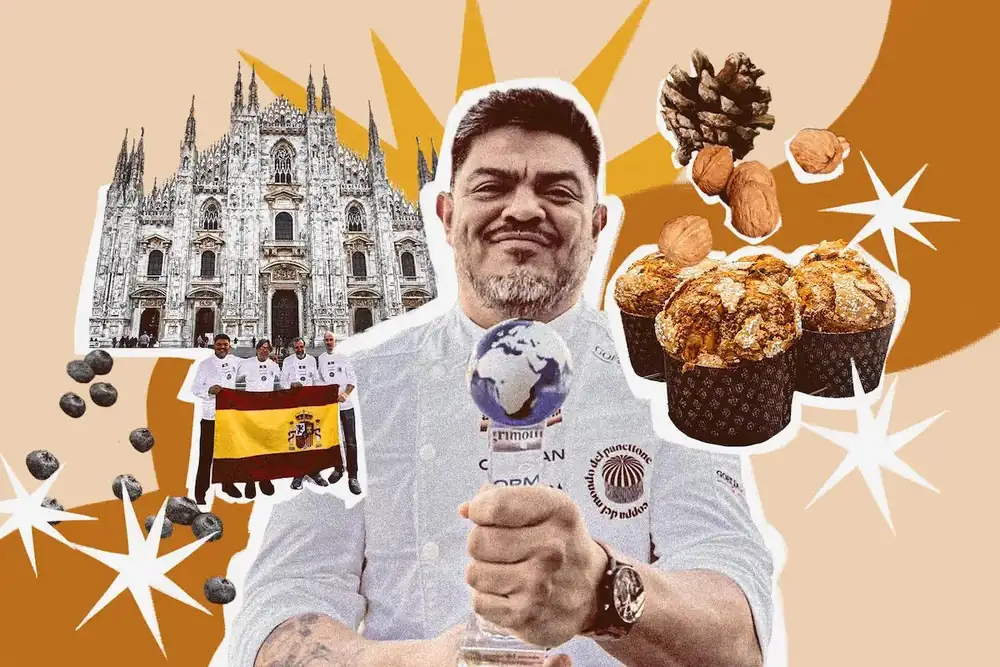
The story of Panettone and how Mexican baker Tonatiuh Cortés became its greatest exponent
A few weeks ago, we learned one of the most exciting pieces of news any baker could receive. The news thrilled all bread lovers, especially those in Mexico. The prestigious Coppa del Mondo del Panettone was won by Tonatiuh Cortés, a passionate Mexican musician who found refuge in baking to achieve his greatest dreams.
Panettone: a cultural identity of Italy and Mexico?
Incredulous, serene, and calm, "Ton" tells us that he's still struggling to process everything that's happening to him. His bakery, Suca'l, also known as Cloudstreet Bakery, located in Barcelona, has attracted a lot of attention since the news broke.
In Mexico, people have embraced with great enthusiasm the story of the Mexican baker who beat 23 other bakers from around the world. This is especially true because he is the first non-Italian in history to win the award for best traditional panettone.
The panel of judges is mostly made up of Italians, and telling a group of bakers, mostly from Italy, that a Mexican has captured a little better what this product of national identity symbolizes in flavor and cultural value, must have hurt.
The two legends about the history of panettone
But to understand the significance of this valuable achievement, let me give you an example. It's like saying that an Italian man won a Day of the Dead bread-making contest in Mexico. It goes beyond simply being a good baker; it's about understanding the customs, traditions, and tastes of another culture to which you don't belong.
Talking about panettone in Italy, especially in the north, is perhaps comparable to the cultural significance of tiramisu. Despite being a seasonal product, panettone has transcended its origins and is now a cultural emblem.
Panettone is one of the most iconic Christmas symbols in Italy. Its origins lie in Milan, the city where the Coppa del Mondo is celebrated. There are two legends about the history of panettone; here's how it came about:
The Legend of Toni
This is a popular version; it is believed that panettone originated in the court of Ludovico Sforza, Duke of Milan. At a Christmas dinner, due to an unforeseen problem with the main dessert, a kitchen helper named Toni had to save the meal by inventing a recipe using whatever ingredients he had on hand. The result was christened "Toni's Bread," which was later changed to panettone.
This is the true story of panettone
The truth is that neither account can be verified; they are just one of the many fabricated stories that have been invented. What is documented, however, is a 15th-century manuscript by Giorgio Valagussa, which states that during the Sforza dynasty, it was a ducal custom to celebrate Christmas Eve with the "Log Ritual."
The first records of panettone as such date back to the 18th century and appear in an article by the cook Pietro Verri, in which he mentions that it was a type of Christmas sweet from Milan. The cook refers to it as pane di tono, or large bread.
This bread, synonymous with Christmas festivities, should be understood as a recipe of collective tradition, something that gives it special value, as it is a product of shared knowledge. We may never be able to identify its true history, but we can certainly understand the historical and cultural relevance of a product that is symbolic for Italy.
Italian identity as understood by a Mexican
For Mexican baker "Ton" Cortés, panettone is an Italian national symbol. Its historical significance carries a lot of weight, and that's why he was surprised to learn that he beat Italian bakers who have been making this traditional Christmas bread for four generations.
Despite the fact that the Coppa del Mondo del Panettone has very established rules regarding the flavors, techniques, and characteristics that must be met, it was not a limitation for him.
Well, one of his greatest qualities and the secret to his success in this competition was his nationality. In his own words, something that has helped him a lot is the palate and home-loving spirit he developed while living in Mexico.
Traditionally, panettone must be made with sourdough starter; commercial yeast cannot be used. It's a bread with a long fermentation process, which brings out the citrus acidity in its flavor.
Externally, the panettone's cuts must be cross-shaped; this is called the "scarpata" and is very distinctive. Another highly characteristic aspect is its height and cylindrical shape. This is thanks to the panettone maker Angelo Motta (1920), who created a paper mold to achieve it.
Each and every one of these elements is key to the correct preparation of a panettone, basic rules of the Italian baking tradition and taken into account in any competition.
Ton's success in making the best panettone stems from something very simple: "Understanding what Italians like." His ability to empathize with the judges' tastes and desires allowed the Mexican to become the ultimate panettone expert.
“You have to think about who your jury will be, you have to know more or less what they like. That's what I tried to do, a very Italian and very classic panettone.”
From musician to baker and from baker to musician
Sugar, dough, fat, and candied fruit are the elements that bring this Christmas symbol to life. But they are not only elements that embody the spirit of Christmas, they also safeguard people's hopes and wishes.
Dreams like those of "Ton," a musician from UNAM who had to emigrate to Barcelona to pursue his dream as a recorder player. The struggle to survive was tough, things became increasingly complicated, and he had to make a difficult decision:
“It became clear to me that if I wanted to make a living from music, I would have to move again, to a country like Switzerland, Belgium, or France. It was a very difficult decision. I was very happy here in Barcelona; after four years of living here, I was just starting to feel good. I decided to stay, so I had a lot of free time and started baking bread at home.”
Since then, making bread became an obsession. “Ton” tells me that the first sourdough starter he made more than 7 years ago is the same one used to make panettone today.
A beautiful analogy about transition, letting go, and growth. A sourdough starter, like life itself, needs to be fed every day to remain active and useful, but it also requires discarding what is no longer needed to maintain balance.
Because once time passes and you find balance, life offers you new opportunities. After eight years of working almost full-time as a baker, "Ton" had the chance to rediscover music.
“I ran into my bassoon teacher, and he asked me why I wasn’t still making music. I decided to return to music, and two years ago I finished my master’s degree in bassoon performance. Now, I occasionally get gigs. With the bassoon, you have the advantage of being able to play with everyone. They call me even though I’m not a professional bassoonist; they call me to do concerts. Now I can dedicate myself completely to music, purely for pleasure.”
This is undoubtedly a story of vindication. Tonatiuh Cortés exemplifies the great value of perseverance. Like the preparation of a panettone, patience, constant effort, and faith ultimately bear fruit.
Humility leads to greatness. Understanding traditions and customs can only be achieved through empathy, a symbol that represents this bread and, above all, the Christmas spirit.
Today, the best panettone in the world is made by a Mexican baker; this is how history is rewritten.