Eating better is possible with these easy ideas to apply at home
Eating better shouldn't be an obstacle course. Nor does it require filling your pantry with exotic products, counting calories like you're doing your taxes, or living on nothing but grilled chicken breast and lettuce.
The idea is much simpler: shop a little better, cook more sensibly, and make small, sustainable changes. Because it's one thing to feel motivated on a Monday, and quite another to keep doing the same thing on Thursday, when the fridge is half empty and the sofa is calling your name.
Eating better starts with making more room for fruits, vegetables, legumes, and nuts, and prioritizing fresh foods over ultra-processed ones. It's not a revolution, but it works.
Eating better doesn't mean eating perfectly.
The first thing is to take the pressure off. Eating better doesn't mean making everything perfect, weighing every ingredient, or giving up croquettes forever.
A healthy diet is built on what we do most days. If our home is full of vegetables, legumes, fruits, eggs, fish, nuts, olive oil, and whole grains, we're already halfway there.
The World Health Organization recommends that a healthy diet include fruits, vegetables, legumes, nuts, and whole grains. It also advises limiting salt, free sugars, and unhealthy fats.
More market and less aisle of eternal products
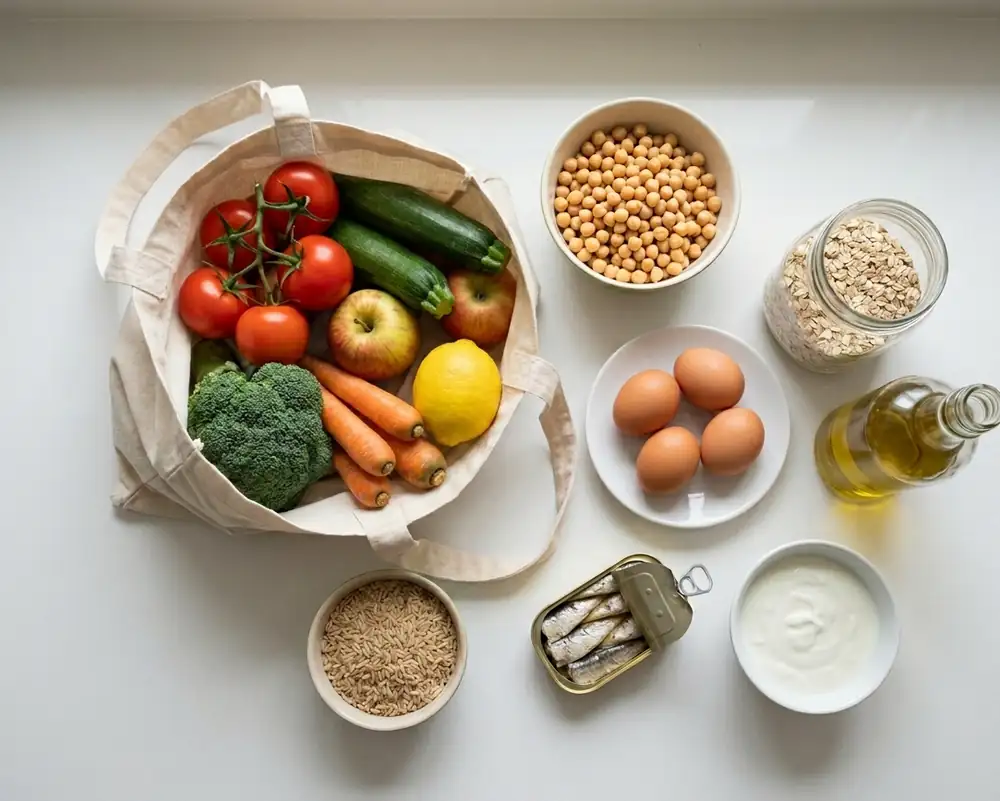
A good tip for eating better is to look at which parts of your shopping need little explanation. Tomatoes, zucchini, lentils, eggs, apples, sardines, brown rice, or plain yogurt don't usually come with an ingredient list that looks like a medicine leaflet.
That doesn't mean everything has to be fresh. Frozen vegetables, cooked legumes, canned fish, crushed tomatoes, or natural nuts are all great options.
The key is to choose simple ingredients and combine them well. A can of chickpeas can be used in a salad, a stir-fry, hummus, or a quick stew.
Fill half a plate with vegetables, without complicating things.
The famous "eat more vegetables" slogan sounds great, but sometimes it just remains a slogan. The easiest way to put it into practice is to think about your plate: make sure vegetables make up a good portion of your lunch or dinner.
They don't always have to be salads. Green beans with potatoes, zucchini soup, ratatouille, roasted vegetables, baked cauliflower, grilled eggplant, or sautéed broccoli with garlic are all good options.
The Harvard Healthy Eating Plate suggests that half your plate should be fruits and vegetables, a quarter whole grains, and another quarter healthy protein. It's a helpful visual guide for meal planning without going crazy.
Legumes deserve more space at the table
Legumes are inexpensive, filling, versatile, and a staple of our cuisine. Chickpeas, lentils, beans, peas, or broad beans can easily provide complete meals.
You can use them in stews, salads, soups, stir-fries, or homemade burgers. And if you use canned, no problem: just rinse them well and cook.
AESAN recommends increasing the consumption of plant-based products, including legumes, and choosing whole grain cereals, olive oil and fish within a pattern close to the Mediterranean diet.
Replace refined with integral, but make sense of it.
Whole-wheat bread, whole-wheat pasta, brown rice, and oats provide more fiber than their refined counterparts. This helps make meals more filling and complete.
However, wholemeal doesn't automatically mean healthy if the product is loaded with sugar, unhealthy fats, or various fillings. A "cereal" bun is still a bun, even if it's dressed up as a fitness supplement.
The most practical option is to choose real whole-wheat bread, plain whole-wheat pasta, brown rice, rolled oats, or cereals without added sugar. Less fuss and more recognizable product.
Protein: it doesn't all have to be meat
Protein is important, but not every meal has to revolve around a steak. Eggs, fish, legumes, plain yogurt, nuts, tofu, chicken, or seafood can all be included in varied menus.
A good idea is to alternate. One day lentils with vegetables, another day baked fish, another day an omelet with salad, sautéed chickpeas for example, and stewed chicken as a final suggestion.
Current recommendations also aim to reduce processed meats and moderate red meats, giving more space to fish, legumes and fresh plant-based foods.
Olive oil is best as the main fat.
There's no need to reinvent the wheel here. In Spain, we have a fantastic staple: olive oil.
It's useful for cooking, seasoning, sautéing, making creams, stir-frying vegetables, or finishing dishes. However, it's still a fat, so it's best to use it sparingly, not like you're watering geraniums.
If you have to choose a main fat for everyday cooking, olive oil fits very well with the Mediterranean pattern recommended by organizations such as AESAN.
Be careful about consuming calories without realizing it.
Sometimes we greatly improve our food, but the problem creeps in with our drinks. Soft drinks, energy drinks, juices, sugary smoothies, and alcohol can add up without contributing much.
For everyday use, water should be your main beverage. Then you can have coffee, herbal teas, or the occasional treat.
The WHO advises reducing free sugars, and sugary drinks are one of the easiest ways to overdo it without realizing it.
Cook more, even if it's simple.
Cooking doesn't have to be about putting together a tasting menu every night. Sometimes all it takes is boiling some potatoes, opening a can of legumes, sautéing some vegetables, and making a vinaigrette.
The more we cook at home, the more control we have over salt, fats, portions, and ingredients. And it's usually cheaper too.
A simple sauté of onion, garlic, and tomato can elevate rice, lentils, meatballs, or fish. Few things offer so much for so little, except perhaps a free tapa, but that depends on the bar.
Plan a little, you don't need to set up an office
Planning helps, but you don't need to create a colorful spreadsheet. Simply thinking about three lunches and two dinners can significantly improve your week.
For example: lentils on Monday, cream of vegetable soup on Tuesday, chicken and rice on Wednesday, omelet on Thursday, and fish on Friday. From there, you use up leftovers and improvise with some common sense.
Having basic ingredients at home also prevents you from always resorting to the first thing you see. Cooked legumes, eggs, frozen vegetables, rice, whole-wheat pasta, crushed tomatoes, tuna, sardines, plain yogurt, and fruit can solve many a food emergency.
Buy with dishes in mind, not individual products.
One common mistake is buying ingredients without knowing what you're going to do with them. Then a sad zucchini ends up at the bottom of the drawer and nobody takes responsibility.
It's best to buy with combinations in mind. Chickpeas with spinach, whole-wheat pasta with vegetables, rice with fish, chicken with salad, eggs with ratatouille, or yogurt with fruit and nuts.
This makes shopping more meaningful and reduces waste. Eating better also means throwing away less food.
Learn to read labels without going crazy
You don't need to scrutinize every product, but it's a good idea to check the basics: the ingredient list, the amount of salt, added sugars, and the type of fat.
A good rule of thumb: the shorter and more understandable the list, the better. If you buy crushed tomatoes, make sure it contains tomatoes. If you buy yogurt, make sure it's yogurt.
Ultra-processed foods often have long ingredient lists, many additives, and a combination designed to make you want to eat them again. They're not forbidden, but they shouldn't be the foundation of your pantry.
Easy ideas for eating better this week
- Swap a breakfast of pastries for whole-wheat toast with tomato and olive oil. It's not a penance, it's a normal and delicious breakfast.
- Prepare a lentil salad with bell pepper, onion, tomato, hard-boiled egg, and tuna. It's quick to make and keeps well in the refrigerator.
- Add a side of vegetables to meals you already make. Chicken with broccoli, omelet with salad, pasta with zucchini, or rice with mushrooms.
- Keep fruit visible. If it's washed by hand, people eat more. If it's hidden in a drawer, it ends up living a second life there.
- Swap some of the meat for legumes. Beans with vegetables, chickpeas with cod, or stewed lentils are classic dishes that work wonderfully.
Eating better also means eating more calmly.
It's not all about nutrients. Eating in a hurry, snacking when you're not hungry, or eating just anything in front of a screen also plays a role.
Sitting down, serving yourself a plate, and eating without rushing helps you better recognize your hunger and satiety cues. And yes, we know it's not always possible, but when you can, it makes a difference.
The goal isn't to turn every meal into a solemn ritual. It's simply to pay a little more attention.
Small changes that add up
Eating better doesn't depend on a miracle recipe. It depends on repeating simple choices many times.
More vegetables. More legumes. More whole fruit. More home cooking. More olive oil. More water. Fewer ultra-processed foods, fewer sugary drinks, and less improvising meals when hungry.
You don't have to do it all at once. Start with one thing: add vegetables to your dinner, switch to real whole-grain bread, eat legumes twice a week, or prepare fruit in advance.
Good everyday cooking isn't about complicating things, it's about having resources. And when those resources are simple, delicious, and easy to recreate, eating better stops being a Monday promise and starts becoming a habit.